

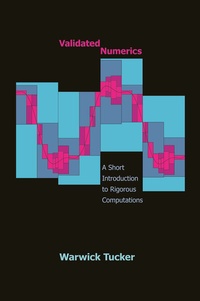
Validated Numerics
A Short Introduction to Rigorous Computations
1st Edition
Published on 18. November 2019
152 pages
978-1-4008-3897-4 (ISBN)
Description

A comprehensive, self-contained primer on validated numerics
This textbook provides a comprehensive introduction to the theory and practice of validated numerics, an emerging new field that combines the strengths of scientific computing and pure mathematics. In numerous fields ranging from pharmaceutics and engineering to weather prediction and robotics, fast and precise computations are essential. Based on the theory of set-valued analysis, a new suite of numerical methods is developed, producing efficient and reliable solvers for numerous problems in nonlinear analysis. Validated numerics yields rigorous computations that can find all possible solutions to a problem while taking into account all possible sources of error-fast, and with guaranteed accuracy.
Validated Numerics offers a self-contained primer on the subject, guiding readers from the basics to more advanced concepts and techniques. This book is an essential resource for those entering this fast-developing field, and it is also the ideal textbook for graduate students and advanced undergraduates needing an accessible introduction to the subject. Validated Numerics features many examples, exercises, and computer labs using MATLAB/C++, as well as detailed appendixes and an extensive bibliography for further reading.
- Provides a comprehensive, self-contained introduction to validated numerics
- Requires no advanced mathematics or programming skills
- Features many examples, exercises, and computer labs
- Includes code snippets that illustrate implementation
- Suitable as a textbook for graduate students and advanced undergraduates
This textbook provides a comprehensive introduction to the theory and practice of validated numerics, an emerging new field that combines the strengths of scientific computing and pure mathematics. In numerous fields ranging from pharmaceutics and engineering to weather prediction and robotics, fast and precise computations are essential. Based on the theory of set-valued analysis, a new suite of numerical methods is developed, producing efficient and reliable solvers for numerous problems in nonlinear analysis. Validated numerics yields rigorous computations that can find all possible solutions to a problem while taking into account all possible sources of error-fast, and with guaranteed accuracy.
Validated Numerics offers a self-contained primer on the subject, guiding readers from the basics to more advanced concepts and techniques. This book is an essential resource for those entering this fast-developing field, and it is also the ideal textbook for graduate students and advanced undergraduates needing an accessible introduction to the subject. Validated Numerics features many examples, exercises, and computer labs using MATLAB/C++, as well as detailed appendixes and an extensive bibliography for further reading.
- Provides a comprehensive, self-contained introduction to validated numerics
- Requires no advanced mathematics or programming skills
- Features many examples, exercises, and computer labs
- Includes code snippets that illustrate implementation
- Suitable as a textbook for graduate students and advanced undergraduates
All prices
More details
Other editions
Additional editions
Book
07/2011
Princeton University Press
€68.00
Shipment within 10-20 days
Person
Warwick Tucker is professor of mathematics and principal investigator for the Computer-Aided Proofs in Analysis (CAPA) Group at Uppsala University in Sweden. He has been honored with several awards, including the European Mathematical Society's Prize for Distinguished Contributions in Mathematics, the R. E. Moore Prize for Applications of Interval Analysis, and the Swedish Mathematical Society's Wallenberg Prize.
Content
Preface ix
Introduction xi
What Is Validated Numerics? xi
The Scope and Aim of This Book xi
Further Reading xii
Acknowledgments xii
Chapter 1. Computer Arithmetic 1
1.1 Positional Systems 1
1.2 Floating Point Numbers 2
1.3 Rounding 5
1.4 Floating Point Arithmetic 12
1.5 The IEEE Standard 14
1.6 Examples of Floating Point Computations 19
1.7 Computer Lab I 23
Chapter 2. Interval Arithmetic 24
2.1 Real Intervals 24
2.2 Real Interval Arithmetic 27
2.3 Extended Interval Arithmetic 30
2.4 Floating Point Interval Arithmetic 37
Chapter 3. Interval Analysis 46
3.1 Interval Functions 46
3.2 Centered Forms 55
3.3 Monotonicity 58
3.4 Computer Lab II 59
Chapter 4. Automatic Differentiation 60
4.1 First-Order Derivatives 60
4.2 Higher-Order Derivatives 64
4.3 Higher-Order Enclosures 71
4.4 Computer Lab III 72
Chapter 5. Interval Analysis in Action 73
5.1 Zero-Finding Methods 73
5.2 Optimization 87
5.3 Quadrature 94
5.4 Computer Lab IV 105
Chapter 6. Ordinary Differential Equations 106
6.1 A Gentle Mathematical Introduction 106
6.2 Simple Enclosure Methods 107
6.3 High-Order Methods 111
6.4 Rigorous High-Order Examples 112
Appendix A. Mathematical Foundations 118
A.1 The Rational Numbers 118
A.2 What Is a Real Number? 120
A.3 Completeness 122
A.4 Fixed-Point Theorems 124
Appendix B. Program Codes 126
B.1 IEEE Constants 126
B.2 Changing Rounding Modes 127
B.3 A Sample Code in C++ 128
Bibliography 131
Index 137
Introduction xi
What Is Validated Numerics? xi
The Scope and Aim of This Book xi
Further Reading xii
Acknowledgments xii
Chapter 1. Computer Arithmetic 1
1.1 Positional Systems 1
1.2 Floating Point Numbers 2
1.3 Rounding 5
1.4 Floating Point Arithmetic 12
1.5 The IEEE Standard 14
1.6 Examples of Floating Point Computations 19
1.7 Computer Lab I 23
Chapter 2. Interval Arithmetic 24
2.1 Real Intervals 24
2.2 Real Interval Arithmetic 27
2.3 Extended Interval Arithmetic 30
2.4 Floating Point Interval Arithmetic 37
Chapter 3. Interval Analysis 46
3.1 Interval Functions 46
3.2 Centered Forms 55
3.3 Monotonicity 58
3.4 Computer Lab II 59
Chapter 4. Automatic Differentiation 60
4.1 First-Order Derivatives 60
4.2 Higher-Order Derivatives 64
4.3 Higher-Order Enclosures 71
4.4 Computer Lab III 72
Chapter 5. Interval Analysis in Action 73
5.1 Zero-Finding Methods 73
5.2 Optimization 87
5.3 Quadrature 94
5.4 Computer Lab IV 105
Chapter 6. Ordinary Differential Equations 106
6.1 A Gentle Mathematical Introduction 106
6.2 Simple Enclosure Methods 107
6.3 High-Order Methods 111
6.4 Rigorous High-Order Examples 112
Appendix A. Mathematical Foundations 118
A.1 The Rational Numbers 118
A.2 What Is a Real Number? 120
A.3 Completeness 122
A.4 Fixed-Point Theorems 124
Appendix B. Program Codes 126
B.1 IEEE Constants 126
B.2 Changing Rounding Modes 127
B.3 A Sample Code in C++ 128
Bibliography 131
Index 137

