

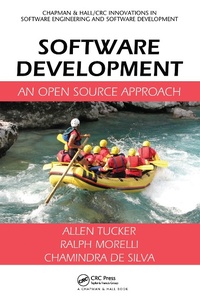
Software Development
An Open Source Approach
1st Edition
Published on 19. January 2011
400 pages
978-1-4398-1291-4 (ISBN)
Description

To understand the principles and practice of software development, there is no better motivator than participating in a software project with real-world value and a life beyond the academic arena. Software Development: An Open Source Approach immerses students directly into an agile free and open source software (FOSS) development process. It focus
Reviews / Votes
Software, which makes all of this data processing possible, must be robust, dependable, and easy to use. Accordingly, people who develop software should use sound methodologies to achieve these properties; this book helps with just that. ... clearly and thoroughly explains the fundamental concepts of software development, with the help of many figures and tables. ... Although the book is heavily centered on free and open-source software, and is organized as a textbook, individual programmers and teams of programmers can easily use it as a guide.-Computing Reviews, February 2012
Integrating project work in computing courses is highly valuable. Project-driven learning experiences are enhanced when students are exposed to real-life problems and actually engaged with community partners, whether industry, business, or nonprofit organizations. While all this sounds very convincing in theory, making it a reality is a big challenge. Software Development: An Open Source Approach is an excellent resource for teachers and students to take on this challenge. The book's RMH Homebase case study and web site supporting materials, RMH Homebase code base releases, and staging server setup instructions transform an individual reading experience of a well-written textbook into a collective software development effort that is productive, effective, and, above all, captivating.
-Mihaela Sabin, University of New Hampshire, Manchester, USA
More details
Series
Edition
1. Auflage
Language
English
Place of publication
Baton Rouge
United States
Publishing group
Taylor & Francis Inc
Target group
College/higher education
Undergraduate and graduate students in computer science; software engineers and computer programmers.
Illustrations
153 s/w Abbildungen, 11 s/w Tabellen
153 b/w images, 11 tables and 3 in text boxes
ISBN-13
978-1-4398-1291-4 (9781439812914)
Copyright in bibliographic data and cover images is held by Nielsen Book Services Limited or by the publishers or by their respective licensors: all rights reserved.
Schweitzer Classification
Other editions
Additional editions
Book
01/2011
1st Edition
CRC Press
€111.41
Shipment within 15-20 days
Persons
Allen B. Tucker is the Anne T. and Robert M. Bass Professor Emeritus at Bowdoin College in Brunswick, Maine. Dr. Tucker is an ACM Fellow and Distinguished Lecturer and a member of the Humanitarian FOSS Project's executive committee. He has published papers in the areas of programming languages, software development, natural language processing, and curriculum development.
Ralph A. Morelli is a professor of computer science at Trinity College in Hartford, Connecticut. Dr. Morelli is one of the principal investigators of the Humanitarian FOSS Project. He has published papers in the areas of artificial intelligence, FOSS, and computer science education.
Chamindra de Silva is the CTO and director of the Sahana Project, which provides a free and open source disaster management system. He is also a co-founder of the Humanitarian FOSS Community and an advisory board member of the Humanitarian FOSS Project. He has participated in many governmental and NGO projects in Pakistan, the Philippines, Peru, the United States, China, and Haiti.
For more information on the Humanitarian FOSS Project, visit its website.
Ralph A. Morelli is a professor of computer science at Trinity College in Hartford, Connecticut. Dr. Morelli is one of the principal investigators of the Humanitarian FOSS Project. He has published papers in the areas of artificial intelligence, FOSS, and computer science education.
Chamindra de Silva is the CTO and director of the Sahana Project, which provides a free and open source disaster management system. He is also a co-founder of the Humanitarian FOSS Community and an advisory board member of the Humanitarian FOSS Project. He has participated in many governmental and NGO projects in Pakistan, the Philippines, Peru, the United States, China, and Haiti.
For more information on the Humanitarian FOSS Project, visit its website.
Content
Overview and Motivation. Working with a Project Team. Using Project Tools. Software Architecture. Working with Code. Developing the Domain Classes. Developing the Database Modules. Developing the User Interface. User Support. Project Governance. New Project Conception. Appendices. References.
