

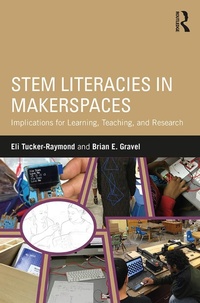
STEM Literacies in Makerspaces
Implications for Learning, Teaching, and Research
1st Edition
Published on 4. March 2019
194 pages
978-1-351-25670-4 (ISBN)
Description

Providing an original framework for the study of makerspaces in a literacy context, this book bridges the scholarship of literacy studies and STEM and offers a window into the practices that makers learn and interact with. Tucker-Raymond and Gravel define and illustrate five key STEM literacies-identifying, organizing, and integrating information; creating and traversing representations; communicating with others for help and feedback during making; documenting processes; and communicating finished products-and demonstrate how these literacies intersect with making communities. Through careful observation and analysis of multiple case studies, the authors highlight the impact of research and practice to support teaching and making in a variety of environments. Using a nuanced, engaging framework, they examine the necessary skills required to develop and foster makerspaces in formal and informal contexts for all students. Grounded in cutting-edge research, this volume paves the way for future study on supporting making and literacies in STEM.
Reviews / Votes
"This book offers powerful resources for researchers and practitioners about the opportunities for robust learning that entails multiple literacies, critical problem solving, and identity development connected to the integration of science, technology and mathematics learning. Its wide scope includes lessons from sites ranging from schools to community settings to professional spaces; and in so doing provides unusual breadth in articulating foundational principles that can be adapted across multiple contexts with lessons for multiple stakeholders. The design principles grow out of systematic and longitudinal empirical research across real world settings. It is a timely publication with the exponential growth of makerspaces within formal and informal institutional settings. It is especially innovative in articulating expansive literacies that are not only required for impactful STEM learning, but equally important for critical problem solving across domains and across the life cycle. It will prove to be a consequential resource for this growing movement."--Carol D. Lee, Northwestern University, USA
"Tucker-Raymond and Gravel offer deep and critical insights into the ways in which literacy practices serve as important entryways for how, why and for what reasons people make. This book offers an assets-driven and deeply layered narrative of the work of makers across spaces and time, opening up dialogue on what constitute STEM-rich maker literacies, and the wide and dynamic meshwork of expertise and supports that nurture, expand and shape them. This rich framing advances how equity considerations can be taken up in making spaces, as well as possibilities of powerful design approaches for enacting these ideals in practice. There is much to learn from this text and the guiding principles put forth regarding new approaches to democratizing STEM-rich making spaces. For too long, STEM education has contributed to the de-humanization of people and communities, rendering lives and rich literacy practices invisible. Working towards design approaches that disrupt these norms is deeply exciting and much needed work."
-Angela Calabrese Barton, Michigan State University, USA
More details
Edition
1. Auflage
Language
English
Place of publication
London
United Kingdom
Publishing group
Taylor & Francis Ltd
Target group
College/higher education
Product notice
Reflowable
Illustrations
6 Tables, black and white; 3 Line drawings, black and white; 29 Halftones, black and white
File size
3,68 MB
ISBN-13
978-1-351-25670-4 (9781351256704)
Copyright in bibliographic data and cover images is held by Nielsen Book Services Limited or by the publishers or by their respective licensors: all rights reserved.
Schweitzer Classification
Other editions
Additional editions
Eli Tucker-Raymond | Brian E. Gravel
STEM Literacies in Makerspaces
Implications for Learning, Teaching, and Research
Book
03/2019
1st Edition
Routledge
€62.90
Shipment within 15-20 days
Eli Tucker-Raymond | Brian E. Gravel
STEM Literacies in Makerspaces
Implications for Learning, Teaching, and Research
Book
03/2019
1st Edition
Routledge
€206.10
Shipment within 15-20 days
Persons
Eli Tucker-Raymond is a senior research scientist with the Cheche Konnen Center at TERC, a non-profit STEM education research and design organization in Cambridge, MA.
Brian E. Gravel is an assistant professor of STEM Education and Director of Elementary Education in the Department of Education at Tufts University, USA.
Brian E. Gravel is an assistant professor of STEM Education and Director of Elementary Education in the Department of Education at Tufts University, USA.
Content
Introduction
Chapter 1 STEM Literacy Practices
Chapter 2 Learning in a Professional Context: LMNPO Case Study
Chapter 3 Space Mediates Communication: Artisan's Asylum Case Study
Chapter 4 Identifying, Organizing, and Integrating information: SETC Case Study
Chapter 5 From Fluency to Fluidity: Representations in Making
Chapter 6 Online Sharing Genres: How-Tos, Crowdsourcing, and Blogging
Chapter 7 Teacher Learning in Making Spaces: "By Design I Realize"
Chapter 8 Implications for Practice and Research
Appendix A Methodology
Appendix B Sharing Genre Scaffolds
Appendix C Meshwork Mapping Protocol
Appendix D STEMLiMS Object-Oriented Interview Protocol
Chapter 1 STEM Literacy Practices
Chapter 2 Learning in a Professional Context: LMNPO Case Study
Chapter 3 Space Mediates Communication: Artisan's Asylum Case Study
Chapter 4 Identifying, Organizing, and Integrating information: SETC Case Study
Chapter 5 From Fluency to Fluidity: Representations in Making
Chapter 6 Online Sharing Genres: How-Tos, Crowdsourcing, and Blogging
Chapter 7 Teacher Learning in Making Spaces: "By Design I Realize"
Chapter 8 Implications for Practice and Research
Appendix A Methodology
Appendix B Sharing Genre Scaffolds
Appendix C Meshwork Mapping Protocol
Appendix D STEMLiMS Object-Oriented Interview Protocol
