

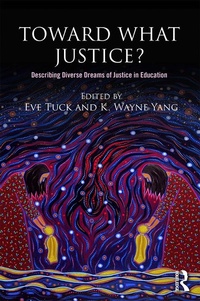
Toward What Justice?
Describing Diverse Dreams of Justice in Education
Published on 1. February 2018
168 pages
978-1-351-24091-8 (ISBN)
Description

Toward What Justice? brings together compelling ideas from a wide range of intellectual traditions in education to discuss corresponding and sometimes competing definitions of justice. Leading scholars articulate new ideas and challenge entrenched views of what justice means when considered from the perspectives of diverse communities. Their chapters, written boldly and pressing directly into the difficult and even strained questions of justice, reflect on the contingencies and incongruences at work when considering what justice wants and requires. At its heart, Toward What Justice? is a book about justice projects, and the incommensurable investments that social justice projects can make. It is a must-have volume for scholars and students working at the intersection of education and Indigenous studies, critical disability studies, climate change research, queer studies, and more.
Reviews / Votes
'What if justice were a collective improvisational practice and not a thing that we could seize and hold? What if justice were not simple nor simplistic, what if it were not an empty set nor an empty void? How would we then approach the possibility for doing, practicing, inhabiting the rubric and sign of social justice? In this volume, edited by Eve Tuck and K. Wayne Wang, justice as social is put to question. Theirs is a project that grounds contingency and incommensurability not as foreclosures but as openings to the very possibilities for collaborative work and practice. In this way, justice-social would not be a private property to be grasped and held and owned, settler logic, but would instead be a pursuit in the direction of a mode for relating, a practice of behavior, a way of life. Not a utopia but a restiveness and desire and drive that imagines the constant flow and force of unfolding otherwise possibility.'-Ashon Crawley is Assistant Professor of Religious Studies and African American and African Studies at the University of Virginia, USA 'What if justice were a collective improvisational practice and not a thing that we could seize and hold? What if justice were not simple nor simplistic, what if it were not an empty set nor an empty void? How would we then approach the possibility for doing, practicing, inhabiting the rubric and sign of social justice? In this volume, edited by Eve Tuck and K. Wayne Yang, justice as social is put to question. Theirs is a project that grounds contingency and incommensurability not as foreclosures but as openings to the very possibilities for collaborative work and practice. In this way, justice-social would not be a private property to be grasped and held and owned, settler logic, but would instead be a pursuit in the direction of a mode for relating, a practice of behavior, a way of life. Not a utopia but a restiveness and desire and drive that imagines the constant flow and force of unfolding otherwise possibility.'
-Ashon Crawley is Assistant Professor of Religious Studies and African American and African Studies at the University of Virginia, USA
More details
Language
English
Place of publication
London
United Kingdom
Publishing group
Taylor & Francis Ltd
Target group
College/higher education
Professional and scholarly
Product notice
Reflowable
File size
1,03 MB
ISBN-13
978-1-351-24091-8 (9781351240918)
Copyright in bibliographic data and cover images is held by Nielsen Book Services Limited or by the publishers or by their respective licensors: all rights reserved.
Schweitzer Classification
Other editions
Additional editions
Book
02/2018
1st Edition
Routledge
€59.70
Shipment within 10-20 days
Book
02/2018
1st Edition
Routledge
€232.40
Shipment within 10-20 days
Persons
Eve Tuck is Associate Professor of Critical Race and Indigenous Studies at the Ontario Institute for Studies in Education (OISE), University of Toronto.
K. Wayne Yang is Associate Professor in Ethnic Studies at the University of California, San Diego.
K. Wayne Yang is Associate Professor in Ethnic Studies at the University of California, San Diego.
Content
Introduction: Born Under the Rising Sign of Social Justice
Chapter One: Against Prisons and the Pipeline to Them
Chapter Two: Beginning and Ending with Black Suffering: A Meditation on and against Racial Justice in Education
Chapter Three: Refusing the University
Chapter Four: Towards Justice as Ontology: Disability and the Question of (In)Difference
Chapter Five: Against Social Justice and The Limits of Diversity: or Black People and Freedom
Chapter Six: When Justice is a Lackey
Chapter Seven: The Revolution Has Begun
Chapter Eight: Pedagogical Applications of Toward What Justice?
Chapter One: Against Prisons and the Pipeline to Them
Chapter Two: Beginning and Ending with Black Suffering: A Meditation on and against Racial Justice in Education
Chapter Three: Refusing the University
Chapter Four: Towards Justice as Ontology: Disability and the Question of (In)Difference
Chapter Five: Against Social Justice and The Limits of Diversity: or Black People and Freedom
Chapter Six: When Justice is a Lackey
Chapter Seven: The Revolution Has Begun
Chapter Eight: Pedagogical Applications of Toward What Justice?
