

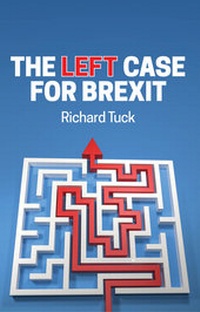
The Left Case for Brexit
Description

Richard Tuck's ongoing commentary on the Brexit crisis demolishes this narrative. He argues that by opposing Brexit and throwing its lot in with a liberal constitutional order tailor-made for the interests of global capitalists, the Left has made a major error. It has tied itself into a framework designed to frustrate its own radical policies. Brexit therefore actually represents a golden opportunity for socialists to implement the kind of economic agenda they have long since advocated. Sadly, however, many of them have lost faith in the kind of popular revolution that the majoritarian British constitution is peculiarly well-placed to deliver and have succumbed instead to defeatism and the cultural politics of virtue-signalling. Another approach is, however, still possible.
Combining brilliant contemporary political insights with a profound grasp of the ironies of modern history, this book is essential for anyone who wants a clear-sighted assessment of the momentous underlying issues brought to the surface by Brexit.
More details
Other editions
Additional editions
Person
Content
16 April 2016
22 April 2016
16 May 2016
The Left Case for Brexit
9 June 2016
Brexit: A Prize in Reach for the Left
16 August 2017
6 November 2017
17 February 2018
28 February 2018
9 March 2018
11 April 2018
Why is Everyone So Hysterical About Brexit?
17 May 2018
How to Break up the Union
1 August 2018
The Surprising Benefits to Ireland of a No-Deal Brexit
16 January 2019
Deal or No Deal
23 January 2019
24 February 2019
Modest Proposals
3 June 2019
5 July 2019
Notes
22 April 2016
On 22 April President Barack Obama gave a press conference at the Foreign Office alongside David Cameron, in which he produced his famous remark that Britain would be 'at the back of the queue' when it came to a trade deal with the US. This remark was widely believed to have been drafted by the British government, given the fact that no American says 'queue' rather than 'line'! But Obama also said of the referendum that 'the outcome of that decision is a matter of deep interest to the United States because it affects our prospects as well. The United States wants a strong United Kingdom as a partner. And the United Kingdom is at its best when it's helping to lead a strong Europe. It leverages UK power to be part of the European Union.'
President Obama's intervention today in the Brexit debate tells us only one thing, but that is something of great significance. It is that President de Gaulle was right when in 1963 and 1967 he vetoed Britain's application to join the Common Market. In his public utterances on the issue, he stressed (as he said in a famous speech in 1963) that
England in effect is insular, she is maritime, she is linked through her exchanges, her markets, her supply lines to the most diverse and often the most distant countries; she pursues essentially industrial and commercial activities, and only slight agricultural ones. She has in all her doings very marked and very original habits and traditions.1
But the French press of the period, and private remarks by French politicians, repeatedly made explicit the specific anxiety which plainly guided de Gaulle's veto - that Britain would be 'America's Trojan Horse' in Europe. Within Britain, this has usually been seen as an example of French cultural anxiety; but with the crisis of Brexit on the horizon, the American foreign policy establishment is finally coming clean: they might talk about their general desire for a stable and united Europe, but in their eyes Britain's membership of the EU is and plainly always has been a means of planting a reliable agent of the United States in the heart of the organisation. The French fears of the 1960s were well founded in a quite definite sense, and it is highly likely that the French intelligence services, always preternaturally well informed, were aware at the time of this aspect of American foreign policy. And de Gaulle, with his intimate knowledge of Anglo-American relations as they had been forged during the Second World War, was in an especially good position to appreciate what British membership would mean.
Leaving aside the feelings of Continental politicians, now they have been told that what they always suspected was indeed the truth, and leaving aside the humiliation of British citizens on learning that their country has been acting as a secret agent for the US within the EU for fifty years, there is a serious question about what has now been revealed. The State Department's devotion to European union under all administrations should always have been more of a puzzle than it has normally appeared. There is much we do not know about its real motives, and about its attitude to British membership. For example, Richard Crossman, a member of Harold Wilson's Cabinet at the time of the renewed application in 1967, recorded in his diary that the Wilson government had turned to the Common Market only after an attempt to construct a North Atlantic free trade area between the US and Britain was rebuffed by the Johnson administration. Was this payback for Wilson's successful manoeuvrings which kept Britain out of the Vietnam War? Certainly, one would not have expected that America's most important military campaign since at least the Korean War would be fought without any British military involvement, while Australians and New Zealanders died on the battlefields of Vietnam (this should always be remembered by people who talk about Britain simply as America's poodle). Or was it already the policy of the State Department that Britain should be inserted into a Continental structure which was now being talked about quite openly in foreign ministries around the world as prospectively a political union? As Con O'Neill, the British representative to the EEC from 1963 to 1965 (and the man who led the successful negotiation to join), said in the characteristically flippant terms of the British diplomat:
Mao Tse Tung declared that power grows out of the barrel of a gun. Professor Hallstein [the President of the Commission from 1958 to 1967] operates in a more sophisticated environment; but he has always declared he is in politics not business, and he may well believe that power grows out of the regulation price of Tilsit cheese or the price of a grain a hen needs to lay one egg. I think it does.2
There were - and still are - good reasons for the US to fear the EU rather than welcome it; beneath the veneer of Western solidarity there has always been a clear vein of anti-Americanism in the politics of the EU. During the Cold War this was obscured by the urgency of forming a united front against the Soviet Union, but even that requirement cut two ways: NATO and the military actions of the 1940s and 1950s such as the Berlin airlift were the most effective means of maintaining the Iron Curtain, and an independent Continental foreign policy led by France was not the most obvious pillar of Western security (and one should not forget the ever-present temptation of German unity bought by a promise of neutrality which the Soviet Union dangled in front of Germany throughout the Cold War, and which in a subtle fashion may turn out in the long run to be the bargain the Germans accepted). Nowadays, one would have thought that any objective analysis of a traditional kind would conclude that the EU was potentially more of a risk to the US than to Russia: it is the EU which is economically successful, which can interfere with American companies in one of their largest markets, and which can increasingly play an independent - and, as it turns out, often catastrophic - role in foreign affairs, as in the disastrous Libyan adventure cooked up by Britain and France, who seem to see themselves as the basis of a kind of EU military force. But America's fears of the EU have been assuaged over the years by Britain's presence; the extraordinary level of integration in foreign policy between the two countries has been a guarantee that the EU will not develop in an openly hostile way.
In the days before the radical extension of qualified majority voting to most important matters that come before the EU Council of Ministers, Britain's role as a Trojan Horse was very straightforward, since it could veto measures that it - or the State Department - opposed. That is no longer the case, as the demand for Brexit within Britain testifies; the central fear of the advocates of Brexit is after all that Britain, with its special interests which are seldom shared by other countries within the EU, will be consistently outvoted - it has been in the minority more than any other state in the last decade, and that is only likely to get worse. Most opponents of the EU in Britain would be mollified by a return to the voting arrangements which were in place when Britain joined. But the State Department does not yet appear to have drawn the obvious conclusion, which is that Britain will not be an especially effective Trojan Horse in the future. Even its military role, as it has come increasingly under the spell of French military revanchism, will be far less reliable as a means of projecting American influence inside Europe. At the extreme, the Horse may be turned against the Greeks themselves, and that prospect ought to keep undersecretaries of state awake at night far more than the prospect of Brexit. The very reasons which drive the campaign for Brexit should - if the State Department were thinking clearly - make it very unconfident that the old order will be maintained even if Britain stays in the EU, and very fearful of what may happen if the existing project simply limps forward for another generation or more. One might even say that the last couple of decades have seen an historic defeat for American foreign policy; the European settlement in which Britain functioned as its arm within the EU was gradually transformed in the course of a subterranean diplomatic struggle into a new arrangement in which Britain cannot play the role assigned to it. Overconfident as ever, the British Foreign Office has clearly continued to pretend to the US that it holds the key to Europe; the snag is that one day the State Department will discover that the locks have been changed.
There are wider issues which the question of America's attitude to Britain and the EU raises. Secrecy has always been part of the business of international affairs, with negotiations conducted entirely in private, and possibly without the agreements which are made ever becoming fully public. In the past there were secret treaties (such as Charles II's infamous Treaty of Dover, which in retrospect bears some similarities to the EU treaties!), and though they have largely vanished, the world of diplomacy still operates with a far higher level of concealment and subterfuge than would ever be acceptable in domestic politics. Traditionally, citizens have accepted this: the ambassador, sent to lie abroad for the good of his country, did not usually threaten the internal political structures of his nation, and if he did he would be...
