

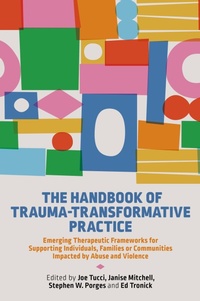
The Handbook of Trauma-Transformative Practice
Emerging Therapeutic Frameworks for Supporting Individuals, Families or Communities Impacted by Abuse and Violence
Published on 21. February 2024
488 pages
978-1-78775-578-9 (ISBN)
Description

The definitive Handbook of Trauma-Transformative Practice brings together the work of leading international trauma experts to provide a detailed overview of trauma-informed practice and intervention: its history, the latest frameworks for practice and an inspiring vision for future trauma-transformative practice.
The Handbook is interdisciplinary, incorporating trauma research, interpersonal neuroscience, the historical and continuing experiences of victims and survivors, and insights from practitioners. It addresses a range of current issues spanning polyvagal theory, the social brain, oxytocin and the healing power of love, and the neuropsychological roots of shame. It also considers trauma through the lens of communities, with chapters on healing inter/transgenerational trauma and building communities' capacity to end interpersonal violence.
Furthermore the Handbook makes the case for a new way of thinking about trauma - trauma transformative practice. One which is founded on the principle of working with the whole person and as part of a network of relationships, rather than focusing on symptoms to improve practice, healing and recovery.
The Handbook is interdisciplinary, incorporating trauma research, interpersonal neuroscience, the historical and continuing experiences of victims and survivors, and insights from practitioners. It addresses a range of current issues spanning polyvagal theory, the social brain, oxytocin and the healing power of love, and the neuropsychological roots of shame. It also considers trauma through the lens of communities, with chapters on healing inter/transgenerational trauma and building communities' capacity to end interpersonal violence.
Furthermore the Handbook makes the case for a new way of thinking about trauma - trauma transformative practice. One which is founded on the principle of working with the whole person and as part of a network of relationships, rather than focusing on symptoms to improve practice, healing and recovery.
More details
Edition
Digital original
Language
English
Place of publication
London
United Kingdom
Target group
College/higher education
Professional and scholarly
Edition type
Digital original
File size
1,54 MB
ISBN-13
978-1-78775-578-9 (9781787755789)
Copyright in bibliographic data and cover images is held by Nielsen Book Services Limited or by the publishers or by their respective licensors: all rights reserved.
Schweitzer Classification
Other editions
Additional editions
Joe Tucci | Janise Mitchell | Stephen W. Porges
The Handbook of Trauma-Transformative Practice
Emerging Therapeutic Frameworks for Supporting Individuals, Families or Communities Impacted by Abuse and Violence
Book
02/2024
Jessica Kingsley Publishers
€50.00
Shipment within 15-20 days
Persons
Joe Tucci was CEO of the Australian Childhood Foundation, Chair of the National Centre for Action on Child Sexual Abuse, a social worker, a psychologist and a children's rights advocate.
Janise Mitchell is CEO of the Australian Childhood Foundation, Director of the Centre for Excellence in Therapeutic Care, a social worker and a children's rights advocate.
Stephen W. Porges is Distinguished University Scientist at Indiana University where he is the founding director of the Traumatic Stress Research Consortium. He is Professor of Psychiatry at the University of North Carolina, and Professor Emeritus at both the University of Illinois at Chicago and the University of Maryland. He is the originator of Poly-vagal Theory.
Ed Tronick is a Professor of Psychiatry and Pediatrics at UMass Chan Medical School. He is Founder and Chief Faculty of the Early Relational Fellowship Program at the Chan Medical School. He is a clinical psychologist and human development neuroscientist and developer of the Still-Face Paradigm.
Janise Mitchell is CEO of the Australian Childhood Foundation, Director of the Centre for Excellence in Therapeutic Care, a social worker and a children's rights advocate.
Stephen W. Porges is Distinguished University Scientist at Indiana University where he is the founding director of the Traumatic Stress Research Consortium. He is Professor of Psychiatry at the University of North Carolina, and Professor Emeritus at both the University of Illinois at Chicago and the University of Maryland. He is the originator of Poly-vagal Theory.
Ed Tronick is a Professor of Psychiatry and Pediatrics at UMass Chan Medical School. He is Founder and Chief Faculty of the Early Relational Fellowship Program at the Chan Medical School. He is a clinical psychologist and human development neuroscientist and developer of the Still-Face Paradigm.
