

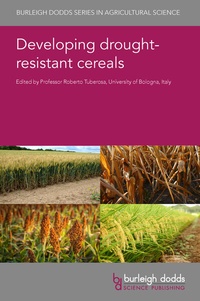
Developing drought-resistant cereals
1st Edition
Published on 9. January 2024
360 pages
978-1-78676-987-9 (ISBN)
Description

Drought remains the biggest single threat from climate change to the production of key cereal crops, such as wheat and barley. Cereals also respond in complex ways to drought stress, making improved drought tolerance a challenging trait to achieve. With many cereals recognised as staple food crops due to their nutritional value, more research is required into improving drought tolerance as a means of ensuring the future food security of millions.
Developing drought-resistant cereals reviews the wealth of research which addresses how to overcome this challenge in order to mitigate climate change effects in cereal production. This collection details our understanding of the mechanisms of drought tolerance, as well as developments in techniques for improving resistance, including phenotyping, identifying genes relating to root and photosynthetic function and the use of genomic selection and genome editing.
Developing drought-resistant cereals reviews the wealth of research which addresses how to overcome this challenge in order to mitigate climate change effects in cereal production. This collection details our understanding of the mechanisms of drought tolerance, as well as developments in techniques for improving resistance, including phenotyping, identifying genes relating to root and photosynthetic function and the use of genomic selection and genome editing.
More details
Series
Edition
1. Auflage
Language
English
Place of publication
Cambridge
United Kingdom
Publishing group
Burleigh Dodds
Target group
University and other researchers in cereal science;arable farmers and breeders;as well as government and private sector agencies supporting sustainable cereal production
Illustrations
Color tables, photos and figures
File size
2,29 MB
ISBN-13
978-1-78676-987-9 (9781786769879)
DOI
10.19103/AS.2022.0109
Schweitzer Classification
Other editions
Additional editions
Roberto Tuberosa
Developing Drought-Resistant Cereals
Book
01/2024
Burleigh Dodds Science Publishing Limited
€239.20
Shipment within 3-4 weeks
Persons
Editor
University of Bologna
Dr Roberto Tuberosa is Professor of Plant Biotechnology and Breeding in the Department of Agriculture and Food Science at the University of Bologna, Italy. Professor Tuberosa is internationally renowned for his genomic studies to dissect the genetic basis of drought resistance in cereals and how to leverage this knowledge toward the release of climate-resilient cultivars. He is on the editorial board of several leading journals, has been involved in many European and international research projects in cereal breeding, represents Europe in the International Crop Science Society (ICSS) and has published over 170 articles as well as edited a number of books. He has organised international congresses on genomics and breeding of cereals under drought conditions and is a member of the scientific board of the Wheat Initiative and of the PlantStress advisory board. Amongst other honours, Professor Tuberosa has been elected a Fellow of the Crop Society of America.
Dr Roberto Tuberosa is Professor of Plant Biotechnology and Breeding in the Department of Agriculture and Food Science at the University of Bologna, Italy. Professor Tuberosa is internationally renowned for his genomic studies to dissect the genetic basis of drought resistance in cereals and how to leverage this knowledge toward the release of climate-resilient cultivars. He is on the editorial board of several leading journals, has been involved in many European and international research projects in cereal breeding, represents Europe in the International Crop Science Society (ICSS) and has published over 170 articles as well as edited a number of books. He has organised international congresses on genomics and breeding of cereals under drought conditions and is a member of the scientific board of the Wheat Initiative and of the PlantStress advisory board. Amongst other honours, Professor Tuberosa has been elected a Fellow of the Crop Society of America.
Contributions
North Carolina State University
Lancaster Environment Centre (United Kingdom)
Bill Davies is Emeritus Distinguished Professor of Plant Biology at Lancaster University, UK. He has published more than 280 papers in the international literature. The Davies lab has won a 'Queen's Award for Innovation' for work on sustainable resource use in agriculture. Recent work with CIMMYT has resulted in the development of new pre-breeding crop screening methods. Professor Davies is currently an Associate Editor of 'Food and Energy Security' and 'Frontiers of Agricultural Science and Engineering'. He was awarded a CBE for his services for science in 2011.
Bill Davies is Emeritus Distinguished Professor of Plant Biology at Lancaster University, UK. He has published more than 280 papers in the international literature. The Davies lab has won a 'Queen's Award for Innovation' for work on sustainable resource use in agriculture. Recent work with CIMMYT has resulted in the development of new pre-breeding crop screening methods. Professor Davies is currently an Associate Editor of 'Food and Energy Security' and 'Frontiers of Agricultural Science and Engineering'. He was awarded a CBE for his services for science in 2011.
University of Nevada-Reno
John C. Cushman is a Foundation Professor at the University of Nevada and Director of the Biochemistry Graduate Program in the Department of Biochemistry & Molecular Biology within the College of Agriculture, Biotechnology, and Natural Resources and the Nevada Agricultural Experiment Station. Professor Cushman's laboratory has used engineered tissue succulence and crassulacean acid metabolism (CAM) to improve the water-use efficiency, salinity, and water-deficit stress tolerance in model plant species with the long-term goal of moving these water-conserving adaptations into food, feed, and (bio)fuel crops enabling production on marginal or abandoned agricultural lands. A major focus of his laboratory is to investigate the productivity and irrigation response of highly productive CAM crops such as cactus pear (Opuntia spp.) to serve as sources of human food, animal feed, and as a biofuel feedstock for semi-arid and arid regions of the world.
John C. Cushman is a Foundation Professor at the University of Nevada and Director of the Biochemistry Graduate Program in the Department of Biochemistry & Molecular Biology within the College of Agriculture, Biotechnology, and Natural Resources and the Nevada Agricultural Experiment Station. Professor Cushman's laboratory has used engineered tissue succulence and crassulacean acid metabolism (CAM) to improve the water-use efficiency, salinity, and water-deficit stress tolerance in model plant species with the long-term goal of moving these water-conserving adaptations into food, feed, and (bio)fuel crops enabling production on marginal or abandoned agricultural lands. A major focus of his laboratory is to investigate the productivity and irrigation response of highly productive CAM crops such as cactus pear (Opuntia spp.) to serve as sources of human food, animal feed, and as a biofuel feedstock for semi-arid and arid regions of the world.
University of Queensland
NIAB
CAAS
Swedish University of Agricultural Sciences
Content
Part 1 Understanding mechanisms of drought tolerance
- 1.Physiological traits affecting water use and water use efficiency in cereals in response to drought stress: Thomas R. Sinclair, North Carolina State University, USA; and Michel E. Ghanem, Centre de coopération internationale en recherche agronomique pour le développement (CIRAD), France and Mohammed VI Polytechnic University, Morocco;
- 2.The role of plant hormones in adaptation to drought stress in cereals: Arnauld A. Thiry, Lancaster Environment Centre, UK; Matthew P. Reynolds, International Maize and Wheat Improvement Center (CIMMYT), Mexico; and William J. Davies and Ian C. Dodd, Lancaster Environment Centre, UK;
- 3.Genetics of drought tolerance in cereals: Roberto Tuberosa, University of Bologna, Italy;
- 4.The role of drought-induced proteins in regulating drought tolerance in cereals: Mitiku A. Mengistu and John C. Cushman, University of Nevada - Reno, USA;
Part 2 Techniques for improving resistance
- 5.Advances in phenotyping to identify drought-resistance traits in cereal roots: Jack Christopher, University of Queensland, Australia;
- 6.Identifying and exploiting genes related to root system architecture in improving drought resistance in cereals: Eric Ober, NIAB, UK;
- 7.Identifying and exploiting photosynthetic genes in improving drought resistance in cereals: Ruilian Jing, Chinese Academy of Agricultural Sciences, China;
- 8.Genomic selection, gene editing and genetic engineering for drought tolerance in cereals: Rodomiro Ortiz, Swedish University of Agricultural Sciences (SLU), Sweden;
- 9.Meta-QTL analysis to identify loci for the plastic response of tetraploid wheat to drought stress: Agata Gadaleta, University of Bari Aldo Moro, Italy;
- 10.Recent progress concerning corn and drought tolerance: Robert Bensen, Umbrella Genetics
- 1.Physiological traits affecting water use and water use efficiency in cereals in response to drought stress: Thomas R. Sinclair, North Carolina State University, USA; and Michel E. Ghanem, Centre de coopération internationale en recherche agronomique pour le développement (CIRAD), France and Mohammed VI Polytechnic University, Morocco;
- 2.The role of plant hormones in adaptation to drought stress in cereals: Arnauld A. Thiry, Lancaster Environment Centre, UK; Matthew P. Reynolds, International Maize and Wheat Improvement Center (CIMMYT), Mexico; and William J. Davies and Ian C. Dodd, Lancaster Environment Centre, UK;
- 3.Genetics of drought tolerance in cereals: Roberto Tuberosa, University of Bologna, Italy;
- 4.The role of drought-induced proteins in regulating drought tolerance in cereals: Mitiku A. Mengistu and John C. Cushman, University of Nevada - Reno, USA;
Part 2 Techniques for improving resistance
- 5.Advances in phenotyping to identify drought-resistance traits in cereal roots: Jack Christopher, University of Queensland, Australia;
- 6.Identifying and exploiting genes related to root system architecture in improving drought resistance in cereals: Eric Ober, NIAB, UK;
- 7.Identifying and exploiting photosynthetic genes in improving drought resistance in cereals: Ruilian Jing, Chinese Academy of Agricultural Sciences, China;
- 8.Genomic selection, gene editing and genetic engineering for drought tolerance in cereals: Rodomiro Ortiz, Swedish University of Agricultural Sciences (SLU), Sweden;
- 9.Meta-QTL analysis to identify loci for the plastic response of tetraploid wheat to drought stress: Agata Gadaleta, University of Bari Aldo Moro, Italy;
- 10.Recent progress concerning corn and drought tolerance: Robert Bensen, Umbrella Genetics
