

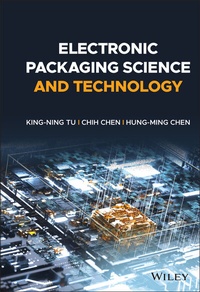
Electronic Packaging Science and Technology
Description

The electronics industry is shifting towards system packaging technology due to the need for higher chip circuit density without increasing production costs. Electronic packaging, or circuit integration, is seen as a necessary strategy to achieve a performance growth of electronic circuitry in next-generation electronics. With the implementation of novel materials with specific and tunable electrical and magnetic properties, electronic packaging is highly attractive as a solution to achieve denser levels of circuit integration.
The first part of the book gives an overview of electronic packaging and provides the reader with the fundamentals of the most important packaging techniques such as wire bonding, tap automatic bonding, flip chip solder joint bonding, microbump bonding, and low temperature direct Cu-to-Cu bonding. Part two consists of concepts of electronic circuit design and its role in low power devices, biomedical devices, and circuit integration. The last part of the book contains topics based on the science of electronic packaging and the reliability of packaging technology.
More details
Other editions
Additional editions
Persons
King-Ning Tu, PhD, is TSMC Chair Professor at the National Chiao Tung University in Taiwan. He received his doctorate in Applied Physics from Harvard University in 1968.
Chih Chen, PhD, is Chairman and Distinguished Professor in the Department of Materials Science and Engineering at National Yang Ming Chiao Tung University in Taiwan. He received his doctorate in Materials Science from the University of California at Los Angeles in 1999.
Hung-Ming Chen, PhD, is Professor in the Institute of Electronics at National Yang Ming Chiao Tung University in Taiwan. He received his doctorate in Computer Sciences from the University of Texas at Austin in 2003.
Content
Preface xi
1 Introduction 1
1.1 Introduction 1
1.2 Impact of Moore's Law on Si Technology 3
1.3 5G Technology and AI Applications 4
1.4 3D IC Packaging Technology 7
1.5 Reliability Science and Engineering 11
1.6 The Future of Electronic Packaging Technology 13
1.7 Outline of the Book 14
References 15
Part I 17
2 Cu-to-Cu and Other Bonding Technologies in Electronic Packaging 19
2.1 Introduction 19
2.2 Wire Bonding 20
2.3 Tape-Automated Bonding 23
2.4 Flip-Chip Solder Joint Bonding 26
2.5 Micro-Bump Bonding 32
2.6 Cu-to-Cu Direct Bonding 35
2.6.1 Critical Factors for Cu-to-Cu Bonding 36
2.6.2 Analysis of Cu-to-Cu Bonding Mechanism 39
2.6.3 Microstructures at the Cu-to-Cu Bonding Interface 46
2.7 Hybrid Bonding 51
2.8 Reliability - Electromigration and Temperature Cycling Tests 54
Problems 56
References 57
3 Randomly-Oriented and (111) Uni-directionally-Oriented Nanotwin Copper 61
3.1 Introduction 61
3.2 Formation Mechanism of Nanotwin Cu 63
3.3 In Situ Measurement of Stress Evolution During Nanotwin Deposition 67
3.4 Electrodeposition of Randomly Oriented Nanotwinned Copper 69
3.5 Formation of Unidirectionally (111)-oriented Nanotwin Copper 71
3.6 Grain Growth in [111]-Oriented nt-Cu 75
3.7 Uni-directional Growth of ¿-Cu 6 Sn 5 in Microbumps on (111) Oriented nt-Cu 77
3.8 Low Thermal-Budget Cu-to-Cu Bonding Using [111]-Oriented nt-Cu 78
3.9 Nanotwin Cu RDL for Fanout Package and 3D IC Integration 83
Problems 86
References 87
4 Solid-Liquid Interfacial Diffusion Reaction (SLID) Between Copper and Solder 91
4.1 Introduction 91
4.2 Kinetics of Scallop-Type IMC Growth in SLID 93
4.3 A Simple Model for the Growth of Mono-Size Hemispheres 95
4.4 Theory of Flux-Driven Ripening 97
4.5 Measurement of the Nano-channel Width Between Two Scallops 100
4.6 Extremely Rapid Grain Growth in Scallop-Type Cu6Sn5 in Slid 100
Problems 102
References 103
5 Solid-State Reactions Between Copper and Solder 105
5.1 Introduction 105
5.2 Layer-Type Growth of IMC in Solid-State Reactions 106
5.3 Wagner Diffusivity 111
5.4 Kirkendall Void Formation in Cu 3 Sn 113
5.5 Sidewall Reaction to Form Porous Cu 3 Sn in µ-Bumps 114
5.6 Effect of Surface Diffusion on IMC Formation in Pillar-Type
µ-Bumps 120
Problems 124
References 125
Part II 127
6 Essence of Integrated Circuits and Packaging Design 129
6.1 Introduction 129
6.2 Transistor and Interconnect Scaling 131
6.3 Circuit Design and LSI 133
6.4 System-on-Chip (SoC) and Multicore Architectures 139
6.5 System-in-Package (SiP) and Package Technology Evolution 140
6.6 3D IC Integration and 3D Silicon Integration 144
6.7 Heterogeneous Integration: An Introduction 145
Problems 146
References 146
7 Performance, Power, Thermal, and Reliability 149
7.1 Introduction 149
7.2 Field-Effect Transistor and Memory Basics 151
7.3 Performance: A Race in Early IC Design 155
7.4 Trend in Low Power 157
7.5 Trade-off between Performance and Power 159
7.6 Power Delivery and Clock Distribution Networks 160
7.7 Low-Power Design Architectures 163
7.8 Thermal Problems in IC and Package 166
7.9 Signal Integrity and Power Integrity (SI/PI) 168
7.10 Robustness: Reliability and Variability 169
Problems 171
References 172
8 2.5D/3D System-in-Packaging Integration 173
8.1 Introduction 173
8.2 2.5D IC: Redistribution Layer (RDL) and TSV-Interposer 174
8.3 2.5D IC: Silicon, Glass, and Organic Substrates 176
8.4 2.5D IC: HBM on Silicon Interposer 177
8.5 3D IC: Memory Bandwidth Challenge for High-Performance Computing 178
8.6 3D IC: Electrical and Thermal TSVs 180
8.7 3D IC: 3D-Stacked Memory and Integrated Memory Controller 182
8.8 Innovative Packaging for Modern Chips/Chiplets 183
8.9 Power Distribution for 3D IC Integration 186
8.10 Challenge and Trend 187
Problems 188
References 188
Part III 191
9 Irreversible Processes in Electronic Packaging Technology 193
9.1 Introduction 193
9.2 Flow in Open Systems 196
9.3 Entropy Production 198
9.3.1 Electrical Conduction 199
9.3.1.1 Joule Heating 201
9.3.2 Atomic Diffusion 203
9.3.3 Heat Conduction 203
9.3.4 Conjugate Forces When Temperature Is a Variable 205
9.4 Cross-Effects in Irreversible Processes 206
9.5 Cross-Effect Between Atomic Diffusion and Electrical Conduction 207
9.5.1 Electromigration and Stress-Migration in Al Strips 209
9.6 Irreversible Processes in Thermomigration 211
9.6.1 Thermomigration in Unpowered Composite Solder Joints 212
9.7 Cross-Effect Between Heat Conduction and Electrical Conduction 215
9.7.1 Seebeck Effect 216
9.7.2 Peltier Effect 218
Problems 219
References 219
10 Electromigration 221
10.1 Introduction 221
10.2 To Compare the Parameters in Atomic Diffusion and Electric Conduction 222
10.3 Basic of Electromigration 224
10.3.1 Electron Wind Force 225
10.3.2 Calculation of the Effective Charge Number 227
10.3.3 Atomic Flux Divergence Induced Electromigration Damage 228
10.3.4 Back Stress in Electromigration 230
10.4 Current Crowding and Electromigration in 3-Dimensional Circuits 231
10.4.1 Void Formation in the Low Current Density Region 234
10.4.2 Current Density Gradient Force in Electromigration 238
10.4.3 Current Crowding Induced Pancake-Type Void Formation in Flip-Chip Solder Joints 242
10.5 Joule Heating and Heat Dissipation 243
10.5.1 Joule Heating and Electromigration 244
10.5.2 Joule Heating on Mean-Time-to-Failure in Electromigration 245
Problems 245
References 246
11 Thermomigration 249
11.1 Introduction 249
11.2 Driving Force of Thermomigration 249
11.3 Analysis of Heat of Transport, Q* 250
11.4 Thermomigration Due to Heat Transfer Between Neighboring Pairs of Poweredand Unpowered Solder Joints 253
Problems 255
References 255
12 Stress-Migration 257
12.1 Introduction 257
12.2 Chemical Potential in a Stressed Solid 258
12.3 Stoney's Equation of Biaxial Stress in Thin Films 260
12.4 Diffusional Creep 264
12.5 Spontaneous Sn Whisker Growth at Room Temperature 267
12.5.1 Morphology 267
12.5.2 Measurement of the Driving Force to Grow a Sn Whisker 271
12.5.3 Kinetics of Sn Whisker Growth 272
12.5.4 Electromigration-Induced Sn Whisker Growth in Solder Joints 275
12.6 Comparison of Driving Forces Among Electromigration, Thermomigration, and Stress-Migration 277
12.6.1 Products of Force 278
Problems 279
References 280
13 Failure Analysis 281
13.1 Introduction 281
13.2 Microstructure Change with or Without Lattice Shift 285
13.3 Statistical Analysis of Failure 287
13.3.1 Black's Equation of MTTF for Electromigration 287
13.3.2 Weibull Distribution Function and JMA Theory of Phase Transformations 289
13.4 A Unified Model of MTTF for Electromigration, Thermomigration, and Stress-Migration 290
13.4.1 Revisit Black's Equation of MTTF for Electromigration 290
13.4.2 MTTF for Thermomigration 292
13.4.3 MTTF for Stress-Migration 292
13.4.4 The Link Among MTTF for Electromigration, Thermomigration, and Stress-Migration 293
13.4.5 MTTF Equations for Other Irreversible Processes in Open Systems 293
13.5 Failure Analysis in Mobile Technology 293
13.5.1 Joule Heating Enhanced Electromigration Failure of Weak-Link in 2.5D IC Technology 294
13.5.2 Joule Heating Induced Thermomigration Failure Due to Thermal Crosstalk in 2.5D IC Technology 298
Problems 301
References 302
14 Artificial Intelligence in Electronic Packaging Reliability 303
14.1 Introduction 303
14.2 To Change Time-Dependent Event to Time-Independent Event 304
14.3 To Deduce MTTF from Mean Microstructure Change to Failure 305
14.4 Summary 306
Index 307
1
Introduction
1.1 Introduction
As we enter the big data era, mobile devices are ubiquitous. On hardware, nearly everyone has a cell phone. On software, internet of things (IOT) reaches everywhere. We have man-to-man, man-to-machine, and machine-to-machine communications. Furthermore, during the Covid-19 virus pandemic, the trend of distance teaching, distance medicine, home office, and online meeting has increased greatly the need of advanced consumer electronic products, demanding smaller form factor, larger memory, more function, cheaper cost, faster and greater rate of data transmission, and superb reliability. Actually, the advanced 5G communication technology and 3-dimensional integration of circuits (3D IC) have already begun their impact to our society. No doubt the world around us is changing rapidly. In human history, this is the second time of a fundamental revolution.
In eighteenth century, we had industrial revolution when steam engine was invented. It developed machine power to replace human power and animal power. The activities in civilization were changing from agriculture to industry. We had railroad trains, ocean liners, automobiles, airplanes, and electricity. While industrial production has transformed human society from feudal to democratic, it was accompanied by capitalism, then communism, and then socialism. Indeed, the impact to human society was huge in the last two to three hundred years.
In twentieth century, after the invention of transistor, very-large-scale integration of transistor circuits, and mobile technology, we have data power to enhance machine power. What is coming is to have artificial intelligence (AI) revolution. We have robots, and human-less vehicles and aircrafts to serve us. Mobile technology supported by mobile internet will have a long way to go in the near future. Accompanying the rapid progress, however, Moore's law of miniaturization in Si chip technology is near ending, so people wonder whether the rapid progress can be sustained.
If we look back to the last 10-20 years, semiconductor industry has had some interesting events. Namely, Japan has lost the leadership in semiconductor technology. The large European countries such as England, France, and Russia have no presence in microelectronics. On the other hand, Taiwan and Korea have gained the leadership due to the success of Taiwan Semiconductor Manufacturing Corporation (TSMC) and Samsung. Today, China has identified semiconductor device development and manufacturing to be a national goal and will spend a large sum of money to achieve it. One of the key reasons behind the trade war between United States and China is due to the competition in advanced semiconductor technology and in manufacturing of consumer electronic products. At the same time, 5G communication technology and AI applications are with us and they exert an unlimited impact and change to our society.
There were many reasons of Japan's failure, such as the critical change in currency exchange rate between yuan and dollar, and also the heavy punishments of Fujitsu by United States. However, Japan has recently joined TSMC to form an advanced electronic packaging factory in Japan to maintain its impact. The weaker and weaker presence of England and France is because of the insufficient financial support on semiconductor technology due to socialism. They tended to support rather uniformly the popular needs of society, but did not concentrate on supporting semiconductor technology. Today, to build a Si-based transistor factory will take 3-5 billion US dollars, so fewer and fewer countries can afford it. Russia is simply poor. Samsung in Korea has had the government's focused support to do so. TSMC in Taiwan is unique that it takes orders from all over the world to make VLSI devices, so it knows the major trend of the technology. Thus, it can spend the money it earned to keep improving the technology with innovation. For example, the technique of immersion lithography has enabled TSMC to lead the manufacturing of nanoscale semiconductor devices for the past five generations. Now, we are having the 5 nm node of nanotechnology, and 3 nm and 2 nm nodes are coming.
Some experts in China commented that China might take 10 years to catch up. No reason was given why it will take so long! On the other hand, China has been very successful in high-speed train and satellite technology. When China can make transistors as cheap as those made in United States, it is a sign that China has caught up. A plausible reason is given below.
A Chinese classic philosopher, Wang Yang-Ming, said "Knowing is hard, but practice is easy." Semiconductor technology is completely opposite that "Knowing is easy, but practice is hard." Take an example of teaching a child to play violin or piano; we can find the best teacher to teach the child all the technique and tricks of how to play well. Even a very talented child, he/she still has to take 10-20 years of practice to be good. It is the "experience" that is needed to do well. Indeed, "experience" cannot be taught quickly and cannot be copied or cannot be steal. Furthermore, in semiconductor manufacturing, the experience is not just of one person, it is of an entire industry.
1.2 Impact of Moore's Law on Si Technology
Moore's law states that the transistor density per chip area is doubling every 18-24 months without the increase of production cost. Figure 1.1 depicts the achievements of 2D IC of Si technology according to Moore's law. From 1970 to 1985, the density has increased from 1K to 1M per chip, which is an increase of 1000 times. From 1985 to 2005, the increase was from 1M to 1G, which is another increase of 1000 times. It is the most successful event of sustainability for about 40 years of any human activity.
Figure 1.1 A sketch of the achievements of 2D IC of Si technology according to Moore's law.
Figure 1.2 An image of part of the device structure of the mainframe computer in 2002. The size of the module is about 10 × 10 cm.
The law has had two significant impacts. First, the price of one transistor is now cheaper than the printing of one alphabet on a newspaper, which is a significant consequence of the Moore's law that circuit density can be doubled without the increase of production cost. Hence, we can have very low cost use of transistors. Second, it enables the reduction of physical size of a computer so that handheld and mobile devices can be made. Figure 1.2 shows part of a mainframe computer in 2002. The module size is about 10 × 10 cm, and between two of the ceramic plates in the module, there are 10 × 11 = 110 pieces of Si chips. According to Moore's law shown in Figure 1.1, the circuit density per chip in 2002 is about 256 M. If we can integrate the central processing unit (CPU) and the memory on the 110 chips into a single chip, we can build a mobile device or a mobile computer by using a single chip! No doubt, we also need to reduce the packaging structure, as well as to replace a keyboard by the finger-touching technique. It is worth mentioning that in Figure 1.2, while we do not see the chips but we see the electronic packaging structure, wherein the bright solder joints are everywhere. It shows how important is solder joint technology in electronic device manufacturing. This is because solder joint is still the best way to join two Cu wires, even two nanowires of Cu.
1.3 5G Technology and AI Applications
Those advances mentioned in the above have changed internet to mobile internet. Internet means computer-to-computer communication. Mobile internet means mobile computer (cell phone)-to-mobile computer communication. At this moment, the rapid advances in 5G and AI require Moore's law to keep going ahead for at the least another 10-20 years, but Moore's law is ending.
In human civilization, the technique of communication has advanced step-by-step slowly from language, written words, printing, telephone and telegraph, television, internet, and now to mobile internet. Today, the advanced communication technology behind mobile internet is defined as 5G, with a standard of certain required performance. Figure 1.3 shows the drawing of a flower, which has six petals. There are two sets of petals: the inner brighter ones and the outer darker ones. The latter represents 5G technology and the former represents 4G technology. Each petal defines a specific technical requirement, as shown in Table 1.1. For example, on point-to-point latency of signals, it was 10 ms in 4G and about 1 ms in 5G. If we can advance the required performance beyond the petals of 5G, it will be 6G.
Figure 1.3 The petals of flower, which shows the required functions in 4G and 5G communication technology.
Table 1.1 5G technical requirements.
...- Primary requirements:
- End-to-end latency (mille sec)
- Peak data rate (mobility, km/h)
- Traffic volume density (tens of Tbps/km2)
- Density of base stations (104/km2)
- Internet of everything
- Energy efficiency
