

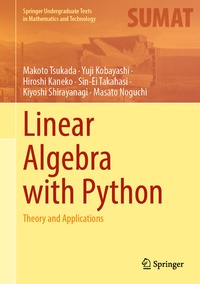
Linear Algebra with Python
Description

This textbook is for those who want to learn linear algebra from the basics. After a brief mathematical introduction, it provides the standard curriculum of linear algebra based on an abstract linear space. It covers, among other aspects: linear mappings and their matrix representations, basis, and dimension; matrix invariants, inner products, and norms; eigenvalues and eigenvectors; and Jordan normal forms. Detailed and self-contained proofs as well as descriptions are given for all theorems, formulas, and algorithms.
A unified overview of linear structures is presented by developing linear algebra from the perspective of functional analysis. Advanced topics such as function space are taken up, along with Fourier analysis, the Perron-Frobenius theorem, linear differential equations, the state transition matrix and the generalized inverse matrix, singular value decomposition, tensor products, and linear regression models. These all provide a bridge to more specialized theories based on linear algebra in mathematics, physics, engineering, economics, and social sciences.
Python is used throughout the book to explain linear algebra. Learning with Python interactively, readers will naturally become accustomed to Python coding. By using Python's libraries NumPy, Matplotlib, VPython, and SymPy, readers can easily perform large-scale matrix calculations, visualization of calculation results, and symbolic computations. All the codes in this book can be executed on both Windows and macOS and also on Raspberry Pi.More details
Other editions
Additional editions
Persons
Makoto Tsukada has been studied in the field of functional analysis. He has been teaching linear algebra, analysis, and probability theory for many years. Also, he has taught programming language courses using Pascal, Prolog, C, Python, etc. Yuji Kobayashi, Hiroshi Kaneko, Sin-Ei Takahasi, Kiyoshi Shirayanagi, and Masato Noguchi are specialists in algebra, analysis, statistics, and computers.
