

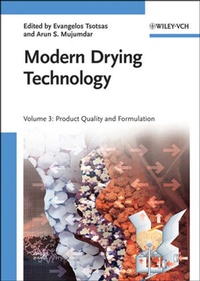
Modern Drying Technology
Volume 3: Product Quality and Formulation
1st Edition
Published on 5. August 2011
XXXVI, 394 pages
978-3-527-64399-8 (ISBN)
Description

This five-volume series provides a comprehensive overview of all important aspects of modern drying technology, concentrating on the transfer of cutting-edge research results to industrial use.
Volume 3 discusses how desired properties of foods, biomaterials, active pharmaceutical ingredients, and fragile aerogels can be preserved during drying, and how spray drying and spray fluidized bed processes can be used for particle formation and formulation. Methods for monitoring product quality, such as process analytical technology, and modeling tools, such as Monte Carlo simulations, discrete particle modeling and neural networks, are presented with real examples from industry and academia.
Volume 3 discusses how desired properties of foods, biomaterials, active pharmaceutical ingredients, and fragile aerogels can be preserved during drying, and how spray drying and spray fluidized bed processes can be used for particle formation and formulation. Methods for monitoring product quality, such as process analytical technology, and modeling tools, such as Monte Carlo simulations, discrete particle modeling and neural networks, are presented with real examples from industry and academia.
More details
Other editions
Additional editions
Evangelos Tsotsas | Arun S. Mujumdar
Modern Drying Technology
Volume 3: Product Quality and Formulation
Book
07/2011
1st Edition
Wiley-VCH
€222.00
Article exhausted; check different version
Software
07/2011
Wiley-VCH
€280.87
No shipping information available
Persons
Professor Dr. Ing. Evangelos Tsotsas holds the Chair of Thermal Process Engineering at Otto von Guericke University Magdeburg (Germany) since 1994. Prior to this, he was a Senior Process Specialist at the Dow Chemical Company. He has authored about 250 papers in refereed journals and conference proceedings, and is the recipient of the Hosokawa Award for Innovation and the ProcessNet Award for Excellence in Drying Research. He serves in various functions in organizations such as the German Research Foundation (DFG), the Alexander von Humboldt Foundation, and the European and German Working Party on Drying.
Professor Arun S. Mujumdar has been Professor of Chemical and Mechanical Engineering at the McGill University, Canada, and at the National University of Singapore. He has authored 2 books and over 60 book chapters, edited or co-edited over 50 books including the Handbook of Industrial Drying.Member of various professional and scientific associations, he was recently conferred Doctor Honoris Causa by the Technical University of Lodz, Poland, and the University of Lyon, France.
Professor Arun S. Mujumdar has been Professor of Chemical and Mechanical Engineering at the McGill University, Canada, and at the National University of Singapore. He has authored 2 books and over 60 book chapters, edited or co-edited over 50 books including the Handbook of Industrial Drying.Member of various professional and scientific associations, he was recently conferred Doctor Honoris Causa by the Technical University of Lodz, Poland, and the University of Lyon, France.
Content
QUALITY CHANGES IN FOOD MATERIALS AS INFLUENCED BY DRYING PROCESSES
Introduction
Biochemical Reactions Induced by Drying
Physical Transformations During Dyring
Mechanical Transformations Induced by Drying
Storage and Rehydration of Food Products
Conclusion
IMPACT OF DRYING ON THE MECHANICAL PROPERTIES AND CRACK FORMATION IN RICE
Introduction
Impact of Drying Conditions on Head Rice Yield for Paddy and Parboiled Rice
Characterization of Fissures Formation by Image Analysis Techniques
Characterization of the Mechanical Properties of the Rice Material
Modeling the Impact of Drying on the Final Quality of Rice Grains
Conclusion
CHARACTERIZATION AND CONTROL OF PHYSICAL QUALITY FACTORS DURING FREEZE-DRYING OF PHARMACEUTICALS IN VIALS
Introduction
Characterization Methods of the Key Quality Factors During Freeze-Drying of Pharmaceuticals in Vials
Influence of Freezing and Freeze-Drying Parameters on Physical Quality Factors
Product Quality and Stability During Drying and Storage
Conclusions
IN-LINE PRODUCT QUALITY CONTROL OF PHARMACEUTICALS IN FREEZE-DRYING PROCESSES
Introduction
Control of the Freezing Step
Monitoring of the Primary Drying
Control of the Primary Drying
Monitoring and Control of Secondary Drying
Quality by Design
Continuous Freeze-Drying
Conclusion
UNDERSTANDING AND PREVENTING STRUCTURAL CHANGES DURING DRYING OF GELS
Introduction
Gels and Their Applications - Quality Aspects
Structural Characterization of Gels - Quality Assessment
Drying Methods for Gels - Quality Loss
Advanced Drying Techniques - Preserving Quality
Advanced Modeling of Convective Drying - Understanding Quality
Summary
MORPHOLOGY AND PROPERTIES OF SPRAY-DRIED PARTICLES
Introduction
Morphology of Spray-Dried Particles
Retention of Flavor in Spray-Dried Food Products
Encapsulation and Microencapsulation of Enzymes and Oil by Spray Drying
General Quality Aspects
Concluding Remarks
PARTICLE FORMULATION IN SPRAY FLUIDIZED BEDS
Introduction
General Principles of Particle Formulation in Spray Fluidized Beds
Influence of Material Properties
Influence of Operating Conditions
Influence of Apparatus Design
Neural Networks, Encapsulation
Stochastic Discrete Modeling of Agglomeration
Summary and Outlook
Introduction
Biochemical Reactions Induced by Drying
Physical Transformations During Dyring
Mechanical Transformations Induced by Drying
Storage and Rehydration of Food Products
Conclusion
IMPACT OF DRYING ON THE MECHANICAL PROPERTIES AND CRACK FORMATION IN RICE
Introduction
Impact of Drying Conditions on Head Rice Yield for Paddy and Parboiled Rice
Characterization of Fissures Formation by Image Analysis Techniques
Characterization of the Mechanical Properties of the Rice Material
Modeling the Impact of Drying on the Final Quality of Rice Grains
Conclusion
CHARACTERIZATION AND CONTROL OF PHYSICAL QUALITY FACTORS DURING FREEZE-DRYING OF PHARMACEUTICALS IN VIALS
Introduction
Characterization Methods of the Key Quality Factors During Freeze-Drying of Pharmaceuticals in Vials
Influence of Freezing and Freeze-Drying Parameters on Physical Quality Factors
Product Quality and Stability During Drying and Storage
Conclusions
IN-LINE PRODUCT QUALITY CONTROL OF PHARMACEUTICALS IN FREEZE-DRYING PROCESSES
Introduction
Control of the Freezing Step
Monitoring of the Primary Drying
Control of the Primary Drying
Monitoring and Control of Secondary Drying
Quality by Design
Continuous Freeze-Drying
Conclusion
UNDERSTANDING AND PREVENTING STRUCTURAL CHANGES DURING DRYING OF GELS
Introduction
Gels and Their Applications - Quality Aspects
Structural Characterization of Gels - Quality Assessment
Drying Methods for Gels - Quality Loss
Advanced Drying Techniques - Preserving Quality
Advanced Modeling of Convective Drying - Understanding Quality
Summary
MORPHOLOGY AND PROPERTIES OF SPRAY-DRIED PARTICLES
Introduction
Morphology of Spray-Dried Particles
Retention of Flavor in Spray-Dried Food Products
Encapsulation and Microencapsulation of Enzymes and Oil by Spray Drying
General Quality Aspects
Concluding Remarks
PARTICLE FORMULATION IN SPRAY FLUIDIZED BEDS
Introduction
General Principles of Particle Formulation in Spray Fluidized Beds
Influence of Material Properties
Influence of Operating Conditions
Influence of Apparatus Design
Neural Networks, Encapsulation
Stochastic Discrete Modeling of Agglomeration
Summary and Outlook
