

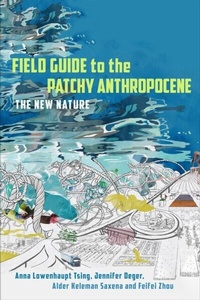
Field Guide to the Patchy Anthropocene
The New Nature
Published on 7. May 2024
344 pages
978-1-5036-3866-2 (ISBN)
Description

Nature has gone feral. How can we re-attune ourselves to the new nature? A field guide can help.
While the global scientific community recently made headlines by ruling the Anthropocene-an era many date to the Industrial Revolution when human action truly began to transform the planet-did not qualify for a geological epoch quite yet, understanding the nature of human transformation of the Earth is more important than ever. The effects of human activity are global in scope, but take shape within distinct social and ecological "patches," discontinuous regions within which the key actors may not be human, but the plants, animals, fungi, viruses, plastics, and chemicals creating our new world. Field Guide to the Patchy Anthropocene takes stock of our current planetary crisis, leading readers through a series of sites, thought experiments, and genre-stretching descriptive practices to nurture a revitalized natural history.
Field guides teach us how to notice, name, and so better appreciate more-than-human worlds. They hone our powers of observation and teach us to see the world anew. Field-based observations and place-based knowledge cultivation-getting up-close and personal with patchy dynamics-are vital to truly grapple with the ecological challenges and the historical conjunctures that are bringing us to multiple catastrophic tipping points. How has commercial agriculture runoff given rise to comb jellies in the Black Sea? What role did the Atlantic slave trade play in the worldwide spread of virus-carrying mosquitoes? How did the green revolution transform the brown planthopper into a superpredator in Philippine rice fields? Questions like these open up new ways of understanding, and ways of living through, the epoch that human activity has ushered in.
This Field Guide shifts attention away from knowledge extractive practices of globalization to encourage skilled observers of many stripes to pursue their commitments to place, social justice, and multispecies community. It is through attention to the beings, places, ecologies, and histories of the Anthropocene that we can reignite curiosity, wonder, and care for our damaged planet.
While the global scientific community recently made headlines by ruling the Anthropocene-an era many date to the Industrial Revolution when human action truly began to transform the planet-did not qualify for a geological epoch quite yet, understanding the nature of human transformation of the Earth is more important than ever. The effects of human activity are global in scope, but take shape within distinct social and ecological "patches," discontinuous regions within which the key actors may not be human, but the plants, animals, fungi, viruses, plastics, and chemicals creating our new world. Field Guide to the Patchy Anthropocene takes stock of our current planetary crisis, leading readers through a series of sites, thought experiments, and genre-stretching descriptive practices to nurture a revitalized natural history.
Field guides teach us how to notice, name, and so better appreciate more-than-human worlds. They hone our powers of observation and teach us to see the world anew. Field-based observations and place-based knowledge cultivation-getting up-close and personal with patchy dynamics-are vital to truly grapple with the ecological challenges and the historical conjunctures that are bringing us to multiple catastrophic tipping points. How has commercial agriculture runoff given rise to comb jellies in the Black Sea? What role did the Atlantic slave trade play in the worldwide spread of virus-carrying mosquitoes? How did the green revolution transform the brown planthopper into a superpredator in Philippine rice fields? Questions like these open up new ways of understanding, and ways of living through, the epoch that human activity has ushered in.
This Field Guide shifts attention away from knowledge extractive practices of globalization to encourage skilled observers of many stripes to pursue their commitments to place, social justice, and multispecies community. It is through attention to the beings, places, ecologies, and histories of the Anthropocene that we can reignite curiosity, wonder, and care for our damaged planet.
Reviews / Votes
"What is life really like on a fast-evolving Earth-for witchweed in Mozambique, water hyacinth in Java, the golden apple snail in Taiwan, and for us? This marvelous, multifaceted Field Guide digs deep beneath the global images of a new epoch and illuminates the changes taking place while showing us how to engage with them."-Jan Zalasiewicz, author of How to Read a Rock: Our Planet's Hidden Stories "Wide-ranging and inclusive, conceptually fresh and creative, with openness and sensitivity to human-nonhuman relationships, this book offers a remarkable guide to the Anthropocene and the patchy unevenness that marks this new geological epoch. A book that is at once useful and thoughtful."
-Dipesh Chakrabarty, author of One Planet, Many Worlds: The Climate Parallax "Field Guide to the Patchy Anthropocene is poetic, playful, and unendingly curious. Its pages abound with unexpected stories and characters, inspiring readers to explore emergent patches for themselves. A timely call to rethink the scales and temporalities of ecological disruption, and a tool for building a new critical lexicon."
-Kregg Hetherington, author of The Government of Beans: Regulating Life in the Age of Monocrops "The connections traced in this beguilingly illustrated volume will make you think twice about the cascading consequences of seemingly small interventions, while giving ample play to indeterminacy about how the sojourns of viruses, boll weevils, Styrofoam, and comb jellies will work themselves out in the world. A powerful invitation to inspect the knock-on effects of human endeavors that are transforming ecologies in ways that evade anyone's control."
-Kath Weston, author of Animate Planet: Making Visceral Sense of Living in a High-Tech Ecologically Damaged World "Refusing the allure of a singular planetary vision, this book foregrounds the importance of creative, pluralistic, and above all, richly descriptive modes of understanding. An indispensable guide for grappling with our complex Anthropocene world."
-Thom van Dooren, author of A World in a Shell: Snail Stories for a Time of Extinctions "This Field Guide makes a mockery of the ideals that inspire imperialist and capitalist infrastructures. Through its multifarious renderings of the out-of-control consequences those infrastructures have unleashed, the book awakens readers to the urgent need for a new, sensible, patchy materialism. A sharp, gripping exploration of the tragic mess of the Anthropocene."
-Isabelle Stengers, author of Another Science is Possible: A Manifesto for Slow Science "[T]his illustrated work of environmental humanities spotlights Anthropocene hotspots, human-instigated environmental and biological catastrophes.... A usefully vivid approach to the complexities of worsening environmental problems."
-Tony Miksanek, Booklist "The book's litany of cataclysms is shot through with a surprising hopefulness, as the authors propose a philosophy of collective well-being extending across species. It's an unsettling but undefeated vision of a world in volatile flux."
-Publishers Weekly "[Field Guide to the Patchy Anthropocene]'s goal is not to be a guide for action but to guide readers to ask different questions of the world they want to act in. If the book has a defining strength, it is its generosity in opening its arms to the possible ways of doing so. There is a lot of aesthetic and intellectual depth in this."-Aria Finkelstein, H-Environment
All prices
More details
Edition
New edition
Language
English
Place of publication
Palo Alto
United States
Target group
Professional and scholarly
Edition type
New edition
Illustrations
68 halftones
ISBN-13
978-1-5036-3866-2 (9781503638662)
Copyright in bibliographic data and cover images is held by Nielsen Book Services Limited or by the publishers or by their respective licensors: all rights reserved.
Schweitzer Classification
Other editions
Additional editions
Anna Lowenhaupt Tsing | Jennifer Deger | Alder Keleman Saxena
Field Guide to the Patchy Anthropocene
The New Nature
Book
approx. 02/2027
Stanford University Press
€19.50
No shipping information available
Anna Lowenhaupt Tsing | Jennifer Deger | Alder Keleman Saxena
Field Guide to the Patchy Anthropocene
The New Nature
Book
05/2024
Stanford University Press
€30.00
Available immediately
Persons
Anna Lowenhaupt Tsing is Distinguished Professor of Anthropology at the University of California, Santa Cruz and the author of The Mushroom at the End of the World. She is also a Professor at Aarhus University. Jennifer Deger is Professor of Digital Humanities and Co-Director of the Centre for Creative Futures at Charles Darwin University, Australia. Alder Keleman Saxena is Assistant Professor in the Department of Anthropology and Program in Sustainable Communities at Northern Arizona University. Feifei Zhou is Adjunct Assistant Professor in Architecture at Columbia University Graduate School of Architecture, Planning and Preservation. Together they are coeditors of Stanford's digital publication Feral Atlas: The More-than Human Anthropocene (2020).
Content
Introduction
PART I. Patches
1. Bringing Field Observation to the Anthropocene
2. What Makes a Patch?
3. Mapping the Patch
Part II. Ruptures
4. Hotspots in the Patchy Anthropocene
5. Unseasonal Weather
6. How to Detonate an Anthropocene
Part III. Histories
7. Others Without History
8. What Is History?
9. Histories of the Future
Part IV. Epistemics
10. Piling
11. Building and Unbuilding
12. Beyond Piling
Appendix: Feral Atlas and Field Guide
PART I. Patches
1. Bringing Field Observation to the Anthropocene
2. What Makes a Patch?
3. Mapping the Patch
Part II. Ruptures
4. Hotspots in the Patchy Anthropocene
5. Unseasonal Weather
6. How to Detonate an Anthropocene
Part III. Histories
7. Others Without History
8. What Is History?
9. Histories of the Future
Part IV. Epistemics
10. Piling
11. Building and Unbuilding
12. Beyond Piling
Appendix: Feral Atlas and Field Guide

