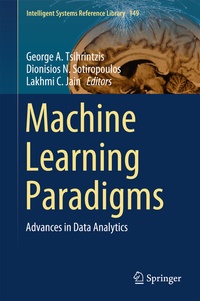
Machine Learning Paradigms
Description

This book explores some of the emerging scientific and technological areas in which the need for data analytics arises and is likely to play a significant role in the years to come. At the dawn of the 4th Industrial Revolution, data analytics is emerging as a force that drives towards dramatic changes in our daily lives, the workplace and human relationships. Synergies between physical, digital, biological and energy sciences and technologies, brought together by non-traditional data collection and analysis, drive the digital economy at all levels and offer new, previously-unavailable opportunities.
The need for data analytics arises in most modern scientific disciplines, including engineering; natural-, computer- and information sciences; economics; business; commerce; environment; healthcare; and life sciences.Coming as the third volume under the general title MACHINE LEARNING PARADIGMS, the book includes an editorial note (Chapter 1) and an additional 12 chapters, and is divided into five parts: (1) Data Analytics in the Medical, Biological and Signal Sciences, (2) Data Analytics in Social Studies and Social Interactions, (3) Data Analytics in Traffic, Computer and Power Networks, (4) Data Analytics for Digital Forensics, and (5) Theoretical Advances and Tools for Data Analytics.
This research book is intended for both experts/researchers in the field of data analytics, and readers working in the fields of artificial and computational intelligence as well as computer science in general who wish to learn more about the field of data analytics and its applications. An extensive list of bibliographic references at the end of each chapter guides readers to probe further into the application areas of interest to them.
Reviews / Votes
"It contains interesting work on machine learning in the medical domain. . it is an interesting collection of machine learning applications across multiple domains. It may be of interest to readers working in one of the discussed areas." (K. Waldhör, Computing Reviews, January, 2019)
More details
Other editions
Additional editions