

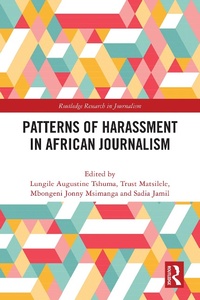
Patterns of Harassment in African Journalism
1st Edition
Published on 14. June 2024
270 pages
978-1-040-04222-9 (ISBN)
Description

This volume examines the trends and patterns of journalists' harassment in Africa and assesses the policy interventions and protection mechanisms that are put into place in the region.
Drawing from case studies from selected African countries, an international team of authors offer a broad insight into the state of harassment across the continent, while building new theoretical perspectives that are also context-specific. The chapters bring previous theories and research up to date by addressing the continual change and development of new discourses, including the use of big data and artificial intelligence in harassing and intimidating journalists and mental health issues affecting journalists in their line of duty. More so, the authors argue that the state and form of harassment is not universal, as location and context are some of the key factors that influence the form and character of harassment.
Offering new theoretical insights into the scope of journalism practices in Africa, this book will interest students and scholars of journalism, African studies, political science, media and communication studies, journalism practice and gender studies.
Drawing from case studies from selected African countries, an international team of authors offer a broad insight into the state of harassment across the continent, while building new theoretical perspectives that are also context-specific. The chapters bring previous theories and research up to date by addressing the continual change and development of new discourses, including the use of big data and artificial intelligence in harassing and intimidating journalists and mental health issues affecting journalists in their line of duty. More so, the authors argue that the state and form of harassment is not universal, as location and context are some of the key factors that influence the form and character of harassment.
Offering new theoretical insights into the scope of journalism practices in Africa, this book will interest students and scholars of journalism, African studies, political science, media and communication studies, journalism practice and gender studies.
Reviews / Votes
This is an urgent and necessary research into the traumatic experiences of African journalists today. Every journalism scholar and practicing journalist will find the different case studies contained in this book, not only heart wrenching, but also illuminating of the crisis of offline and online harassment, even as regimes in Africa are becoming more repressive and enacting laws that make journalism practice difficult. This volume will contribute to raising awareness, shaping the narratives, and providing tools to policymakers in addressing this contemporary pandemic within and across newsrooms.Carol Azungi Dralega, Professor, Department of Journalism, Media and Communication, NLA University College, Norway
If journalism acts as the bellwether of any given society's political and social health, then the circumstances under which journalists work require sustained attention. This edited collection draws on case studies to highlight the myriad ways in which journalists in Africa continue to experience harassment from state and non-state actors, online and offline. It is a welcome and fresh addition to fledgling research on journalism and society in the African context.
Wallace Chuma, Associate Professor, Media Studies, UCT, South Africa. Editor, African Journalism Studies
More details
Series
Edition
1. Auflage
Language
English
Place of publication
London
United Kingdom
Publishing group
Taylor & Francis Ltd
Target group
College/higher education
Professional and scholarly
Illustrations
3 Tables, black and white; 1 Line drawings, black and white; 1 Illustrations, black and white
ISBN-13
978-1-040-04222-9 (9781040042229)
Copyright in bibliographic data and cover images is held by Nielsen Book Services Limited or by the publishers or by their respective licensors: all rights reserved.
Schweitzer Classification
Other editions
Additional editions
Lungile Augustine Tshuma | Trust Matsilele | Mbongeni Jonny Msimanga
Patterns of Harassment in African Journalism
Book
12/2025
1st Edition
Routledge
€69.00
Shipment within 10-20 days

Book
11/2024
Taylor & Francis
Unfortunately, price unknown
Article exhausted; check different version
Lungile Augustine Tshuma | Trust Matsilele | Mbongeni Jonny Msimanga
Patterns of Harassment in African Journalism
Book
06/2024
1st Edition
Routledge
€193.90
Shipment within 10-20 days
Persons
Lungile Augustine Tshuma is Researcher at the Centre for Communication and Culture, Universidade Catolica Portuguesa, Portugal. He holds a Ph.D. in journalism studies from the University of Johannesburg, South Africa. He has worked at the University of Johannesburg as a Senior Post-Doctoral Researcher. Lungile's research interests are in photography, memory and journalism.
Trust Matsilele is Senior Lecturer in the College of English and Media, Birmingham City University, United Kingdom. He publishes in the areas of changing journalism ecologies, social media and protest cultures and the intersection of education and technology. Matsilele holds a Ph.D. in Communication Studies from the University of Johannesburg.
Mbongeni Jonny Msimanga is Senior Post Doctoral Fellow at the Johannesburg Institute of Advanced Study (JIAS). South Africa. He completed his Ph.D. in 2022. Previously, Mbongeni was a recipient for the Canon Collins Sol Plaatje scholarship. Mbongeni's research interests are Journalism Practice, Digital Cultures and Social Media Activism, Cultural Studies.
Sadia Jamil is Assistant Professor and Director of Research at the School of International Communications, the University of Nottingham, Ningbo, China. She is also the Director of Institute of Mobile Studies at UNNC. She earned a Ph.D. in Journalism (University of Queensland, Australia). She has taught courses at the Khalifa University of Science and Technology, Abu Dhabi and in the past, at the University of Queensland, Australia.
Trust Matsilele is Senior Lecturer in the College of English and Media, Birmingham City University, United Kingdom. He publishes in the areas of changing journalism ecologies, social media and protest cultures and the intersection of education and technology. Matsilele holds a Ph.D. in Communication Studies from the University of Johannesburg.
Mbongeni Jonny Msimanga is Senior Post Doctoral Fellow at the Johannesburg Institute of Advanced Study (JIAS). South Africa. He completed his Ph.D. in 2022. Previously, Mbongeni was a recipient for the Canon Collins Sol Plaatje scholarship. Mbongeni's research interests are Journalism Practice, Digital Cultures and Social Media Activism, Cultural Studies.
Sadia Jamil is Assistant Professor and Director of Research at the School of International Communications, the University of Nottingham, Ningbo, China. She is also the Director of Institute of Mobile Studies at UNNC. She earned a Ph.D. in Journalism (University of Queensland, Australia). She has taught courses at the Khalifa University of Science and Technology, Abu Dhabi and in the past, at the University of Queensland, Australia.
Content
Chapter 1: 'Defence-less Defenders': Mapping Harassment in African Journalism
Section 1: Harassment of Female Journalists
Chapter 2: "There Were no Repercussions, Nothing, Life Continued": Experiences of Harassment by Female Journalists'
Chapter 3: Being a Woman-Journalist in a Polarised Context in Mozambique: A Forgotten Issue? Chapter 4: Emergent Forms and Patterns of Online Harassment of Women Journalists in African countries: A Scoping Review
Chapter 5: Gendered Threats and Attacks In and Outside the Newsroom: Nigerian Female Journalists' Experiences with Harassment
Chapter 6: Digital Surveillance, Online and Offline Harassment and Feminist Media Politics
Section 2: Online Harassment of Journalists and the Pitfalls for Democracy
Chapter 7: Independent Online Journalists' Harassment and the Emotional Repercussions: A Case of Selected Zimbabwean Journalists
Chapter 8: Journalists' Repression, Harassment and Attacks in Eswatini and Botswana
Chapter 9: Harassment and Threats Faced by Journalists in Kenya: Implications for Press Freedom and Independent Reporting
Chapter 10: The Cost of Dissent in a Governance System Characterized by 'Political Marketplace': A Phenomenological Study of Independent Journalists in Ethiopia
Chapter 11: Outsourcing Repression: Impunity and Harassment of Journalists in Malawi
Section 3: Journalists Safety and Coping Mechanisms
Chapter 12: Coping into Self-Censorship: Exploring coping strategies of journalists working in South Sudan
Chapter 13: Safety of journalists during elections coverage in Zimbabwe
Chapter 14: Time to Act: Measures of Curbing Harassment of Journalists in African Newsrooms
Section 1: Harassment of Female Journalists
Chapter 2: "There Were no Repercussions, Nothing, Life Continued": Experiences of Harassment by Female Journalists'
Chapter 3: Being a Woman-Journalist in a Polarised Context in Mozambique: A Forgotten Issue? Chapter 4: Emergent Forms and Patterns of Online Harassment of Women Journalists in African countries: A Scoping Review
Chapter 5: Gendered Threats and Attacks In and Outside the Newsroom: Nigerian Female Journalists' Experiences with Harassment
Chapter 6: Digital Surveillance, Online and Offline Harassment and Feminist Media Politics
Section 2: Online Harassment of Journalists and the Pitfalls for Democracy
Chapter 7: Independent Online Journalists' Harassment and the Emotional Repercussions: A Case of Selected Zimbabwean Journalists
Chapter 8: Journalists' Repression, Harassment and Attacks in Eswatini and Botswana
Chapter 9: Harassment and Threats Faced by Journalists in Kenya: Implications for Press Freedom and Independent Reporting
Chapter 10: The Cost of Dissent in a Governance System Characterized by 'Political Marketplace': A Phenomenological Study of Independent Journalists in Ethiopia
Chapter 11: Outsourcing Repression: Impunity and Harassment of Journalists in Malawi
Section 3: Journalists Safety and Coping Mechanisms
Chapter 12: Coping into Self-Censorship: Exploring coping strategies of journalists working in South Sudan
Chapter 13: Safety of journalists during elections coverage in Zimbabwe
Chapter 14: Time to Act: Measures of Curbing Harassment of Journalists in African Newsrooms
