

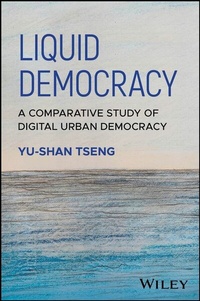
Liquid Democracy
Description

"This timely book carefully interrogates the increasingly fraught intersections of the digital, the city, and democracy. It is a book that will endure, bristling as it is with thoughtful reflection and insight on the democratic challenges that unfold amidst the ordinary, troubled and generative digital worlds of cities as different as Madrid, Taipei and Helsinki. Amidst the work of policymakers, activists, and engineers, what emerges is a hopeful exploration of what 'digital democracy platforms' might enable." -Professor Colin McFarlane, Durham University
"This vital book moves beyond a universal analysis of the effects of social media platforms on liberal democracy. Through an in-depth examination of civic platforms in Finland, Spain and Taiwan, Tseng provides a compelling and nuanced empirical and theoretical analysis of the contingent relationship between platforms, place and democracy." -Professor Rob Kitchin, Maynooth University
Reimagining Democracy in the Digital and Urban Age
How can democracy adapt and thrive in a world reshaped by artificial intelligence and digital platforms?
In Liquid Democracy, author Yu-Shan Tseng offers a bold new framework for understanding democracy as a dynamic, fluid process. Challenging the idea that AI and digital tools are inherently anti-democratic, this innovative volume bridges theory and practice to investigate various "liquid conditions," a novel concept capturing how political action flows and transforms like water within the intersections of urban spaces and digital technologies.
Through an in-depth comparative study of three groundbreaking digital democracy platforms-Decide Madrid in Madrid, OmaStadi in Helsinki, and vTaiwan in Taipei-Tseng explores how digital platforms can foster participatory governance, pluralism, and alternative democratic futures. In-depth chapters critically examine the interactions between humans, algorithms, and urban systems, revealing how digital tools reconfigure the boundaries of political participation, decision-making, and collective action. Throughout the text, Tseng offers fresh insights into how democracy emerges under contingent conditions shaped by technology and geography.
Drawing from years of ethnographic fieldwork, Liquid Democracy is essential reading for master's and PhD students in geography, political science, and urban studies, as well as scholars, practitioners, and policymakers interested in digital governance, smart cities, civic technology, and algorithmic politics.
More details
Other editions
Additional editions
Person
YU-SHAN TSENG is an Anniversary Research Fellow at the School of Geography and Environmental Science, University of Southampton, UK. Her research explores the intersections of digital platforms, democracy, and urban geographies, with a focus on participatory governance and algorithmic systems. Tseng's work has been widely published in leading journals, including Social and Cultural Geography, Urban Studies, and Big Data and Society.
Content
List of Figures and Table x
Acknowledgements xi
Introduction: Approaching Democracy from the Field xv
1 Democracy in the Age of Platformisation 1
1.1 Reproblematising Democracy in the Age of Platformisation 1
1.2 Meeting 'Differences' of Democracy at the Intersections 3
1.3 Democratisations, Occupy Movements and Global Circulations 10
1.4 A Liquid Comparison and Epistemology 14
1.5 Liquid Conditions for Democracy in Digital and Urban Worlds 21
2 Dissolving Democratic Theories into Larger Worlds 25
2.1 Correct Ontologies, Normative Claims and Universal Assumptions in Democratic Theories 28
2.1.1 Aggregative democracy 28
2.1.2 Participatory democracy and consensus democracy 29
2.1.3 Radical democracy 31
2.1.4 Digital democracies the slippery tyranny of normative principles 34
2.1.5 Feminist and post-colonial democracy 36
2.1.6 Post-structuralist democracy Jacques Derrida 38
2.2 Democracy In-The- World Ontologies: More- Than-Human, Liquidity and Multiplicity 39
2.2.1 Democracy as convergent movements: between different powers and times 44
2.2.2 Plural democracy keeping political boundaries fluid 47
2.2.3 Everyday/ordinary democracy 48
2.3 From a Correct Democracy to Democratic Multiplicity 54
3 DDPs at Comparative Conjunctures 56
3.1 Movements, Calculus and Futures 56
3.2 Convergent Democratic Movements Underpinning the DDPs 58
3.2.1 Madrid: between political consensus and (dis) alliance for democracy 60
3.2.2 Taipei: political consensus for democratisation and neoliberal development 65
3.2.3 Helsinki: political consensus around Finlandisation and neoliberal urbanisation 69
3.3 On Risk Calculus and Democratic Futures 73
3.3.1 vTaiwan: securing an undivided democratic future against geopolitical tension 74
3.3.2 Decide Madrid and OmaStadi: global neoliberal futures for the simple majority 77
3.3.3 Uncounted democratic futures in urban and digital worlds 80
3.4 Orienting Towards Different Democratic Futures 82
4 Frictions for Care Democracy 85
4.1 Gamification as a New Digital Solution and Environment for Democracy 85
4.2 Friction as Contestations 89
4.2.1 Decide Madrid 90
4.2.2 OmaStadi 92
4.2.3 vTaiwan 95
4.3 Tactical Friction: Power, Knowledge Inequalities and Care 97
4.3.1 Decide Madrid 98
4.3.2 OmaStadi 102
4.3.3 vTaiwan 104
4.4 Frictions as Ordinary Rhythms for Care Democracy 106
5 Algorithmic Reordering for Plural Democracy 109
5.1 Reordering as a Liquid Condition for Plural Democracy 109
5.2 vTaiwan: Reordering Plural Opinions for Uber Legalisation 111
5.2.1 Plural Opinions from Algorithmic Reordering 112
5.2.2 Human in the Making of the Binary Propositions 118
5.3 Decide Madrid: Reordering Issues into Urban Services and Infrastructures 121
5.3.1 (Re)ordering majoritarian urban issues 123
5.3.2 En Route to Institutional Implementation 125
5.4 Reordering in Decision-Making for Liquid Plural Democracy 131
6 Urban Thrown-Togetherness for Ordinary Democracy 134
6.1 Introduction 134
6.2 Challenging Neoliberal Trends in Helsinki 137
6.2.1 A social experiment for the everyday struggles of drug abusers 137
6.2.2 When welfare services fade away the elderly's struggles over budget-cutting 140
6.2.3 Fighting against time to save an urban cultural space from decay and privatisation 143
6.3 Decide Madrid: Collective Presence for Alternative Urban Futures 146
6.3.1 A la Nave Daoiz y Velarde 147
6.3.2 Weaving layers of knowledge into alternative urban futures the Legazpi market 150
6.4 Thrown-togetherness in Liquid Temporal-Geographies for Ordinary Democracy 153
7 Moving on with Liquid Democracy 157
7.1 Seeing Democracy Like Water 157
7.2 Becoming with the Liquid Worlds for Policymaking 166
7.3 Where to Look for Democratic Futures 171
References 175
Index 194
Acknowledgements
This book would not have been possible without the support and contributions of numerous individuals, communities, and institutions to whom I am indebted. I take this opportunity to express my sincere gratitude to all of them.
I consider myself extremely fortunate to have had the opportunity to know and learn from many colleagues, whose wisdom and brilliance have nurtured a critical and liberal academic culture within Durham Geography. Those intellectually stimulating conversations and interactions had a profound impact on my research and worldview, both during and even more after my PhD. I constantly found myself in awe of their intellectual critique and creativity. I am grateful to Hannah, Cynthia, Hung-Ying, Ludovico, James, Grace, Marcin, Ayushman, Tilly, Paul, Gordon, Lauren, and many others for their support and encouragement. It was an environment that constantly privileges the importance of acknowledging and appreciating someone's perspective on the world, no matter how small or seemingly insignificant it may be to others. Durham was brimming with a strong sense of intellectual liberation, respect and a constant worry about 'what might be foreclosed'. I enjoyed intellectual conversations undertaken in the purist possible way, imbued with passion and care, going beyond all kinds of numerical measurements and hierarchies.
I extend a special thank you to my PhD supervisors, Colin McFarlane and Andres Luque-Ayala, for their unwavering patience, wisdom and support throughout and beyond my doctoral studies. I am also very grateful to Louise Amoore, who graciously provided me with her mentorship for a short time during my postdoc. Looking back, I realise that there were many things, spoken and unspoken, that I did not fully comprehend as a PhD student. However, as I transitioned to a postdoctoral position in a different country and department at the University of Helsinki, things began to illuminate themselves in strange and unexpected moments.
I am grateful to have been granted a three-year independent postdoctoral position at the University of Helsinki, which provided me with the time and resources to delve deeper into the investigation of the OmaStadi platform and urban communities. During my time at the University of Helsinki, I had the pleasure of getting to know many wonderful colleagues, including David, Tuukka, Sonja, Laura, Santerri, Kirkissika, Mika, Jim, and Zhuo from Minna Ruckenstain's research group at the Centre for Consumer Society Research (CCSR). The biweekly seminars fostered interesting conversations and discussions on topics such as algorithmic decision-making and digital technologies. There was always a sense of frankness in our discussions, whether regarding manuscripts or specific technologies.
Outside of the research group, insightful and constructive suggestions were gleaned from the two panels at the EEAST conference (in Madrid) and at the conference on 'Digitalisation and Welfare' hosted by the IT University of Copenhagen, where I had the chance to speak to Nanna Thylstrup and other Danish STS scholars. I also had the pleasure of presenting the outline of my book project at the National Taiwan University (online) and at the University of Aalborg where I received interesting feedback from STS scholars like Sung-Yeuh Perng, Mei-Chun Lee, Anders Munk and Anders Madsen. Back to Helsinki, I thank Niilo, Petteri, Visa, Joe and Mikko for their support on administrative matters and for engaging in conversations. Beyond the CCSR, I extend my thanks to fellow postdocs in urban studies and sustainability studies, including Stephan, Basile, Niharika, Anna, Nilay, Seona, and Lasse, for their peer support and for having fun during lunches, drinks and other social activities. I am particularly grateful to Annina, who provided me with support in various administrative matters.
I am grateful to the individuals who provided tremendous support during my fieldwork in Taipei, Madrid, and Helsinki. Foremost, I express my deepest gratitude to Audrey Tang, the digital minister of the Taiwanese government. Audrey has consistently responded to my inquiries about vTaiwan over the years and has been incredibly generous with her time and insights for my research project. I consider myself fortunate to have had the opportunity to work at Audrey's cabinet office, where I had the pleasure of getting to know and engaging in conversations with key stakeholders such as Shu-Yang, Yu-Tzan, Tzu-Yu, Mark, Fang and many others who were involved in and made significant contributions to the vTaiwan project. Additionally, I thank Christopher Small from Pol.is Inc. Christopher not only provided me with invaluable knowledge of machine learning algorithms but also recreated a highly unique database that allowed for the daily reconstruction of online participation in the Uber case. This database became a critical material for my analysis of algorithmic decision-making.
In Madrid, a heart-felt appreciation is, without doubt, given to Miguel for his invaluable assistance in interpreting during meetings and a few interviews with Spanish colleagues. His generosity with time and scheduling was a great help to my fieldwork. I also express my gratitude to Paula, Chema, Ana, Vicky, Rai, Yago, Pablo Aragon and Saya, who were involved in or conducted research on the Decide Madrid project. Their honest and intellectual insights, as well as their warm hospitality during our conversations, have been very helpful to my fieldwork. I am also grateful to Alberto Corsin for his inspirational conversations during my several visits to Madrid. Finally, I acknowledge the contributions of my research assistant, Tanja, who interpreted short conversations and interviews with activists and citizens (even in scorching hot weather) during the follow-up fieldwork.
In Helsinki, a lot of gratitude goes to my research team members: Christoph Becker and Ida Roikonen. Ida provided assistance in facilitating interviews and participatory observations by interpreting Finnish to English (and vice versa), while Chris contributed to the analysis of voting patterns and provided comments on the journal manuscript. I also appreciated Antti Hukkanen for providing a user database upon request. On top of this, I have enjoyed the insightful conversations about OmaStadi with Thomas Wallgren at the University of Helsinki, Pauli Saloranta, Kirsi Verkka and many others at the City of Helsinki. I have enjoyed doing participatory observation in several suburban communities alone or with my master's student, Ida. Finally, I also thank Vesa from Laajasalo and his son Thomas for their help with language interpretation during the walking tour, as well as Ina from Philajamaki for her help with interviewee recruitment.
The two editors at the Antipode book series - David and Kiran - have been instrumental in publishing this book. Their editorial comments on an earlier draft helped me feel companionship during the lengthy process. I felt encouragement and was prompted to think more critically and write more rigorously. In addition, I thank the dozens of reviewers from Urban Studies, Big Data & Society, AI & Society, and Cultural and Social Geography. Their feedback on the journal manuscripts, which I incorporated into empirical chapters 4, 5, and 6, indirectly contributed to this book.
This book could not have gotten off the ground without financial support from the cities of Helsinki, Vantaa, and Espoo, Centre for Consumer Society Research at the University of Helsinki, and the Taiwanese government, which funded my postdoc position and PhD study. I was also supported by small grants for fieldwork and conferencing from Royal Geography Society (the Dudley Memorial Award), Geography Department and Hatfield College at Durham University, and the Urban and Regional Studies Institute and the Social Science Faculty at the University of Helsinki. While funding was essential, the freedom of my three-year position at the University of Helsinki allowed me to think and write slowly, steadily and critically. Finally, I also thank the University of Southampton for offering me a prestigious anniversary research fellowship. This fellowship ensured the financial security, continuity and intellectual recognition that allowed me to finish off the revisions. A conversation about post-structuralism and comparison methods with Nick Clarke has been helpful for me to rethink what has been produced or added to democratic theories through my choice of a comparative methodology.
In my personal life, a massive thank you goes to my partner, Jeff, who has supported my academic career, fieldwork and the writing up of this book in his own way. It is comforting to find food on the table when you come home from curious trips. I thank my late mother-in-law, Ann, who was always there for me throughout and whose spirit still lives through my actions and words. I thank Dave and Richard from the Maughan family for their support. Speaking of unconditional love and support, I thank my sister, mum and dad in Taipei.
If there is anything left unsaid here or in the book, it is meant to be understood by way of the Dao. While it is often left unsaid or not completely clear in large measure, I can clearly recall such moments when the Dao brought new directions and visions into the world throughout different stages of writing this book. With Dao in mind, I ventured into the random directions that snowflakes swerve, without completely losing myself. I was able to join and let go of the wind whispering in the trees, upon which I had once...
