

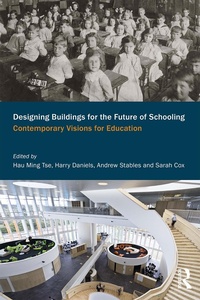
Designing Buildings for the Future of Schooling
Contemporary Visions for Education
1st Edition
Published on 9. November 2018
208 pages
978-1-351-37371-5 (ISBN)
Description

Bringing together leading experts from the fields of architecture, design, engineering, education and the social sciences, this valuable collection presents a multidimensional understanding of the complexities and ways in which school designs influence and are influenced by educational practice.
Moving beyond the long-debated question as to whether the design of a school influences pedagogic practice, chapters acknowledge the multiple and diverse ways in which teaching, learning, development and inclusion are impacted by the nature and quality of the physical environment. Considering changes in national and international policy, and exploring the changing pressures and demands on design, education and schooling more broadly, contributors rethink and re-envision those aspects of design and educational practice in which they specialise. Together, these chapters present a bold vision for the future conceptualisation, development and use of school buildings and facilities.
An important contribution to debates on school design and education, inclusion and pedagogy, this is an essential and fascinating read for students, researchers, lecturers and policymakers involved in the fields of education and architecture.
Moving beyond the long-debated question as to whether the design of a school influences pedagogic practice, chapters acknowledge the multiple and diverse ways in which teaching, learning, development and inclusion are impacted by the nature and quality of the physical environment. Considering changes in national and international policy, and exploring the changing pressures and demands on design, education and schooling more broadly, contributors rethink and re-envision those aspects of design and educational practice in which they specialise. Together, these chapters present a bold vision for the future conceptualisation, development and use of school buildings and facilities.
An important contribution to debates on school design and education, inclusion and pedagogy, this is an essential and fascinating read for students, researchers, lecturers and policymakers involved in the fields of education and architecture.
Reviews / Votes
"This is a book full of wisdom and common sense; it tells us what we thought we knew about how schools function technically and pedagogically, in a highly readable, visually stimulating format, which is bang up to date. Full of insightful ideas and theories on the complex ecosystems of learning, it asks important questions about how school buildings should be formed in the 21st century, and then answers them. It can be used as a design guide or as a compendium of innovation and inspiration for educationalists, designers and politicians. This is a timely addition to the debate because it puts schooling and learning at the centre of everything."Mark Dudek, schools architect and writer, UK.
"This fascinating text provides a set of provocative and well-informed responses to the question of whether (and how) school buildings are significant to the education of those taught within them. One of the many key strengths of this book is that it draws together academics and practitioners from a range of disciplines - including practicing architects - in a way that highlights the complex ways in which design, policy, curricula and everyday educational experiences intersect. In so doing, the chapters offer novel and valuable insights into questions ranging from the very purpose of schools (and their buildings) to questions of environmental efficiency and air quality. The book will be of interest to a wide range of readers interested in school design, education and childhood - including architects, geographers, social policy analysts, sociologists and construction industry professionals."
Peter Kraftl, Professor of Human Geography, University of Birmingham, UK; and Honorary Professor, School of Education, RMIT, Australia
More details
Edition
1. Auflage
Language
English
Place of publication
London
United Kingdom
Publishing group
Taylor & Francis Ltd
Target group
College/higher education
Professional and scholarly
Product notice
Reflowable
Illustrations
8 Tables, color; 22 Line drawings, color; 25 Halftones, color
File size
6,70 MB
ISBN-13
978-1-351-37371-5 (9781351373715)
Copyright in bibliographic data and cover images is held by Nielsen Book Services Limited or by the publishers or by their respective licensors: all rights reserved.
Schweitzer Classification
Other editions
Additional editions
Hau Ming Tse | Harry Daniels | Andrew Stables
Designing Buildings for the Future of Schooling
Contemporary Visions for Education
Book
12/2018
1st Edition
Routledge
€67.03
Shipment within 10-20 days
Hau Ming Tse | Harry Daniels | Andrew Stables
Designing Buildings for the Future of Schooling
Contemporary Visions for Education
Book
11/2018
1st Edition
Routledge
€215.41
Shipment within 10-20 days
Persons
Hau Ming Tse is a Research Fellow in the Department of Education, University of Oxford, UK.
Harry Daniels is Professor of Education in the Department of Education, University of Oxford, UK.
Andrew Stables is Professor Emeritus at the University of Roehampton and a Senior Researcher with the International Semiotics Institute.
Sarah Cox is a Researcher in the Department of Education at the University of Oxford, UK
Harry Daniels is Professor of Education in the Department of Education, University of Oxford, UK.
Andrew Stables is Professor Emeritus at the University of Roehampton and a Senior Researcher with the International Semiotics Institute.
Sarah Cox is a Researcher in the Department of Education at the University of Oxford, UK
Content
List of Figures List of Tables About the Editors List of Contributors Introduction, Hau Ming Tse, Harry Daniels, Andrew Stables Chapter 1: School Buildings, Tim Brighouse Chapter 2: Creating Spaces for Learning or Making Room for Education?: New Parameters for the Architecture of Education, Gert Biesta Chapter 3: School Design Matters, Hau Ming Tse, Harry Daniels, Andrew Stables Chapter 4: School Buildings as an Enabler for Progressive Teaching, Peter Clegg and Joe Jack Williams Chapter 5: Corridors, Classrooms, Classification - The Impact of School Layout on Pedagogy and Social Behaviours, Kerstin Sailer Chapter 6: Primary Schools Must be Designed to Enhance Learning, Peter Barrett and Lucinda Barrett Chapter 7: Knotworking: An Emerging Form of Multi-party Collaboration between Clients, Users and Designers in School Design, Hannele Kerosuo Chapter 8: Designing Schools for Health, Comfort and Cognitive Performance: What do we Know?, Dejan Mumovic, Lia Chatzidiakou, Gaber Riham Chapter 9: Inclusive Design and Schools, Jill Porter Index
