

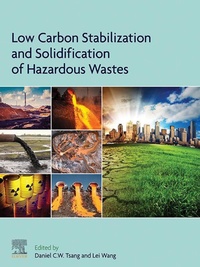
Low Carbon Stabilization and Solidification of Hazardous Wastes
Published on 24. September 2021
590 pages
978-0-12-824252-0 (ISBN)
Description

Low Carbon Stabilization and Solidification of Hazardous Wastes details sustainable and low-carbon treatments for addressing environmental pollution problems, critically reviewing low-carbon stabilization/solidification technologies. This book presents the latest state-of-the-art knowledge of low-carbon stabilization/solidification technologies to provide cost-effective sustainable solutions for real-life environmental problems related to hazardous wastes including contaminated sediments. As stabilization/solidification is one of the most widely used waste remediation methods for its versatility, fast implementation and final treatment of hazardous waste treatment, it is imperative that those working in this field follow the most recent developments.
Low Carbon Stabilization and Solidification of Hazardous Wastes is a necessary read for academics, postgraduates, researchers and engineers in the field of environmental science and engineering, waste management, and soil science, who need to keep up to date with the most recent advances in low-carbon technologies. This audience will develop a better understanding of these low-carbon mechanisms and advanced characterization technologies, fostering the future development of low-carbon technologies and the actualization of green and sustainable remediation.
- Focuses on stabilization/solidification for environmental remediation, as one of the most widely used environmental remediation technologies in field-scale applications
- Details the most advanced and up-to-date low-carbon sustainable technologies necessary to guide future research and sustainable development
- Provides comprehensive coverage of low-carbon solutions for treating a variety of hazardous wastes as well as contaminated soil and sediment
More details
Other editions
Additional editions
Daniel C.W. Tsang | Lei Wang
Low Carbon Stabilization and Solidification of Hazardous Wastes
Book
09/2021
Elsevier
€174.50
Shipment within 15-20 days
Content
Part I Overview of environmental remediation and stabilization/solidification1. Sustainable waste management2. Overview of low-carbon stabilization/solidification
Part II Low-carbon stabilization/solidification (S/S) of contaminated soil and sediment3. Green cementitious materials for S/S4. Natural or organophilic clay for S/S5. Nanomaterials for S/S6. Biochar for S/S7. S/S of contaminated river/lake sediment 8. S/S of contaminated marine sediment
Part III Low-carbon stabilization/solidification of industrial waste 9. S/S of waste incineration fly ash and bottom ash10. S/S of waste incineration bottom ash11. S/S of industrial sludge (electroplating)12. S/S of industrial sludge (mining)13. S/S of sewage sludge ash14. Remediation of mine waste15. Remediation of tailing waste16. Remediation of chemical waste17. Utilization of waste slag 18. Utilization of coal fly ash and bottom ash19. Utilization of contaminated bio-waste
Part IV Low-carbon stabilization/solidification of radioactive waste20. Cement-based S/S of radioactive waste21. Glass-based S/S of radioactive waste22. Ceramic-based S/S of radioactive waste23. Chemical enhanced S/S of radioactive waste
Part V Future prospects24. Novel materials for S/S technologies25. Advanced characterization for S/S technologies26. New lab-scale analytical methods for S/S technologies27. Life cycle analysis of S/S technologies 28. Cost-benefit analysis of S/S technologies29. Sustainable waste management and circular economy30. Future research directions for sustainable remediation
