

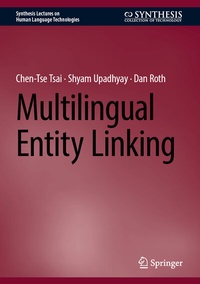
Multilingual Entity Linking
Description

This book focuses on Entity Discovery and Linking (EDL), which is the problem of identifying concepts and entities, disambiguating them, and grounding them to one or more knowledge bases (KBs). The authors first provide background on the topic and emphasize why it is a crucial step toward understanding natural language text. As most of the content on the internet is not in English, the book also discusses cross-lingual EDL. The authors present the challenges associated with EDL problems and explain the existing solutions. The book covers the core challenges that apply to all EDL problems, as well as the additional challenges associated with cross-lingual EDL problems. The authors also survey relevant research papers, highlight recent trends, and identify areas for future research.
More details
Other editions
Additional editions
Persons
Chen-Tse Tsai, Ph.D., is a Senior Research Scientist at Bloomberg, specializing in information extraction and time series prediction. He received his Ph.D. in Computer Science from the University of Illinois Urbana-Champaign and his M.S. in Computer Science from the National Taiwan University. Dr. Tsai has authored over 20 papers presented at top-tier NLP and ML conferences, including EMNLP, NAACL, EACL, CoNLL, and AAAI. As an action editor for ACL Rolling Review and a reviewer for various NLP conferences and journals, he actively contributes to the scholarly community.
Shyam Upadhyay, Ph.D., is a Staff Research Scientist at Google Deepmind, where he has worked on products such as the Google Assistant and Gemini. He received his Ph.D. in Natural Language Processing (NLP) from the University of Pennsylvania in 2019, where his focus was on multilingual representation learning and low-resource NLP. He has published over 20 papers at top-tier NLP conferences, such as EMNLP, ACL, NAACL, *SEM, Interspeech, and AAAI. He has also served as the action editor for ACL rolling review, associate editor for ACM Transactions on Asian and Low-Resource Language Information Processing (TALLIP), and as an area chair for several ACL conferences.
Dan Roth, Ph.D., is the Eduardo D. Glandt Distinguished Professor at the University of Pennsylvania Department of Computer and Information Science , a VP and Distinguished Scientist at Amazon AWS AI, and a Fellow of the AAAS, the ACM, AAAI, and the ACL. He received his Ph.D. in Computer Science from Harvard University and his B.A Summa cum laude in Mathematics from the Technion, Israel. Dr. Roth has published broadly in machine learning, natural language processing, knowledge representation and reasoning, and learning theory, and he has developed advanced machine learning based tools for natural language applications that are being used widely. In 2017, Dr. Roth was awarded the John McCarthy Award, the highest award the AI community gives to mid-career AI researchers.
Content
Chapter 1 Introduction to Entity Discovery and Linking.- Chapter 2 Knowledge Bases, Datasets, and Evaluation.- Chapter 3 Overview of Entity Discovery and Linking Pipeline.
