

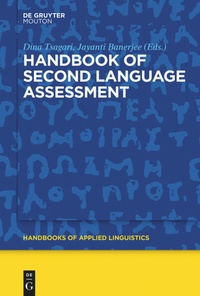
Handbook of Second Language Assessment
Description

Second language assessment is ubiquitous. It has found its way from education into questions about access to professions and migration. This volume focuses on the main debates and research advances in second language assessment in the last fifty years or so, showing the influence of linguistics, politics, philosophy, psychology, sociology, and psychometrics. There are four parts which, when taken together, address the principles and practices of second language assessment while considering its impact on society. Read separately, each part addresses a different aspect of the field.
Part I deals with the conceptual foundations of second language assessment with chapters on the purposes of assessment, and standards and frameworks, as well as matters of scoring, quality assurance, and test validation.
Part II addresses the theory and practice of assessing different second language skills including aspects like intercultural competence and fluency.
Part III examines the challenges and opportunities of second language assessment in a range of contexts. In addition to chapters on second language assessment on a national scale, there are chapters on learning-oriented assessment, as well as the uses of second language assessment in the workplace and for migration.
Part IV examines a selection of important issues in the field that deserve attention. These include the alignment of language examinations to external frameworks, the increasing use of technology to both deliver and score second language tests, the responsibilities associated with assessing test takers with special needs, the concept of 'voice' in second language assessment, and assessment literacy for teachers and other test and score users.
More details
Other editions
Additional editions
Persons
Content
- Intro
- Preface
- Introduction to the handbook series
- Contents
- 1. The handbook of second language assessment
- I. Conceptual foundations of second language assessment
- 2. Purposes of assessment
- 3. Standards and frameworks
- 4. Norm-referenced vs. criterion-referenced approach to assessment
- 5. Quality factors in language assessment
- 6. The impact of language assessment
- II. Assessing second language skills/areas
- 7. Assessing listening
- 8. Assessing reading
- 9. Assessing speaking
- 10. Assessing writing
- 11. Assessing pragmatic competence
- 12. Assessing intercultural competence
- 13. Fluency in second language assessment
- 14. Translation and interpretation skills
- III. Second language asessment contexts
- 15. Assessment in educational settings
- 16. Learning-oriented assessment in second and foreign language classrooms
- 17. Dynamic Assessment in the language classroom
- 18. Language assessment for the workplace
- 19. Language assessment and analysis for immigration, citizenship and asylum
- IV. Issues in second language assessment
- 20. Aligning language assessments to standards and frameworks
- 21. Technology and artificial intelligence in language assessment
- 22. Assessing young learners
- 23. Assessing students with learning and other disabilities/special needs
- 24. 'Authorial voice' in the assessment of writing
- 25. Teacher assessment literacy and professional development
- Biographical notes
- Index
