

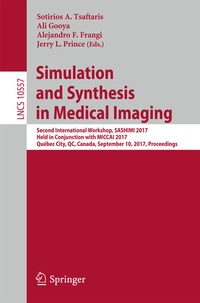
Simulation and Synthesis in Medical Imaging
Second International Workshop, SASHIMI 2017, Held in Conjunction with MICCAI 2017, Québec City, QC, Canada, September 10, 2017, Proceedings
Published on 28. September 2017
X, 109 pages
978-3-319-68127-6 (ISBN)
Description

This book constitutes the refereed proceedings of the Second International Workshop on Simulation and Synthesis in Medical Imaging, held in conjunction with MICCAI 2017, in Québec City, Canada, in September 2017.
The 11 revised full papers presented were carefully reviewed and selected from 14 submissions. The contributions span the following broad categories: cross modality (PET/MR, PET/CT, CT/MR, etc.) image synthesis, simulation and synthesis from large-scale image databases, automated techniques for quality assessment images, and several applications of image synthesis and simulation in medical imaging such as image interpolation and segmentation, image reconstruction, cell imaging, and blood flow.
More details
Series
Edition
1st ed. 2017
Language
English
Place of publication
Cham
Switzerland
Publishing group
Springer International Publishing
Product notice
Reflowable
Illustrations
X, 109 p. 41 illus.
File size
18,46 MB
ISBN-13
978-3-319-68127-6 (9783319681276)
DOI
10.1007/978-3-319-68127-6
Schweitzer Classification
Other editions
Additional editions
Sotirios A. Tsaftaris | Ali Gooya | Alejandro F. Frangi
Simulation and Synthesis in Medical Imaging
Second International Workshop, SASHIMI 2017, Held in Conjunction with MICCAI 2017, Québec City, QC, Canada, September 10, 2017, Proceedings
Book
09/2017
Springer
€53.49
Shipment within 10-15 days
Content
- Intro
- Preface
- Organization
- Contents
- Synthesis and Its Applications in Computational Medical Imaging
- Adversarial Image Synthesis for Unpaired Multi-modal Cardiac Data
- 1 Introduction
- 2 Previous Work
- 3 Method Details
- 3.1 View Alignment
- 3.2 Transform Learning with CycleGAN
- 3.3 Synthesis
- 4 Experiments
- 4.1 Segmentation
- 4.2 Data
- 4.3 Data Preprocessing
- 4.4 Experiment Details
- 4.5 Results
- 5 Discussion and Conclusion
- References
- Deep MR to CT Synthesis Using Unpaired Data
- 1 Introduction
- 2 Data
- 3 Methods
- 3.1 CNN Architectures
- 3.2 Evaluation
- 4 Experiments and Results
- 5 Discussion and Conclusion
- References
- Synthesizing CT from Ultrashort Echo-Time MR Images via Convolutional Neural Networks
- 1 Introduction
- 2 Data Description
- 3 Method
- 4 Results
- 5 Discussion
- References
- A Supervoxel Based Random Forest Synthesis Framework for Bidirectional MR/CT Synthesis
- 1 Introduction
- 2 Methods
- 3 Experiments
- 4 Conclusion
- References
- Region-Enhanced Joint Dictionary Learning for Cross-Modality Synthesis in Diffusion Tensor Imaging
- 1 Introduction
- 2 Method
- 2.1 Single Dictionary Learning
- 2.2 Region-Enhanced Setting
- 2.3 Patch Normalization
- 2.4 Joint Dictionary Learning
- 2.5 Objective Function
- 2.6 Synthesis
- 3 Experiments
- 3.1 Experimental Setting
- 3.2 Results
- 4 Conclusion
- References
- Virtual PET Images from CT Data Using Deep Convolutional Networks: Initial Results
- 1 Introduction
- 1.1 Fully Convolutional Networks
- 1.2 Conditional Adversarial Networks
- 2 Methods
- 2.1 Training Data Preparation
- 2.2 Fully Convolutional Network Architecture
- 2.3 Conditional GAN Architecture
- 2.4 Loss Weights
- 2.5 Image Blending
- 3 Results
- 3.1 Dataset
- 3.2 Preliminary Results
- 4 Conclusions
- References
- Simulation and Processing Approaches for Medical Imaging
- Semi-supervised Assessment of Incomplete LV Coverage in Cardiac MRI Using Generative Adversarial Nets
- 1 Introduction
- 2 Methodology
- 2.1 Generative Adversarial Learning
- 2.2 Semi-coupled GANs
- 2.3 Quality Estimation
- 3 Experiment and Related Analysis
- 4 Conclusion
- References
- High Order Slice Interpolation for Medical Images
- 1 Introduction
- 2 Method
- 3 Experiments and Results
- 4 Discussion and Conclusion
- References
- A Monte Carlo Framework for Low Dose CT Reconstruction Testing
- 1 Introduction
- 2 Physically Modelling CT Systems
- 2.1 Discrete Measurement Model
- 2.2 Modelling the Source and Detector
- 2.3 Specimen Material and Movement
- 2.4 Parallel Implementation and Data Consolidation
- 3 Examples and Testing
- 3.1 Fan-Beam CT Example
- 3.2 CBCT Example
- 4 Conclusions
- References
- Multimodal Simulations in Live Cell Imaging
- 1 Introduction
- 2 Methodology
- 2.1 Cellular Potts Model
- 2.2 Subcellular Components
- 2.3 Sphericity of Components
- 2.4 Modified Chemotaxis
- 2.5 Connectivity
- 2.6 Simulation of Optical Microscope and Detector
- 3 Results and Discussion
- 4 Conclusion
- References
- Medical Image Processing and Numerical Simulation for Digital Hepatic Parenchymal Blood Flow
- 1 Introduction
- 2 Liver Segmentation in CT and MRI Modalities
- 3 Liver Components Reconstruction
- 3.1 Liver Reconstruction
- 3.2 Venous System Reconstruction
- 3.3 Boolean Operations
- 4 Numerical Simulation of Blood Transport Within Liver Parenchyma
- 4.1 Constitutive Equations
- 4.2 Boundary Conditions
- 4.3 Experimental Results
- 5 Discussion
- References
- Author Index
