

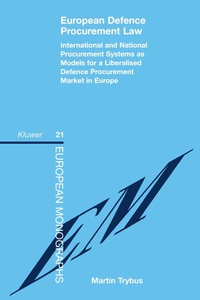
European Defence Procurement Law
International and National Procurement Systems as Models for a Liberalised Defence Procurement Market in Europe
Published on 1. July 1999
374 pages
978-90-411-7594-6 (ISBN)
Description

This book analvses in detail the current legal rules on defence procurement within the European Union, the limited regulatory efforts of the Western European Union. and the defence procurement regimes of three major states. France. Germany and the United Kingdom. Using these various models. and also the current regime governing civil procurement in the European Union, the book then examines the legal problems of developing a pan-European code on defence procurement, and suggests how these problems might be resolved.
This excellent and timely contribution to the literature not only offers a comprehensive and authoritative analysis of the legal issues involved In liberalising defence procurement, but also provides stimulating suggestions on constructing a suitable regime. Whatever the eventual solution to the problems facing the European defence industry. there is no doubt that this book will make an important contribution to the policy debate.
This excellent and timely contribution to the literature not only offers a comprehensive and authoritative analysis of the legal issues involved In liberalising defence procurement, but also provides stimulating suggestions on constructing a suitable regime. Whatever the eventual solution to the problems facing the European defence industry. there is no doubt that this book will make an important contribution to the policy debate.
More details
Other editions
Additional editions
Martin Trybus
European Defence Procurement Law:International and National Procurement Systems As Models for a Liberalised Defence Procurement Market in Europe
International and National Procurement Systems as Models for a Liberalised Defence Procurement Market in Europe
Book
07/1999
1st Edition
Kluwer Law International
€100.05
Shipment within 10-20 days
Content
- Cover
- Half Title Page
- Title Page
- Copyright Page
- Table of Contents
- Foreword
- Acknowledgements
- Abbreviations
- Table of Cases
- Table of Legislation
- Introduction
- Part I THE BACKGROUND TO EUROPEAN DEFENCE PROCUREMENT
- Chapter 1 The Current Position and Future Prospects of Defence Procurement in Europe
- 1.1. Difficulties Arising in Attempting to Liberalise Defence Purchasing within Europe
- 1.1.1. Economic Reasons
- 1.1.2. Political Reasons
- 1.1.3. Historical Reasons
- 1.1.4. Organisational and Legal Reasons
- 1.1.4.1. "Bottom-up" Approaches
- 1.1.4.2. Lack of Remedies
- 1.1.4.3. Exclusions
- 1.2. Measures already Taken
- 1.2.1. The European Defence Community Initiative of 1950
- 1.2.2. The European Union (EU)
- 1.2.3. The Western European Union (WEU)
- 1.2.4. The Organisation for Joint Armaments Cooperation (OCCAR)
- 1.3. Prospects of Further Liberalisation in the Near Future
- 1.3.1. Models of Organisation
- 1.3.1.1. The Minimal Solution: Separate Procurement with Common Rules
- 1.3.1.2. A Mixed Solution: Separate Procurement Combined with Common Procurement with Common Rules
- 1.3.1.3. A Far-Reaching Model: Common Procurement with Common Rules
- 1.3.1.4. The Maximum Solution: Common Procurement with Common Rules For a Common Army
- 1.3.2. Influences
- 1.4. Characteristics of Defence Procurement
- 1.4.1. Economic Characteristics
- 1.4.2. Political Characteristics
- 1.4.3. Technological Characteristics
- 1.4.3.1. Off-the-Shelf Purchases
- 1.4.3.2. Research and Development Procurement
- 1.5. Conclusions
- Part II THE WESTERN EUROPEAN ARMAMENTS GROUP AND THE EUROPEAN DEFENCE EQUIPMENT MARKET AS A MODEL FOR REGULATING DEFENCE PROCUREMENT
- Chapter 2 A Critical Analysis of the European Defence Equipment Market
- 2.1. Introduction
- 2.1.1. Right Membership
- 2.1.2. Expertise
- 2.1.3. All-Alliance Aspect
- 2.2. Organisation
- 2.3. Procurement Regulation?
- 2.3.1. Contracts Covered
- 2.3.1.1. Thresholds
- 2.3.1.2. Exceptions
- 2.3.2. Principles of Contract Awards
- 2.3.3. Procedures
- 2.3.3.1. Contract Bulletins
- 2.3.3.2. Declaration of Interest
- 2.3.4. Contract Award Criteria
- 2.3.4.1. Most Economic Solution
- 2.3.4.2. Contribution to the European Technological Base
- 2.3.5. Enforcement
- 2.4. Conclusions
- Part III THE EC PROCUREMENT REGIME AS A POSSIBLE MODEL FOR DEFENCE PROCUREMENT REGULATION
- Chapter 3 The EC Public Sector Procurement Regime
- 3.1. Introduction
- 3.2. The Detailed Rules on the Purchase of Supplies under the Directives
- 3.2.1. Definition of Performances
- 3.2.2. Principles of Contract Awards
- 3.2.3. Procedures
- 3.2.3.1. Open Procedure
- 3.2.3.2. Restricted Procedure
- 3.2.3.3. Negotiated Procedures
- 3.2.4. Criteria for the Rejection of Suppliers
- 3.2.4.1. Minimum Standards
- 3.2.4.2. Financial Standing and Technical Capacity
- 3.2.5. Evaluation of Bids
- 3.2.6. Activities after the Submission of Tenders
- 3.2.7. Information to be Given to Bidders
- 3.3. Enforcement
- 3.3.1. General Principles of Remedies for Breach of European Community Law
- 3.3.2. The Public Sector Remedies Directive
- 3.3.3. Enforcement by the Commission
- 3.4. Conclusions
- Chapter 4 The EC Utilities Procurement Regime
- 4.1. Introduction
- 4.2. The Detailed Rules on the Purchase of Supplies under the Utilities Directive
- 4.2.1. Definition of Performances
- 4.2.2. Principles of Contract Awards
- 4.2.3. Procedures
- 4.2.3.1. Open Procedure
- 4.2.3.2. Restricted Procedure
- 4.2.3.3. Negotiated Procedures
- 4.2.4. Criteria for the Rejection of Suppliers
- 4.2.5. Evaluation of Bids
- 4.2.6. Activities after the Submission of Tenders
- 4.2.7. Information to be Given to Bidders
- 4.3. Enforcement
- 4.4. Conclusions
- Chapter 5 Defence Procurement and the EC Treaty
- 5.1. Introduction
- 5.2. Interaction of a Liberalised Defence Procurement Regime with the EC Treaty
- 5.2.1. Competition Law: Articles 81 and 82 EC
- 5.2.1.1. Problems of Competition Law in the Defence Sector
- 5.2.1.2. Application of Articles 81 and 82 EC to the Defence Sector
- 5.2.2. Merger Control
- 5.2.2.1. Application to the Defence Equipment Industry
- 5.2.2.2. Application of the Legitimate-Interests Exception
- 5.2.2.3. Mergers and the Defence-Industrial Base
- 5.2.3. Exports
- 5.2.4. Subsidies
- 5.3. Conclusions
- Part IV NATIONAL DEFENCE PROCUREMENT SYSTEMS AS A MODEL FOR A COMMON REGIME
- Chapter 6 France: Defence Procurement on a Regulated Basis
- 6.1. Introduction
- 6.1.1. Policy Issues
- 6.1.2. The French Armed Forces
- 6.1.3. The French Defence Industry
- 6.1.4. Procurement Regulation
- 6.2. Organisation and Responsibilities
- 6.3. Defence Procurement Law
- 6.3.1. Introduction
- 6.3.1.1. The Constitution
- 6.3.1.2. Statutory Law
- 6.3.1.3. Case Law
- 6.3.1.4. Detailed Rules on Defence Procurement
- 6.3.2. The Government Procurement Code
- 6.3.2.1. Definition of Performances
- 6.3.2.2. Principles of Contract Awards
- 6.3.2.3. Procedures
- 6.3.2.4. Criteria for the Rejection of Suppliers
- 6.3.2.5. Evaluation of Bids
- 6.3.2.6. Information to be Given to Bidders
- 6.3.3. Regulation of Contracts
- 6.3.4. Enforcement and Remedies
- 6.3.4.1. Summary Proceedings
- 6.3.4.2. Claims for Damages
- 6.3.4.3. Other Enforcement Measures
- 6.4. Conclusions
- Chapter 7 Germany: Defence Procurement on a Semi-Regulated Basis
- 7.1. Introduction
- 7.1.1. Policy Aspects
- 7.1.2. The Federal Defence Forces
- 7.1.3. The German Defence Industry
- 7.1.4. Defence Procurement Regulation
- 7.2. Organisation and Responsibilities
- 7.3. Defence Procurement Law
- 7.3.1. Introduction: the Sources of Defence Procurement Law
- 7.3.1.1. Constitutional Law
- 7.3.1.2. Statutory Law
- 7.3.1.3. Regulations
- 7.3.2. The Detailed Rules on the Purchase of Hard-Defence Material under the VOL/A without "a-paragraphs
- 7.3.2.1. Definition of Performances
- 7.3.2.2. Principles of Contract Awards
- 7.3.2.3. Procedures
- 7.3.2.4. Cancellation of the Advertising Procedures
- 7.3.2.5. Criteria for the Rejection of Suppliers
- 7.3.2.6. Evaluation of Bids
- 7.3.2.7. Information to be given to Bidders
- 7.3.3. Regulation of Contracts
- 7.3.4. Enforcement
- 7.4. Conclusions
- Chapter 8 United Kingdom: Defence Procurement on a Non-regulated Basis
- 8.1. Introduction
- 8.1.1. Policy Aspects
- 8.1.2. Defence Forces
- 8.1.3. The UK Defence Industry
- 8.1.4. Defence Procurement Regulation
- 8.2. Organisation and Responsibilities
- 8.2.1. The Procurement Executive
- 8.2.2. The Single Services
- 8.2.3. Local Purchases
- 8.2.4. Defence Agencies
- 8.2.5. Construction Industry Contracts
- 8.3. Defence Procurement Law
- 8.3.1. Introduction
- 8.3.2. The United Kingdom Defence Procurement Regime
- 8.3.2.1. Definition of Performances
- 8.3.2.2. Principles of Contract Awards
- 8.3.2.3. Procedures
- 8.3.2.4. Criteria for the Rejection of Suppliers
- 8.3.2.5. Evaluation of Bids
- 8.3.2.6. Activities after the Submission of Tenders
- 8.3.2.7. Information to be Given to Bidders
- 8.3.3. Enforcement and Remedies
- 8.4. Conclusions
- Part V A EUROPEAN DEFENCE PROCUREMENT CODE
- Chapter 9 The Background to a European Defence Procurement Code
- 9.1. Policy Issues
- 9.2. The Armed Forces
- 9.3. The Defence Industries
- 9.4. Legal Issues
- 9.4.1. Defence Procurement Regulation?
- 9.4.2. The Legal Background to a European Defence Procurement Code
- 9.4.2.1. The Constitutional Level
- 9.4.2.2. Related Statutory Frameworks
- Chapter 10 The Coverage and Principles of a European Defence Procurement Code
- 10.1. Definition of Contracts Covered
- 10.1.1. Authorities Covered
- 10.1.2. Type of Supplies Covered
- 10.1.3. Exclusions
- 10.2. Principles of Contract Awards
- Chapter 11 Award Procedures under a European Defence Procurement Code
- 11.1. Open Tendering Procedures
- 11.2. Selective Procedures
- 11.3. Negotiated Procedures
- 11.3.1. Different Forms of Negotiated Procedure
- 11.3.1.1. Negotiated Procedure without Competition
- 11.3.1.2. Negotiated Procedure with Competition
- 11.3.2. Selective and Negotiated Procedures and the Defence Sector
- 11.3.3. Negotiated Procedures in a European Defence Procurement Code
- 11.3.3.1. Pre-Phase Feasibility Study
- 11.3.3.2. Research and Development Phases
- 11.3.3.3. Production Phase
- 11.3.3.4. Conclusions
- 11.3.4. Detailed Circumstances Allowing the Use of the Negotiated Procedure Without Competition
- 11.3.4.1. Internationally Common Grounds
- 11.3.4.2. Military-Specific Grounds
- 11.3.4.3. Utility-Specific Grounds
- 11.3.4.4. Grounds Specific for Only One System
- 11.3.4.5. Conclusions
- 11.4. Criteria for the Rejection of Suppliers
- 11.4.1. Financial and Technical Standing
- 11.4.2. Other Minimum Standards and Registration
- 11.4.3. European Defence Contractors List
- 11.5. Evaluation of Bids
- 11.6. Activities after the Submission of Tenders
- 11.7. Information to be Given to Bidders
- 11.8. European Preference
- Chapter 12 Enforcement and Remedies under a European Defence Procurement Code
- 12.1. Non-financial Relief
- 12.2. Damages
- 12.3. Other Means of Enforcement
- 12.4. Conclusions
- Conclusions
- Select Bibliography
- Index
- Back Cover
