
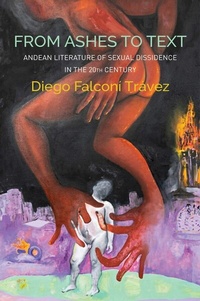
From Ashes to Text
Description
Alles über E-Books | Antworten auf Fragen rund um E-Books, Kopierschutz und Dateiformate finden Sie in unserem Info- & Hilfebereich.
According to some chronicles of the Spanish Conquest, the violent arrival of the Conquerors to the Andes in the sixteenth century led to sex-dissident people who lived outside the dominant European cisheteropatriarchal model being burned at the stake. This act burned more than the flesh; it also charred practices, ways of life, and textualities, leaving an emptiness and a trauma that would mark the future literatures of the Andean region.
This book cannot repair those pre-sodomite texts and bodies. It seeks instead to reconsider the value of the ash, a metaphor that allows for a critical and contradictory reading of sexual dissidences in the Andean region in the twentieth century, beyond both multiculturalism and the wake of a globalized LGBTI movement. Through a comparative analysis, and drawing on theoretical perspectives such as anticoloniality, feminisms, and cuir (rather than queer) theories, the book aims to understand the value of a series of complex texts in which dissident subjectivities, practices, and desires help to broaden the understanding of the Andean.
Winner of the prestigious Casa de las Américas prize, the book was praised by the jury for the paradoxical and provocative way that it struggles against the abyss of past destruction and reflects on the contribution of the Global South to the often uniformist thinking around the body and its intersections.
All prices
More details
Other editions
Additional editions
Persons
Diego Falconí Trávez is an Associate Professor at the Universitat Autònoma de Barcelona, and Professor at the Universidad San Francisco de Quito.
Content
Foreword - Joseph Pierce
Instructions for Reading this Book: By Way of an Introduction
1. Re-sent(I)Ment of the Andean Literary Canon: Proposal for a Heterofagcontradictory Reading through Pablo Palacio
2. Mestizaje's Back Door: Crossings in the Narrative of Jaime Bayly, from Homo to Gay to Bi
3. Julieta Paredes: Rearranging the Lesbian Aymara Body through Devilish Writing
4. Writing at the Andean Limits: Decadence, Migration and Aids-Reciprocity in the Writing of Fernando Vallejo's I
5. From Queer to Cuy(R)? The Bewitching Proposal to Entundar in the Literature of Adalberto Ortiz

System requirements
File format: PDF
Copy-Protection: Adobe-DRM (Digital Rights Management)
System requirements:
- Computer (Windows; MacOS X; Linux): Install the free reader Adobe Digital Editions prior to download (see eBook Help).
- Tablet/smartphone (Android; iOS): Install the free app Adobe Digital Editions or the app PocketBook before downloading (see eBook Help).
- E-reader: Bookeen, Kobo, Pocketbook, Sony, Tolino and many more (only limited: Kindle).
The file format PDF always displays a book page identically on any hardware. This makes PDF suitable for complex layouts such as those used in textbooks and reference books (images, tables, columns, footnotes). Unfortunately, on the small screens of e-readers or smartphones, PDFs are rather annoying, requiring too much scrolling.
This eBook uses Adobe-DRM, a „hard” copy protection. If the necessary requirements are not met, unfortunately you will not be able to open the eBook. You will therefore need to prepare your reading hardware before downloading.
Please note: We strongly recommend that you authorise using your personal Adobe ID after installation of any reading software.
For more information, see our eBook Help page.
File format: PDF
Copy protection: without DRM (Digital Rights Management)
System requirements:
- Computer (Windows; MacOS X; Linux): Use the free software Adobe Reader, Adobe Digital Editions, or any other PDF viewer of your choice (see eBook Help).
- Tablet/Smartphone (Android; iOS): Install the free app Adobe Digital Editions or another reading app for eBooks, e.g., PocketBook (see eBook Help).
- E-reader: Bookeen, Kobo, Pocketbook, Sony, Tolino and many more (only limited: Kindle).
The file format PDF always displays a book page identically on any hardware. This makes PDF suitable for complex layouts such as those used in textbooks and reference books (images, tables, columns, footnotes). Unfortunately, on the small screens of e-readers or smartphones, PDFs are rather annoying, requiring too much scrolling.
This eBook does not use copy protection or Digital Rights Management.
For more information, see our eBook Help page.