

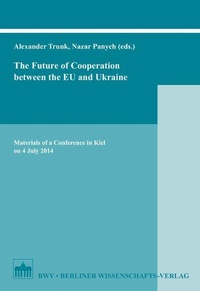
The Future of Cooperation between the EU and Ukraine
Materials of a Conference in Kiel on 4 July 2014
1st Edition
Published on 17. March 2016
94 pages
978-3-8305-2114-3 (ISBN)
Description

Since the outbreak of the Ukrainian crisis in late 2013, relations between the EU and Ukraine have changed fundamentally. The Ukrainian crisis has developed into a deep conflict between "the West" and Russia. In 2014 the EU and Ukraine signed the Association Agreement, and the EU has promised strong support of Ukraine's inner reforms with a view to further approximation to the EU.°°°°The present volume contains presentations held at an interdisciplinary Conference organized by the Institute of East European Law at the University of Kiel in 2014. It includes presentations by diplomats from the EU, Germany and Ukraine as well asanalyses by political scientists, economists and lawyers. Some papers give a general overview and also show certain differences in the evaluation of developments. Other papers deal with more specific issues, illustrating both the complexity of Ukrainianreforms and the need for a more coherent and effective support strategy of the EU. The purpose of the volume is to give a structured and balanced picture of the present stateof EU-Ukrainian relations with a view to future perspectives. For the publication, the papers have been updated and a post-script has been added.°°
More details
Other editions
Additional editions
Alexander Trunk | Nazar Panych
The Future of Cooperation between the EU and Ukraine
Materials of a Conference in Kiel on 4 July 2014
Book
01/2015
1st Edition
Berliner Wissenschafts-Verlag
€22.00
Shipment within 7-9 days
Persons
Content
- Intro
- Content
- Foreword
- Welcome address Bernd Heinemann
- Welcome address Gunnar Wiegand
- Part I: Political Issues
- Relations between the EU and Ukraine after the signature of the Association Agreement - Which Way Forward? The Perspective of the European Union (Gunnar Wiegand)
- Relations between the EU and Ukraine after the signature of the Association Agreement: The Ukrainian view (Vasyl Khymynets)
- Relations between the EU and Ukraine after the signature of the Association Agreement: A View from German Diplomacy (Detlev Wolter)
- Part II: Economic Issues
- An Economic Analysis of the Probable Effects of the Proposed AA/DCFTA with the EU upon Ukraine (Esther Ademmer and Matthias Lücke)
- 1. Why do countries conclude Preferential Trade Agreements (PTAs)? With which countries should Ukraine have PTAs?
- 2. Economic effects of the proposed EU-Ukraine DCFTA
- 3. The proposed DCFTA and economic reforms in Ukraine
- 4. Should Ukraine join the Customs Union to obtain cheap natural gas from Russia?
- Some Words on the DCFTA Part of the Association Agreement and on the EU Support Group for Ukraine (Philippe Cuisson)
- Part III: Legal Issues - General Aspects
- Overview of the EU-Ukraine Association Agreement in the Context of European Neighbourhood Policy Documents with a View to Future Possible Forms of Cooperation (Narine Ghazaryan)
- The Supranational Character of the European Unions's Associations with Third Countries
- I. Introduction
- II. The Association Agreements as legal instruments for the incorporation of the EU acquis into the legal order of third countries
- III. The supranational character of the harmonization of legislation of the associated countries
- IV. The supranationality of the association institutions
- V. Conclusions
- Part IV: Legal Issues - Particular Aspects of the Association Agreement
- The Impact of the Association Agreement with the EU on the Development of the Private Law of Ukraine (Roman Maydanyk)
- I. Micro-level implementation of the Agreement associating Ukraine and EU
- II. Macro level implementation of the Association Agreement of Ukraine and the EU
- The Long and Winding Road to a "Stake in the Internal Market" under the Association Agreement between the EU and Ukraine - with a Particular Focus on Telecommunication Services (Olga Batura and Olga Kretova)
- 1. Introduction
- 2. The scope of approximation
- 3. Substantive provisions to be transposed and Ukrainian ability to absorb
- a) Independent market regulator
- b) Access to the market: Authorisation regime
- c) Regulation of interconnection
- d) Access to and use of scarce resources
- e) Provision of universal service
- 4. Prospects of the stake in the internal market
- The regulation of trade disputes under the Association Agreement between the European Union and its Member States, of the one part, and Ukraine, of the other part (Elena Kostadinova)
- Part V: Research and Education
- Strengthening Ukrainian Universities - How May the West be of Use? (Fryderyk Zoll)
- 1. The role of universities in the reform of the legal system
- 2. The risk of make-believe reforms
- 3. How support for Ukrainian universities should look like
- 4. Conclusion
- Part VI: Post-Script
- EU-Ukrainian relations - Developments since the Kiel Conference 2014 (Alexander Trunk and Nazar Panych)
- List of Contributors
