

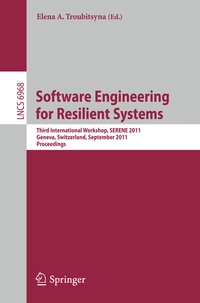
Software Engineering for Resilient Systems
Third International Workshop, SERENE 2011, Geneva, Switzerland, September 29-30, 2011, Proceedings
Published on 25. September 2011
X, 165 pages
978-3-642-24124-6 (ISBN)
Description

This book constitutes the refereed proceedings of the Third International Workshop on Software Engineering for Resilient Systems, SERENE 2011, held in Geneva, Switzerland, in September 2011.
The 13 revised full papers presented together with 2 invited talks were carefully reviewed and selected from numerous submissions. The papers address all aspects of formal modeling and verification, architecting resilient systems, fault tolerance, requirements engineering and product lines, monitoring and self-adaption, and security and intrusion avoidance.
The 13 revised full papers presented together with 2 invited talks were carefully reviewed and selected from numerous submissions. The papers address all aspects of formal modeling and verification, architecting resilient systems, fault tolerance, requirements engineering and product lines, monitoring and self-adaption, and security and intrusion avoidance.
More details
Other editions
Additional editions
Elena A. Troubitsyna
Software Engineering for Resilient Systems
Third International Workshop, SERENE 2011, Geneva, Switzerland, September 29-30, 2011, Proceedings
Book
09/2011
Springer
€53.49
Shipment within 7-9 days
Content
- Title
- Preface
- Organization
- Table of Contents
- Invited Talk
- Preliminary Interdependency Analysis (PIA): Method and Tool Support
- Introduction
- Method: Preliminary Interdependency Analysis (PIA)
- PIA Model Architecture: Two Levels of Abstraction
- PIA Stages
- Stage 1
- Stage 2
- Stage 3
- Stage 4
- Stage 5
- Stage 6
- Stage 7
- References
- Formal Modelling and Verification
- Use Case Scenarios as Verification Conditions: Event-B/Flow Approach
- Introduction
- Event-B
- Motivation
- Flow Language
- Flow theorems
- Graphical Notation
- Structuring
- Case Study
- Use Case 1: File Look-Up After Addition
- Use Case 2: Idempotent Requests
- Use Case 3: File May Be Read If Found
- Conclusion
- References
- Quantitative Verification of System Safety in Event-B
- Introduction
- Modelling in Event-B
- Safety Analysis in Event-B
- Case Study
- Discussion
- Related Work
- Conclusions
- References
- Experience-Based Model Refinement
- Introduction
- Motivating Example
- Model Transformation
- Failure and Correction of the Transformation
- Lessons Learned
- Proposed Methodology
- Related Work
- Conclusion and Future Work
- References
- Architecting Resilient Systems
- Architecting Resilient Computing Systems: Overall Approach and Open Issues
- Introduction
- Problem Statement
- Our Approach
- Description of the Frame of Reference
- Fault Tolerance Mechanisms
- System Evolution
- Development Process
- Classification of Fault Tolerance Mechanisms
- Description of Design Patterns for Fault Tolerance
- Runtime Support and Reconfiguration
- Transitions between Mechanisms
- Case Study
- Related Works
- Conclusion and Perspectives
- References
- Supporting Architectural Design Decisions Evolution through Model Driven Engineering
- Introduction
- Background and Motivation
- Supporting Design Decisions Evolution
- ADDMM: A Metamodel for Supporting Design Decisions Evolution
- Tracing Design Decisions to/from other Artifacts
- Evolution Impact Analysis
- Prototype Implementation
- Models and Metamodels Implementation
- Seamless Visualization of Architectural Artifacts
- Evolution Analysis Implementation
- Related Work
- Conclusion and Future Work
- References
- Fault Tolerance
- On Enabling Dependability Assurance in Heterogeneous Networks through Automated Model-Based Analysis
- Introduction and Background
- The SAN Formalism
- Library of Dependability Mechanisms
- Retry Mechanism
- Probing Mechanism
- Majority Voting Mechanism
- Error Correction Mechanism
- Security Mechanism
- Case Study
- Specification
- SAN Models
- Analysis
- Related Work and Conclusions
- References
- Supporting Cross-Language Exception Handling When Extending Applications with Embedded Languages
- Introduction
- Related Work
- Implementation Approach
- Conclusions
- References
- Requirements Engineering and Product Lines
- Guaranteeing Correct Evolution of Software Product Lines: Setting Up the Problem
- Introduction
- Problem Setting
- Proposed Solution
- Conclusion and Future Work
- References
- Idealized Fault-Tolerant Components in Requirements Engineering
- Introduction
- Idealized Fault-Tolerant Components in DREP
- IFTCs in DREP
- IFTC Exceptions in DREP
- Mapping Summary
- Related Work
- Discussion
- References
- Invited Talk
- Predictability and Evolution in Resilient Systems
- System Resilience, Robustness and Sustainability
- Compositions of System and Software Attributes Limitations
- Software Evolvability Analysis and Resilience Property
- References
- Monitoring and Self-adaptation
- Self-organising Pervasive Ecosystems: A Crowd Evacuation Example
- Introduction
- Architecture
- Eco-law Language
- A Crowd Evacuation Application
- Types of LSAs in the System
- Building the Fire, Exit and Crowding Gradients
- Ranking Escape Paths: The Attractiveness Field
- Choosing a Direction
- Resilient Behaviour
- Simulation
- The Simulator
- Simulation Setting
- Tuning Parameters
- Resilience to Node Failures
- Related Works
- Conclusions
- References
- Towards a Model-Driven Infrastructure for Runtime Monitoring
- Introduction
- Property Meta-model
- GLIMPSE Architecture
- Property-Driven Monitoring Configuration
- Application Example
- Related Work
- Conclusions
- References
- Security and Intrusion Avoidance
- Using Diversity in Cloud-Based Deployment Environment to Avoid Intrusions
- Introduction
- Intrusion-Avoidance Architecture
- Diversity of Deployment Environment
- Intrusion-Avoidance Architecture Making Use of System Components Diversity
- Demonstration and Simulation
- Vulnerability Databases
- Operating Systems Vulnerability Analysis
- Simulation of Dynamic Reconfiguration Strategy Making Use of Operating System Diversity
- Conclusions
- References
- 'Known Secure Sensor Measurements' for Critical Infrastructure Systems: Detecting Falsification of System State
- Introduction
- Technical Objectives and Research Approach
- Targeted Facilities
- KSSM System Hypotheses
- KSSM Sensor
- KSSM and Attacker Scenarios
- Attack Scenarios
- KSSM Control Room Module
- Conclusion
- References
- Author Index
