

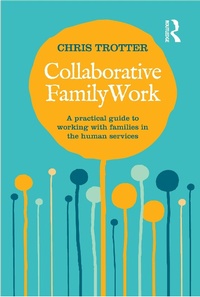
Collaborative Family Work
A practical guide to working with families in the human services
1st Edition
Published on 13. August 2020
248 pages
978-1-000-24905-7 (ISBN)
Description

Life can be a struggle for some families and support from skilled human service workers can make a real difference.
Collaborative Family Work offers practical strategies for working with families, always emphasising the importance of collaboration in assisting them in developing strategies to learn new skills and improve their lives. Chris Trotter explains how to identify strengths, assist families in setting goals, articulate strategies for change and develop methods of ongoing evaluation.
He offers a systematic overview of family work models and theories, from long-term therapeutic and narrative approaches to short-term solution-focused and mediation models. His evidence-based model for family work draws on extensive field research and observation with experienced professionals.
Collaborative Family Work is a valuable reference for professionals seeking to enhance their professional skills, and an essential text for students in the human services.
'Chris Trotter addresses the ''how'' of practice in a field that is often stronger on general principles than it is on practical detail.' - Dr Chris Beckett, University of East Anglia, UK
Collaborative Family Work offers practical strategies for working with families, always emphasising the importance of collaboration in assisting them in developing strategies to learn new skills and improve their lives. Chris Trotter explains how to identify strengths, assist families in setting goals, articulate strategies for change and develop methods of ongoing evaluation.
He offers a systematic overview of family work models and theories, from long-term therapeutic and narrative approaches to short-term solution-focused and mediation models. His evidence-based model for family work draws on extensive field research and observation with experienced professionals.
Collaborative Family Work is a valuable reference for professionals seeking to enhance their professional skills, and an essential text for students in the human services.
'Chris Trotter addresses the ''how'' of practice in a field that is often stronger on general principles than it is on practical detail.' - Dr Chris Beckett, University of East Anglia, UK
More details
Edition
1. Auflage
Language
English
Place of publication
London
United Kingdom
Publishing group
Taylor & Francis Ltd
Target group
College/higher education
ISBN-13
978-1-000-24905-7 (9781000249057)
Copyright in bibliographic data and cover images is held by Nielsen Book Services Limited or by the publishers or by their respective licensors: all rights reserved.
Schweitzer Classification
Other editions
Additional editions
Chris Trotter
Collaborative Family Work
A practical guide to working with families in the human services
Book
03/2021
1st Edition
Routledge
€189.30
Shipment within 15-20 days
Chris Trotter
Collaborative Family Work
A practical guide to working with families in the human services
Book
05/2013
1st Edition
Allen & Unwin
€56.10
Shipment within 3-4 weeks
Person
Chris Trotter is Professor in Social Work at Monash University. He has an international reputation for his research on family work, offender supervision and pro-social modelling. He is author of Working with Involuntary Clients and Helping Abused Children and their Families, and his books have been translated into German, Japanese and Chinese.
Content
Figures
Acknowledgements
1 Introduction: Why Collaborative Family Work?
2 Family work models and theories
3 The Collaborative Family Work model
4 Preparing families for family work and developing ground rules
5 Identifying issues to work on and focusing on strengths
6 Deciding what to work on first and setting goals
7 Problem exploration and developing strategies
8 Reviewing and concluding the family work sessions
References
Index
Acknowledgements
1 Introduction: Why Collaborative Family Work?
2 Family work models and theories
3 The Collaborative Family Work model
4 Preparing families for family work and developing ground rules
5 Identifying issues to work on and focusing on strengths
6 Deciding what to work on first and setting goals
7 Problem exploration and developing strategies
8 Reviewing and concluding the family work sessions
References
Index
