

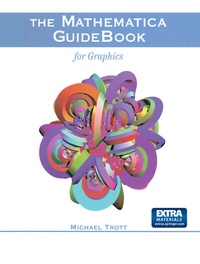
The Mathematica GuideBook for Graphics
Description

Mathematica is today's most advanced technical computing system. It features a rich programming environment, two-and three-dimensional graphics capabilities and hundreds of sophisticated, powerful programming and mathematical functions using state-of-the-art algorithms. Combined with a user-friendly interface, and a complete mathematical typesetting system, Mathematica offers an intuitive, easy-to-handle environment of great power and utility.
The Mathematica Guidebook for Graphics provides a comprehensive step-by-step development of how to use Mathematica to visualize functions and data, manipulate graphics, and optimize their appearance. Two-dimensional graphics, contour plots, plots of surfaces, free-form three-dimensional surfaces, and animations are the core topics. Hundreds of detailed examples and programs show a large variety of visualization techniques, algorithms, methods, and tricks. These tools allow the reader to create virtually any possible graphic, from simple curves to scientific visualizations and artistic images and logos. Mathematica graphics functions are discussed in detail, explained in numerous examples, and put to work in programs that are all contained on the accompanying DVD.
Unique Features:
* Step-by-step introductions to all of Mathematica graphics capabilities
* Comprehensive presentation of two-and three-dimensional graphics primitives and directives, as well as plotting capabilities for functions and data
* Hundreds of unique and innovative scientific visualizations and artistic images
* Website for book with additional materials and updates:
http://www.MathematicaGuideBooks.org
* Accompanying DVD contains all material as an electronic book with complete, executable Mathematica versions 4 and 5 compatible code and programs, rendered color graphics, and animations
Michael Trott is a symbolic computation and computer graphics expert. He holds a Ph.D. in theoretical physics and joined the R&D team at Wolfram Research in 1994, the creators of Mathematica. Since 1998, he has been leading development of the Wolfram Functions Site http://functions.wolfram.com, which currently features more that 80,000 formulas and identities, and thousands of visualizations.
Reviews / Votes
From the reviews:
"Through an abundance of examples, this volume teaches the reader how to use Mathematica to visualize functions and data, manipulate graphics, and optimize their appearance. . the graphics GuideBook confronts you with a huge collection of 2D graphics, contour plots, plots of surfaces, free-form 3D surfaces, and animations. Hundreds of detailed examples and programs . illustrate visualization techniques, methods, and algorithms." (Willy Hereman, SIAM Review, Vol. 47 (4), 2005)
More details
Other editions
Additional editions
Content
1. Two-Dimensional Graphics
2. Three-Dimensional Graphics
3. Contour and Density Plots
