

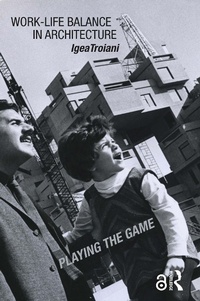
Work-Life Balance in Architecture
Playing the Game
1st Edition
Published on 4. March 2024
264 pages
978-1-351-19982-7 (ISBN)
Description

This book seeks to improve the work lives of architects of diverse demographics who do not fit, or want to replicate, the traditional '24/7' white-male architect lifestyle. Aimed at a workforce whose life and career expectations have changed drastically in recent years, it helps readers of different generations to make informed choices about their careers - enabling students, educators, and professionals to prioritise wellbeing and offer their design and practice voice to enhance a built environment for all.
Work-Life Balance in Architecture examines what it means to play the 'game of architecture' - to choose to study and pursue a career in architecture rather than another profession. The book shows the economic, social, and professional structures within which architectural education and practice operate and reveals the impact of a corporate, neoliberal 'big business' mentality on wellbeing.
After setting out the context exacerbating work-life imbalance, the book discusses the paths an architect may take - whether this leads to a career in practice or not in architecture at all - and how alternative gameplay moves can advantage or disadvantage those of different gender, class, ethnicity, race, or age at different career stages. It concludes by examining how the places in which an architect works, the time available to work and critiques of perpetual neoliberal economic growth can enhance the lives of all architects today.
Work-Life Balance in Architecture examines what it means to play the 'game of architecture' - to choose to study and pursue a career in architecture rather than another profession. The book shows the economic, social, and professional structures within which architectural education and practice operate and reveals the impact of a corporate, neoliberal 'big business' mentality on wellbeing.
After setting out the context exacerbating work-life imbalance, the book discusses the paths an architect may take - whether this leads to a career in practice or not in architecture at all - and how alternative gameplay moves can advantage or disadvantage those of different gender, class, ethnicity, race, or age at different career stages. It concludes by examining how the places in which an architect works, the time available to work and critiques of perpetual neoliberal economic growth can enhance the lives of all architects today.
Reviews / Votes
"A sharp critique of the architecture profession's exploitative tendencies, examining how neoliberal policies and entrenched cultural norms have shaped the way architects live and work. Troiani effectively exposes the contradictions within an industry that prides itself on creativity yet often stifles personal wellbeing in pursuit of output and efficiency. Her examination of how architectural culture has normalised overwork is particularly compelling, shedding light on an issue that has long been accepted as an unfortunate but inevitable reality of the profession."Chloe Naughton, ArchitectureAu.
"Igea Troiani's 'Work-Life Balance in Architecture: Playing the Game' combines a chastening rehearsal of what is already known -but all too often covered up-about the education and practices of architects, with a wide-ranging exploration of tactics that could change our own practices or those affected by them. Both political and practical, this book makes the tacit 'rules' of this game explicit, allowing students, educators and practitioners to play better or differently, and to challenge the structural, institutional frameworks behind these rules."
Stephen Walker, Professor of Architectural Humanities, University of Manchester.
"It was heartwarming to see the photo on the cover which, in many ways, captures so much about my close relationship with my father. The topic of your book really hit home as a daughter of an architect (Moshe Safdie) and a mother of three children. I spent much of my childhood immersed in architecture as a way for my father to spend time with me. Being married to an architect has made a work/life balance a constant challenge and a frequent subject in our lives...."
Taal Safdie, Principal, Safdie Rabines Architects.
"This book totally understands its audience - those who are thinking of going into architecture, or moving to a different architectural office, or searching for a different type of work - and describes exactly why they should have no illusions about finding a personal calling. As Troiani lays out with a masterful combination of intimate detail (much of practice in the UK is laid bare and Margaret Thatcher skewered) and theoretical expansiveness (Michel Foucault, David Harvey, Jonathan Crary, and Zygmunt Bauman are called upon), the profession's neoliberal turn is shown to stack the game of architectural life against us. It's not that the book is depressing; it just makes clear that architectural seekers should be alert to the ideological, political, and economic forces that limit personal autonomy. I'm not sure it is a rallying cry for a revolution, but its powerful critique is the ground work for necessary change in our profession."
Peggy Deamer, Professor Emerita, Yale School of Architecture and a founding member of The Architecture Lobby.
"This book is a timely reminder to reject the capitalist imposition that requires we measure our worth by metrics of productivity and career progression. It reminds us that sometimes the most daring act of resistance is to simply exist, and that we can start resisting by reclaiming the 'life' in the work/life balance."
Kudzai Matsvai, Building Design
More details
Edition
1. Auflage
Language
English
Place of publication
London
United Kingdom
Publishing group
Taylor & Francis Ltd
Target group
College/higher education
Professional and scholarly
Illustrations
18 Halftones, black and white; 18 Illustrations, black and white
ISBN-13
978-1-351-19982-7 (9781351199827)
Copyright in bibliographic data and cover images is held by Nielsen Book Services Limited or by the publishers or by their respective licensors: all rights reserved.
Schweitzer Classification
Other editions
Additional editions
Book
03/2024
1st Edition
Routledge
€63.40
Shipment within 15-20 days
Book
03/2024
1st Edition
Routledge
€207.80
Shipment within 15-20 days
Person
Australian born, Igea Troiani (PhD) is a Professor of Architecture and Head of Division of Architecture at London South Bank University. She has taught or practiced architecture in Australia, Germany, China, and the United Kingdom. As a practice-centred academic, her research over the last 26 years has focused on the production of the architect. She has authored five books, 50 articles and book chapters, and was editor-in-chief of Architecture and Culture from 2012-2022. She is a mother of two.
Content
Part 1. Life in Architecture under Neoliberalism 1. Work-life Imbalance in Architecture: An Introduction 2. Celebrity Architect as Homo Oeconomicus 3. Starting from a Different Position: Architect as Femina Domestica Part 2. Gameplay Moves: Become an Architect (or not) 4. The Freedom to Choose to study Architecture or Not 5. Academic Capitalism and Architectural Education 6. A Neoliberal Life in Architectural Practice Part 3. Work-life Balance in Architecture beyond Neoliberalism 7. The Sites of Neoliberal Architectural Labour: Work, Home, Everywhere 8. 24/7 Architectural Capitalism, No Time, No Sleep 9. Playing the Game of Life in Architecture beyond Neoliberal Capitalism
