


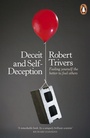
Deceit and Self-Deception
Fooling Yourself the Better to Fool Others
1st Edition
Published on 6. October 2011
416 pages
978-0-14-197106-3 (ISBN)
Description

In this foundational book, Robert Trivers seeks to answer one of the most provocative and consequential questions to face humanity: why do we lie to ourselves?
Deception is everywhere in nature. And nowhere more so than in our own species. We humans are especially good at telling others less - or more - than the truth. Why, however, would organisms both seek out information and then act to destroy it? In short, why practice self-deception?
After decades of research, Robert Trivers has at last provided the missing theory to answer these questions. What emerges is a picture of deceit and self-deception as, at root, different sides of the same coin. We deceive ourselves the better to deceive others, and thereby reap the advantages. From space and aviation disasters to warfare, politics and religion, and the anxieties of our everyday social lives, Deceit and Self-Deception explains what really underlies a whole host of human problems. But can we correct our own biases? Are we doomed to indulge in fantasies, inflate our egos, and show off? Is it even a good idea to battle self-deception?
With his characteristically wry and self-effacing wit, Trivers reveals how he finds self-deception everywhere in his own life, and shows us that while we may not always avoid it, we can now at least hope to understand it.
Deception is everywhere in nature. And nowhere more so than in our own species. We humans are especially good at telling others less - or more - than the truth. Why, however, would organisms both seek out information and then act to destroy it? In short, why practice self-deception?
After decades of research, Robert Trivers has at last provided the missing theory to answer these questions. What emerges is a picture of deceit and self-deception as, at root, different sides of the same coin. We deceive ourselves the better to deceive others, and thereby reap the advantages. From space and aviation disasters to warfare, politics and religion, and the anxieties of our everyday social lives, Deceit and Self-Deception explains what really underlies a whole host of human problems. But can we correct our own biases? Are we doomed to indulge in fantasies, inflate our egos, and show off? Is it even a good idea to battle self-deception?
With his characteristically wry and self-effacing wit, Trivers reveals how he finds self-deception everywhere in his own life, and shows us that while we may not always avoid it, we can now at least hope to understand it.
Reviews / Votes
This is a remarkable book, by a uniquely brilliant scientist. [It] is enlivened by Trivers' candid personal style, and is a pleasure to read. Strongly recommended. -- Richard Dawkins [A] startlingly original and important book that will start a global conversation. -- Richard Wrangham Great books contain important new ideas, and this book is no exception. What makes Trivers' book unusual even among great books is the density of new ideas. Striking observations and new twists on old themes are packed into every chapter...Entertaining and accessible. -- Willem von Hippel [A]n important contribution to psychology and social science more generally and will undoubtedly stimulate debate on these important questions. -- David Haig This is a remarkable book, by a uniquely brilliant scientist. Robert Trivers has a track record of producing highly original ideas, which have gone on to stimulate much research. His Darwinian theory of self-deception is arguably his most provocative and interesting idea so far, and he has chosen to present it at book length, in order to explore all the wide-ranging implications and ramifications, including those relevant to human social and even political affairs. The book is enlivened by Trivers' candid personal style, and is a pleasure to read. Strongly recommended. -- Richard Dawkins, Evolutionary Biologist; Emeritus Professor of the Public Understanding of Science, Oxford Remarkable ... It is up-to-date and comprehensive, and far more importantly it provides new insight on a wide variety of findings. Great books contain important new ideas, and this book is no exception. What makes Trivers' book unusual even among great books is the density of new ideas. Striking observations and new twists on old themes are packed into every chapter. Like other great popular press books in science, this book advances an important new idea in an entertaining and accessible manner. This book goes beyond that, however, by providing dozens of new hypotheses for those of us who have been laboring in this field for the last twenty years ... This book is not just exporting science to the lay public, but is also an important piece of scholarship. Indeed, the ideas in this book are on par with Trivers' classic work in the 1970's that completely changed the landscape of behavioral science, and I expect that this book will have a similarly broad and long-lasting impact. -- William von Hippel, Psychologist, University of Queensland This is an enjoyable, thought-provoking book on how our mind systematically creates distorted perceptions of reality and how these distort our presentation of self to others. We construct false internal narratives to present ourselves and our actions in a favorable light, and the same applies to the presentation of 'our side' and the 'other side' in political debates and in intranational and international conflicts. I believe the book is an important contribution to psychology and social science more generally and will undoubtedly stimulate debate on these important questions. -- David Haig, Professor of Biology, Harvard The problem of why natural selection favors dishonesty to oneself is as poorly understood as it is riveting. In Deceit and Self-Deception evolutionary biologist Robert Trivers uses examples from stick insects to international relations to guide us to the fundamental logic. The result is a startlingly original and important book that will start a global conversation on a topic of both scholarly and personal interest. -- Richard WranghamMore details
Language
English
Place of publication
London
United Kingdom
Target group
Professional and scholarly
College/higher education
File size
0,86 MB
ISBN-13
978-0-14-197106-3 (9780141971063)
Copyright in bibliographic data and cover images is held by Nielsen Book Services Limited or by the publishers or by their respective licensors: all rights reserved.
Schweitzer Classification
Other editions
Additional editions
Book
01/2014
Penguin Books Ltd
€16.50
Shipment within 15-20 days
Person
Robert Trivers is one of the leading figures pioneering the field of sociobiology. He received his bachelors and PhD from Harvard University. He has been on the faculty at Harvard, the University of California, Santa Cruz, and Rutgers University.
'Trivers ranks as one of the most important evolutionary theorists of his generation' E. O. Wilson
'Trivers is a pivotal figure in the second neo-Darwinian revolution. He was a seminal inspiration for my own first book, The Selfish Gene' Richard Dawkins
'Trivers ranks as one of the most important evolutionary theorists of his generation' E. O. Wilson
'Trivers is a pivotal figure in the second neo-Darwinian revolution. He was a seminal inspiration for my own first book, The Selfish Gene' Richard Dawkins
