

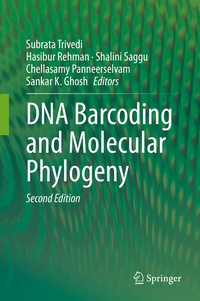
DNA Barcoding and Molecular Phylogeny
Description

This book presents a comprehensive overview of DNA barcoding and molecular phylogeny, along with a number of case studies.
It discusses a number of areas where DNA barcoding can be applied, such as clinical microbiology, especially in relation to infection management; DNA database management; and plant -animal interactions, and also presents valuable information on the DNA barcoding and molecular phylogeny of microbes, algae, elasmobranchs, fishes, birds and ruminant mammals. Furthermore it features unique case studies describing DNA barcoding of reptiles dwelling in Saudi Arabian deserts, genetic variation studies in both wild and hatchery populations of Anabas testudineus, DNA barcoding and molecular phylogeny of Ichthyoplankton and juvenile fishes of Kuantan River in Malaysia, and barcoding and molecular phylogenetic analysis of indigenous bacteria from fishes dwelling in a tropical tidal river. Moreover, since prompt identification and management of invasive species is vital to prevent economic and ecological loss, the book includes a chapter on DNA barcoding of invasive species.
Given its scope, this book will appeal not only to researchers, teachers and students around the globe, but also to general readers.
More details
Other editions
Additional editions
Persons
Dr. Subrata Trivedi completed his M.Sc. at the University of Calcutta, M.Phil at Jadavpur University (India) and Ph.D. in Molecular Biology at Hiroshima University, Japan. He received a Japanese Government (Monbusho) Scholarship, BBC World Service (London) Scholarship and Ministry of Environment and Forests Scholarship. He has discovered five new genes encoding vanadium binding proteins, and has published more than 150 papers. He has taught at several universities and is currently an Assistant Professor at the Department of Biology, University of Tabuk.
Dr. Hasibur Rehman holds an M.Sc. and Ph.D. in Toxicology from Jamia Hamdard, New Delhi, India. He served as a Staff Scientist at the Center for Cell Death, Injury and Regeneration, at the Medical University of South Carolina, USA. He has published more than 150 papers. He was an Assistant Professor at the Department of Biology, University of Tabuk, Saudi Arabia, and is currently a Senior Scientist at the University of Alabama at Birmingham, USA.
Dr. Shalini Saggu holds an M.Sc. and Ph.D. in Toxicology from Jamia Hamdard, New Delhi, India. She served as a Postdoctoral Fellow at the University of Louisville, KY, USA, and then became a Staff Scientist at the Center for Cell Death, Injury and Regeneration at the Medical University of South Carolina, USA. Dr. Saggu has been a PI or Co-PI in several major projects, and has published more than 90 papers. She was an Assistant Professor at the Department of Biology, University of Tabuk, and is currently a Senior Scientist at the University of Alabama at Birmingham, USA.
Dr. Chellasamy Panneerselvam is an Assistant Professor at the Department of Biology at the University of Tabuk. He holds an M.Sc. and M. Phil from Madurai Kamaraj University, a Ph.D. from Bharathiar University, India, and he won a gold medal for best Ph.D. thesis in Zoology. He worked as a UGC-Post-Doctoral Fellow (PDF) and Senior Research Fellow (SRF) at DRDO-BUCampus and has published over 75 peer-reviewed papers and 10 Book Chapters. Prof. Sankar K. Ghosh (FNASc) is currently the Vice-Chancellor of Kalyani University, India. He holds an MVSc and Ph.D. from the Bose Institute, India. He served as Dean of the School of Life Sciences at Assam University, India, and worked as a Postdoctoral Fellow at the Lerner Research Institute, Cleveland, USA. A scientist, institution builder, policy maker and administrator, Prof. Ghosh is internationally known for his research on DNA barcoding, and has published over 250 in respected, peer-reviewed journals.
