

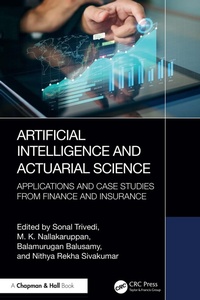
Artificial Intelligence and Actuarial Science
Applications and Case Studies from Finance and Insurance
1st Edition
Published on 27. December 2024
238 pages
978-1-040-27047-9 (ISBN)
Description

This book aims to explore how to automate, innovate, design, and deploy emerging technologies in actuarial work transformations for the insurance and finance sector. It examines the role of artificial intelligence with process automation in daily monitoring of solvency, governance, compliance, data processes, etc. It also explores the usage of machine learning, telematics system, AI-enabled claim processing software, Big Data and Algorithms, Explainable AI, and AI-enabled risk management tools in various actuarial processes.
This book:
* Presents case studies and best practices with real-world examples of successful and unsuccessful actuarial work transformation initiatives and transformation with emerging technologies
* Offers deployment solutions for different applications of AI in actuarial work
* Discusses how organizations can effectively incorporate AI into their current practices of actuarial work
* Covers diverse emerging technologies, practices, and processes of actuaries from around the globe
* Elaborates upon a framework for comprehending how big data and AI developments may affect insurance offers and their supervision
* Explains how insurance companies may review and modify their current Risk Management Framework (RMF) to take into account some of the significant differences while implementing AI use cases
This reference book is for scholars, researchers and professionals interested in Artificial Intelligence and Actuarial Science.
This book:
* Presents case studies and best practices with real-world examples of successful and unsuccessful actuarial work transformation initiatives and transformation with emerging technologies
* Offers deployment solutions for different applications of AI in actuarial work
* Discusses how organizations can effectively incorporate AI into their current practices of actuarial work
* Covers diverse emerging technologies, practices, and processes of actuaries from around the globe
* Elaborates upon a framework for comprehending how big data and AI developments may affect insurance offers and their supervision
* Explains how insurance companies may review and modify their current Risk Management Framework (RMF) to take into account some of the significant differences while implementing AI use cases
This reference book is for scholars, researchers and professionals interested in Artificial Intelligence and Actuarial Science.
More details
Edition
1. Auflage
Language
English
Place of publication
London
United Kingdom
Publishing group
Taylor & Francis Ltd
Target group
Professional and scholarly
Illustrations
13 Tables, black and white; 31 Line drawings, black and white; 31 Illustrations, black and white
File size
5,33 MB
ISBN-13
978-1-040-27047-9 (9781040270479)
Copyright in bibliographic data and cover images is held by Nielsen Book Services Limited or by the publishers or by their respective licensors: all rights reserved.
Schweitzer Classification
Other editions
Additional editions
Sonal Trivedi | M. K. Nallakaruppan | Balamurugan Balusamy
Artificial Intelligence and Actuarial Science
Applications and Case Studies from Finance and Insurance
Book
approx. 07/2026
1st Edition
Chapman & Hall/CRC
€65.00
Not yet published
Sonal Trivedi | M. K. Nallakaruppan | Balamurugan Balusamy
Artificial Intelligence and Actuarial Science
Applications and Case Studies from Finance and Insurance
Book
12/2024
1st Edition
Chapman & Hall/CRC
€206.40
Shipment within 10-20 days

Sonal Trivedi | M. K. Nallakaruppan | Balamurugan Balusamy
Artificial Intelligence and Actuarial Science
Applications and Case Studies from Finance and Insurance
Book
12/2024
CRC Press
Unfortunately, price unknown
Available (delivery time upon request)
Persons
Dr. Sonal Trivedi is an assistant professor at VIT Bhopal University, India. She has more than 12 years of teaching experience. She has published two books in national publications and has two edited books with international publishers in the process of publishing. She has 27 documents in Scopus indexed journal. She has six patents granted. She has 22 research papers in UGC-approved journals and presented 15 papers at international and national conferences. She has acted as conference chair for five international conferences. She is a reviewer for four reputed journals. She did her Ph.D. in Management (Finance) with a thesis titled 'A Study on Risk Management Tools and Techniques in Life Insurance Industry in India' from the University of Kota (Rajasthan) in 2017. She has also worked as a teaching assistant at S.V. National Institute of Technology (NIT), Surat (Institute of National Importance under Ministry of Human Resource Development (MHRD), Government of India). Her areas of interest are blockchain, finance, banking, and insurance.
Dr. Nallakaruppan M.K is an assistant professor in Balaji Institute of Modern Management Sri Balaji University Pune India. He completed his bachelor's degree (B.E.) in Electronics and Communication Engineering at J.J. College of Engineering and Technology. He completed his master's degree (M.E.) in Software Engineering at Anna University. He completed his Ph.D. in "Decision Support Systems for IoT-based Infrastructures" at VIT University, Vellore. His areas of expertise are IoT and smart networks, machine learning, soft computing, decision science, and deep learning. He has 32 international publications in various international journals under his area of interest. This includes 20 research papers, 9 conferences, and 3 book chapters, all with various reputed publishers.
Dr. Balamurugan Balusamy is Associate Dean of Students at Shiv Nadar University, Delhi-NCR. Prior to this assignment, he was a professor at the School of Computing Sciences & Engineering and Director of International Relations at Galgotias University, Greater Noida, India. His contributions focus on engineering education, blockchain, and data sciences. His academic degrees and 12 years of experience working as a faculty in a global university like VIT University, Vellore, have made him more receptive and prominent in his domain. He has over 200 papers with high impact factor published in multiple reputed journals. He has edited and authored more than 80 books, as well as collaborated with eminent professors across the world from top QS-ranked universities. He has served up to the position of associate professor in his stint of 12 years of experience with VIT University, Vellore. He had completed his bachelor's, master's, and Ph.D. degrees from India's top premier institutions. His passion is teaching, and he adapts different design thinking principles while delivering his lectures. He has published over 80 books on various technologies and has visited over 15 countries for his technical course. He has attended several top-notch conferences and has published over 200 high-quality journal, conference, and book chapters combined. He serves on the advisory committee for several start-ups and forums, as well as does consultancy work for industry on industrial IOT. He has given over 195 talks at various events and symposiums.
Dr. Nithya Rekha Sivakumar received a grant from UGC and completed her Ph.D. as a full-time research scholar at Periyar University awarded with "UGC BSR Research Fellowship in Science for Meritorious Students" by the University Grants Commission, New Delhi, Govt. of India, from 2010 to 2013. She received a travel grant from the Department of Science and Technology (DST), Govt. of India, to go to United States for her Ph.D. research. She received the "Best Distinguished Researcher Award" for the year 2015-2016 from the College of Computer, Qassim Private Colleges, Buraydah, Kingdom of Saudi Arabia. She has received a research grant for the Research Identity Fast-track Funding Program from the Deputyship for Research & Innovation, as well as the Ministry of Education and Researchers Supporting Project Award from Princess Nourah Bint Abdulrahman University in Saudi Arabia four times. She is on a Panel of External Examiners for Ph.D. for more than 25 candidates who have been awarded Ph.D. She is the author of over 50 peer-reviewed articles. She also has three patents. She is a reviewer for reputed journals. She is supervising several graduates (B.S. and M.S.). Her research interests include mobile computing, artificial intelligence, Internet of Things, deep learning, machine learning, wireless networks, network/cyber security, blockchain, VANET, cognitive radio networks, and cloud computing. She is currently an associate professor in the Department of Computer Sciences, College of Computer and Information Sciences, Princess Nourah Bint Abdulrahman University, Riyadh, Saudi Arabia. She has 17 years of teaching experience in the field of computer science and 15 years of research experience.
Dr. Nallakaruppan M.K is an assistant professor in Balaji Institute of Modern Management Sri Balaji University Pune India. He completed his bachelor's degree (B.E.) in Electronics and Communication Engineering at J.J. College of Engineering and Technology. He completed his master's degree (M.E.) in Software Engineering at Anna University. He completed his Ph.D. in "Decision Support Systems for IoT-based Infrastructures" at VIT University, Vellore. His areas of expertise are IoT and smart networks, machine learning, soft computing, decision science, and deep learning. He has 32 international publications in various international journals under his area of interest. This includes 20 research papers, 9 conferences, and 3 book chapters, all with various reputed publishers.
Dr. Balamurugan Balusamy is Associate Dean of Students at Shiv Nadar University, Delhi-NCR. Prior to this assignment, he was a professor at the School of Computing Sciences & Engineering and Director of International Relations at Galgotias University, Greater Noida, India. His contributions focus on engineering education, blockchain, and data sciences. His academic degrees and 12 years of experience working as a faculty in a global university like VIT University, Vellore, have made him more receptive and prominent in his domain. He has over 200 papers with high impact factor published in multiple reputed journals. He has edited and authored more than 80 books, as well as collaborated with eminent professors across the world from top QS-ranked universities. He has served up to the position of associate professor in his stint of 12 years of experience with VIT University, Vellore. He had completed his bachelor's, master's, and Ph.D. degrees from India's top premier institutions. His passion is teaching, and he adapts different design thinking principles while delivering his lectures. He has published over 80 books on various technologies and has visited over 15 countries for his technical course. He has attended several top-notch conferences and has published over 200 high-quality journal, conference, and book chapters combined. He serves on the advisory committee for several start-ups and forums, as well as does consultancy work for industry on industrial IOT. He has given over 195 talks at various events and symposiums.
Dr. Nithya Rekha Sivakumar received a grant from UGC and completed her Ph.D. as a full-time research scholar at Periyar University awarded with "UGC BSR Research Fellowship in Science for Meritorious Students" by the University Grants Commission, New Delhi, Govt. of India, from 2010 to 2013. She received a travel grant from the Department of Science and Technology (DST), Govt. of India, to go to United States for her Ph.D. research. She received the "Best Distinguished Researcher Award" for the year 2015-2016 from the College of Computer, Qassim Private Colleges, Buraydah, Kingdom of Saudi Arabia. She has received a research grant for the Research Identity Fast-track Funding Program from the Deputyship for Research & Innovation, as well as the Ministry of Education and Researchers Supporting Project Award from Princess Nourah Bint Abdulrahman University in Saudi Arabia four times. She is on a Panel of External Examiners for Ph.D. for more than 25 candidates who have been awarded Ph.D. She is the author of over 50 peer-reviewed articles. She also has three patents. She is a reviewer for reputed journals. She is supervising several graduates (B.S. and M.S.). Her research interests include mobile computing, artificial intelligence, Internet of Things, deep learning, machine learning, wireless networks, network/cyber security, blockchain, VANET, cognitive radio networks, and cloud computing. She is currently an associate professor in the Department of Computer Sciences, College of Computer and Information Sciences, Princess Nourah Bint Abdulrahman University, Riyadh, Saudi Arabia. She has 17 years of teaching experience in the field of computer science and 15 years of research experience.
Content
Section A Introduction 1. Evolutions of Actuarial Systems in the Insurance Industry & challenges in the existing system Section B Application of AI 2. Experts Opinion on Generative AI: Adoption and Challenges in Actuarial Science 3. AI: A revolutionary tool for actuarial work in insurance 4. Explainability AI: A Key Driver for Enhanced Quality of Service in Actuarial Practices 5. Explainability of AI in improving the Quality of Service in the Actuarial Industry 6. AI Transformation of the Insurance Industry: A Systematic Review of Progress and Possibilities 7. Examining the factors influencing AI adoption in the insurance Industry specifically in actuarial process. 8. Role of Artificial Intelligence (AI) in Insurance Industry: Scope, Benefits, and Adoption Roadmap 9. AI's role in improving the quality of Insurance services 10. Fuzzy Artificial Intelligence as A Technique to Find Relative Desirability for Automated Insurance Premium Assignment 11. Opportunities and Challenges of Combining Artificial Intelligence Power with the Richness of Healthcare Claims Data Section C Technological Advancement 12. Implementing Machine Learning in Actuarial Practice: Real World Applications and Insight 13. Telematics System in Usage Based Motor Insurance 14. Secured and Scalable: Integrating Blockchain Solutions for Health Insurance Claim Using Client Support Chatbot Automation Section D Conclusion 15. Law and AI-Powered Actuarial Revolution: Navigating the Future of Insurance Risk Assessment 16. Charting the Future: Artificial Intelligence's Role in Revolutionizing Actuarial Work in Insurance Sector
