

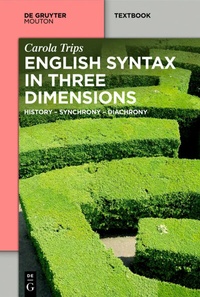
English Syntax in Three Dimensions
Description

This book deals with syntax in three dimensions: in part I with the history of grammatical theory, in part II with synchronic aspects of Present-Day English, and in part III with diachronic aspects of English. The most prominent linguistic terms and phenomena are discussed in their historical context and are taken up again in the synchronic and diachronic parts. In this way they can be viewed from different perspectives.
At the end of each chapter a summary and recommendations for further reading is provided as well as exercises in parts II and III. There is also a webpage for this book with more material, a glossary, and model answers of the exercises. The aims of the book are 1) to provide an introduction to the history of grammatical theory in order to show how and why generative grammar evolved (alongside other theories); in this way, generative grammar is presented in its historical context, and the motivation for the ideas and assumptions of this theory becomes clear; 2) to show that the terms and phenomena discussed are still applicable and interesting today; 3) to investigate phenomena of Present-Day English and their development in the history of English by means of authentic data, and to find explanations for the developmental paths they took by applying theory.
This book primarily aims at undergraduate students of English or linguistics who have already acquired some knowledge of syntax and generative syntactic theory. It is also well suited for students specialising in syntax, syntactic theory, and language change. It can further be used as a study aid for final exams.
More details
Other editions
Additional editions
Person
Content
- Intro
- Preface
- Contents
- List of abbreviations
- Part I: The history of grammar
- 1. Introduction
- 2. The Greeks and Romans and the first grammatical theory
- 3. The Middle Ages
- 4. Grammar in the Renaissance and the first grammars of English
- 5. Modern linguistics and structuralism
- 6. Chomsky and constituency grammars
- Part II: Synchronic analysis of English syntax
- 7. Introduction
- 8. Sentence structure of Present-Day English
- 9. Dependency relations and linguistic universals
- 10. Syntactic variation
- 11. Comparative syntax from a synchronic perspective
- 12. Movement and its application to the syntax of English
- Part III: Diachronic analysis of English syntax
- 13. Introduction
- 14. Sentence structure of Early English
- 15. Dependency relations in Early English
- 16. Syntactic variation in Early English
- 17. Comparative syntax from a diachronic perspective
- 18. Syntactic movement in the history of English
- Epilogue
- Bibliography
- Index
