

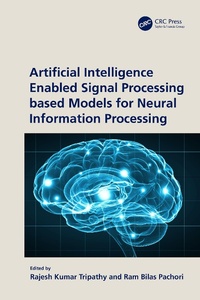
Artificial Intelligence Enabled Signal Processing based Models for Neural Information Processing
1st Edition
Published on 6. June 2024
226 pages
978-1-040-02880-3 (ISBN)
Description

The book provides details regarding the application of various signal processing and artificial intelligence-based methods for electroencephalography data analysis. It will help readers in understanding the use of electroencephalography signals for different neural information processing and cognitive neuroscience applications. The book:
Covers topics related to the application of signal processing and machine learning-based techniques for the analysis and classification of electroencephalography signals
Presents automated methods for detection of neurological disorders and other applications such as cognitive task recognition, and brain-computer interface
Highlights the latest machine learning and deep learning methods for neural signal processing
Discusses mathematical details for the signal processing and machine learning algorithms applied for electroencephalography data analysis
Showcases the detection of dementia from electroencephalography signals using signal processing and machine learning-based techniques
It is primarily written for senior undergraduates, graduate students, and researchers in the fields of electrical engineering, electronics and communications engineering, and biomedical engineering.
Covers topics related to the application of signal processing and machine learning-based techniques for the analysis and classification of electroencephalography signals
Presents automated methods for detection of neurological disorders and other applications such as cognitive task recognition, and brain-computer interface
Highlights the latest machine learning and deep learning methods for neural signal processing
Discusses mathematical details for the signal processing and machine learning algorithms applied for electroencephalography data analysis
Showcases the detection of dementia from electroencephalography signals using signal processing and machine learning-based techniques
It is primarily written for senior undergraduates, graduate students, and researchers in the fields of electrical engineering, electronics and communications engineering, and biomedical engineering.
More details
Edition
1. Auflage
Language
English
Place of publication
London
United Kingdom
Publishing group
Taylor & Francis Ltd
Target group
College/higher education
Product notice
Reflowable
Illustrations
26 Tables, black and white; 44 Line drawings, black and white; 1 Halftones, black and white; 45 Illustrations, black and white
ISBN-13
978-1-040-02880-3 (9781040028803)
Copyright in bibliographic data and cover images is held by Nielsen Book Services Limited or by the publishers or by their respective licensors: all rights reserved.
Schweitzer Classification
Other editions
Additional editions
Rajesh Kumar Tripathy | Ram Bilas Pachori
Artificial Intelligence Enabled Signal Processing based Models for Neural Information Processing
Book
05/2026
1st Edition
CRC Press
€66.00
Shipment within 10-20 days
Rajesh Kumar Tripathy | Ram Bilas Pachori
Artificial Intelligence Enabled Signal Processing based Models for Neural Information Processing
Book
06/2024
1st Edition
CRC Press
€177.00
Shipment within 10-20 days
Persons
Rajesh Kumar Tripathy received a B.Tech degree in Electronics and Telecommunication Engineering from the Biju Patnaik University of Technology (BPUT), Odisha, India, in 2009; and the M.Tech degree in Biomedical Engineering from the National Institute of Technology (NIT) Rourkela, Rourkela, India, in 2013; and a Ph.D. degree in machine learning for biomedical signal processing from the Indian Institute of Technology (IIT) Guwahati, Guwahati, India in 2017. He worked as an Assistant Professor at the Faculty of Engineering and Technology (FET), Siksha `O' Anusandhan Deemed to be University from March 2017 to June 2018. Since July 2018, he has worked as an Assistant Professor in the Department of Electrical and Electronics Engineering (EEE), Birla Institute of Technology and Science (BITS), Pilani, Hyderabad Campus. His research interests are machine learning, deep learning, biomedical signal processing, sensor data processing, medical image processing, and the Internet of Things (IoT) for healthcare. He has published research papers in reputed international journals and conferences. He has served as a reviewer for more than 15 scientific journals and served as a technical program committee (TPC) member in various national and international conferences. He is an associate editor for IEEE Access and Frontier in Physiology journals.
Ram Bilas Pachori received a B.E. degree with honours in electronics and communication engineering from Rajiv Gandhi Technological University, Bhopal, India, in 2001, and M.Tech. and Ph.D. degrees in electrical engineering from IIT Kanpur, India, in 2003 and 2008, respectively. Before joining the IIT Indore, India, faculty, he was a postdoctoral fellow at the Charles Delaunay Institute, University of Technology of Troyes, France (2007-2008) and an Assistant Professor at the Communication Research Center, International Institute of Information Technology, Hyderabad, India (2008-2009). He was an assistant professor (2009-2013) and an associate professor (2013-2017) at the Department of Electrical Engineering, IIT Indore, where he has now been a Professor since 2017. He is also associated with the Center for Advanced Electronics, IIT Indore. He was a visiting professor at the Department of Computer Engineering, Modeling, Electronics and Systems Engineering, University of Calabria, Rende, Italy, in July 2023; Faculty of Information & Communication Technology, University of Malta, Malta, from June 2023 to July 2023; Neural Dynamics of Visual Cognition Lab, Free University of Berlin, Germany, from July 2022 to September 2022; School of Medicine, Faculty of Health and Medical Sciences, Taylor's University, Malaysia, from 2018 to 2019. Previously, he was a Visiting Scholar at the Intelligent Systems Research Center, Ulster University, Londonderry, UK, in December 2014. His research interests include signal and image processing, biomedical signal processing, non-stationary signal processing, speech signal processing, brain-computer interface, machine learning, and artificial intelligence and the Internet of Things in health care. He is an Associate Editor of Electronics Letters, IEEE Transactions on Neural Systems and Rehabilitation Engineering, and Biomedical Signal Processing and Control, and an Editor of IETE Technical Review. He is a Fellow of IETE, IEI, and IET. He has 307 publications: journal articles (189), conference papers (82), books (10), and book chapters (26). He has also eight patents, including one Australian patent (granted) and seven Indian patents (published). His publications have been cited approximately 15,000 times with an h-index of 66 according to Google Scholar.
Ram Bilas Pachori received a B.E. degree with honours in electronics and communication engineering from Rajiv Gandhi Technological University, Bhopal, India, in 2001, and M.Tech. and Ph.D. degrees in electrical engineering from IIT Kanpur, India, in 2003 and 2008, respectively. Before joining the IIT Indore, India, faculty, he was a postdoctoral fellow at the Charles Delaunay Institute, University of Technology of Troyes, France (2007-2008) and an Assistant Professor at the Communication Research Center, International Institute of Information Technology, Hyderabad, India (2008-2009). He was an assistant professor (2009-2013) and an associate professor (2013-2017) at the Department of Electrical Engineering, IIT Indore, where he has now been a Professor since 2017. He is also associated with the Center for Advanced Electronics, IIT Indore. He was a visiting professor at the Department of Computer Engineering, Modeling, Electronics and Systems Engineering, University of Calabria, Rende, Italy, in July 2023; Faculty of Information & Communication Technology, University of Malta, Malta, from June 2023 to July 2023; Neural Dynamics of Visual Cognition Lab, Free University of Berlin, Germany, from July 2022 to September 2022; School of Medicine, Faculty of Health and Medical Sciences, Taylor's University, Malaysia, from 2018 to 2019. Previously, he was a Visiting Scholar at the Intelligent Systems Research Center, Ulster University, Londonderry, UK, in December 2014. His research interests include signal and image processing, biomedical signal processing, non-stationary signal processing, speech signal processing, brain-computer interface, machine learning, and artificial intelligence and the Internet of Things in health care. He is an Associate Editor of Electronics Letters, IEEE Transactions on Neural Systems and Rehabilitation Engineering, and Biomedical Signal Processing and Control, and an Editor of IETE Technical Review. He is a Fellow of IETE, IEI, and IET. He has 307 publications: journal articles (189), conference papers (82), books (10), and book chapters (26). He has also eight patents, including one Australian patent (granted) and seven Indian patents (published). His publications have been cited approximately 15,000 times with an h-index of 66 according to Google Scholar.
Content
1. Introduction to Neural Signals and Information Systems. 2. Artificial intelligence (AI)-enabled Signal Processing-based Methods for the Automated Detection of Epileptic Seizures using EEG Signals. 3. Machine Learning or Deep Learning Combined with Signal Processing for the Automated Classification of Sleep Stages using EEG Signals. 4. Classification of Normal and Alcoholic EEG Signals using Signal Processing and Machine Learning Models. 5. Artificial Intelligence-enabled Signal Processing-based Approach for the Automated Detection of Depression using EEG Signals. 6. Detection of Sleep Disorders from EEG Signals using Signal Processing and Machine Learning Techniques. 7. Automated Emotion Recognition from EEG Signals using Signal Processing and Machine Learning Techniques. 8. Signal Processing and Machine Learning-based Automated Approach for the Detection of Parkinson's Disease using EEG Signals. 9. Automated Detection of Alzheimer's Disease from EEG Signal using Signal Processing and Machine Learning-based Methods. 10. Artificial Intelligence-enabled Signal Processing-based Method for Brain-Computer Interface (BCI) Applications using EEG Signals. 11. Detection of Dementia from EEG Signals using Signal Processing and Machine Learning-based Techniques. 12. Signal Processing enabled Machine Learning based Approach for Automated Recognition of Cognitive tasks using EEG Signals.
