

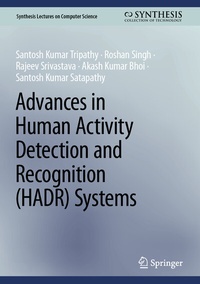
Advances in Human Activity Detection and Recognition (HADR) Systems
Description

This book provides a comprehensive overview of Human Activity Detection or Recognition (HADR) systems. Detection or recognition of human activities is a prominent research area in the fields of computer vision and artificial intelligence because of its many applications in daily life, including monitoring in public transport areas, health monitoring, anomaly detection in traffic, and smart homes. This book divides different activities according to their criticality, then discusses the various motivations and challenges that are involved in HADR systems. The authors then propose a framework for activity detection or recognition. The book also covers ten key applications of HADR systems and the recent developments for each of them. The authors also propose areas for future research.
More details
Other editions
Additional editions
Persons
Dr. Santosh Kumar Tripathy earned his Ph.D. in Computer Science and Engineering from The Indian Institute of Technology (BHU) Varanasi. He completed his M.Tech. (CSE) at S.I.E.T Dhenkanal. He is currently working as an Assistant Professor Grade 2 at the VIT Bhopal University School of Computing Science and Engineering. His expertise is in computer vision, image processing, and machine learning, and deep learning. His area of research includes crowd analysis, visual surveillance, medical image analysis, and image security.
Dr. Roshan Singh earned his Ph.D. in Computer Science and Engineering from The Indian Institute of Technology (BHU) Varanasi. He completed his M.Tech. in Information Technology and M.Sc. in Computer Science GGSIP University, Delhi and the University of Allahabad respectively. He is currently working at The Indian Institute of Technology Centre for Computing and Information Services. His research interests include video and image processing, classification, tracking, and human activity analysis.
Dr. Rajeev Srivastava is currently working as a Professor in the Department of Computer Science and Engineering, Head of the Centre for Computing and Information Services (CCIS), and the Dean (Resource and Alumni Affairs), Indian Institute of Technology (BHU), Varanasi. He also served as Head of the Department of Computer Science and Engineering during August'2017-December'2020. He holds the degrees of B.E., M.E., and PhD all in Computer Science & Engineering and possess 24+ years of teaching and research experience. He is a Fellow of Institution of Engineers (India) (FIE), Institution of Electronic and Telecommunication Engineers (FIETE), Senior Member IEEE USA, and Member ACM USA. He has published around 165+ research publications in reputed international journals and conferences, 04 research reference books, and 18 book chapters and filed four patents including one published patent. He successfully executed research projects funded by MoE, Govt. of India and DRDO. He has produced 16 PhDs, and 05 PhDs are ongoing under his Supervision. His research interests lies in the areas of Image and Video Processing, Computer Vision, Artificial Intelligence (AI), Machine Learning, Deep learning and Computational Bioinformatics.
Dr. Akash Kumar Bhoi holds a B.Tech. in Biomedical Engineering, an M.Tech. in Biomedical Instrumentation, and a Ph.D. in Biomedical Signal Processing. He is currently associated with the Sikkim Manipal University Directorate of Research as an Adjunct Research Faculty and a Research Associate at the Wireless Networks (WN) Research Laboratory, the Institute of Information Science and Technologies, and the National Research Council (ISTI-CRN). His research interests include biomedical technologies, the Internet of Things, computational intelligence, antennas, and renewable energy.
Dr. Santosh Kumar Satapathy received his Ph.D. in Computer Science and Engineeringfrom Pondicherry University(Central University), Puducherry, India in 2022. He completed his M.Tech in CSE from BPUT, Rourkela, Odisha, India in 2012. He did his Bachelor's degree in IT from BPUT, Rourkela, Odisha, India in the year 2009. He is also playing the role of a reviewer of many reputed journals, such as Scientific Reports(Springer Nature), Biocybernetics and Biomedical Engineering, Elsevier, Multimedia Tools and Applications, Springer, Journal of Healthcare Engineering, Hindawi, Sleep Oxford University Press, and Neuro Computing, Elsevier. He has worked as an Assistant Professor in different colleges in Odisha for 8 Years. He has published his research works in various International Journals and Conferences.
Content
Introduction.- Basic Framework of HADR.- Datasets.- Applications for HADR.- Comparative Analysis of HADR 94.- Conclusion and Future Directions.
