

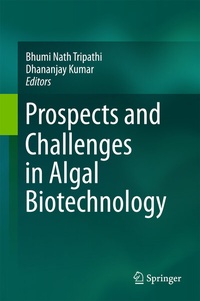
Prospects and Challenges in Algal Biotechnology
Description

This contributed volume presents the latest research and state-of-the-art approaches in the study of microalgae. It describes in detail technologies for the cultivation of marine, freshwater and extremophilic algae, as well as phototrophic biofilms, cyanobacterial mats and periphytons, including the media requirements and growth rates of different types of algae. The second part of the book is dedicated to the biotechnological applications of algal biomass and secondary metabolites produced by these organisms, and critically discusses topics such as algae-based biofuels and CO2 sequestration. In addition, it reviews the prospects and challenges of algal bioremediation of domestic and industrial wastewaters, including the use of planktonic and self-immobilized algae systems in wastewater treatment, explaining their merits and drawbacks. Lastly, it highlights research methods and approaches related to the production of high-value products and bioactive compounds.
More details
Other editions
Additional editions
Persons
Dr. Bhumi Nath Tripathi obtained his PhD from Banaras Hindu University, India. Currently, he is working at Department of Biotechnology, Indira Gandhi National Tribal University, Amarkantak, India. He has long lasting work experience on Stress Physiology of plants and Algal Biology. He recipient of several fellowships and research grants. He has published more than 50 research papers in journals of international repute. He has also published three books on Stress responses in Plants, Molecular Biology and Biotechnology and Applications of Biotechnology.
Dr. Dhananjay Kumar has obtained his PhD from Banaras Hindu University. Currently, he is working at Department of Botany, H.N.B Garhwal University. His research work is focused on Algal Biology especially use of algae/algal mat for the removal of metal contaminants. He is also recipient of DS Kothari Post-Doctoral Fellowship and worked at Jawaharlal Nehru University. He has published several research papers in journals of international repute.
Content
Section I:Algal Culture Technology.- 1.General Introduction.- 2.The culture technology for freshwater microalgae and cyanobacteria.- 3.The culture technology for marine algae and cyanobacteria.- 4.The culture technology for Periphytons and Cyanobacterial mats.- 5.The culture technology for extremophilic algae including cyanobacteria.- Section II Algal Biofuel and CO2 sequestration.- 6.Suitability of algae for biofuel production.- 7.Generation and harvesting of algal biomass for biofuel production.- 8.Manipulation of algal lipid production.- 9.System biology approach to enhance algal lipid production.- 10.Algae and carbon sequestration: Role, strategy and future perspectives.- Section III Algae in wastewater treatment.- 11.Planktonic algae and wastewater treatment: advantages and disadvantages.- 12.Wastewater treatment using Phototrophic biofilms and cyanobacterial mats.- 13.Algal turf scruber technology and periphytons.- 14.Biosrption heavy metals and dyes from industrial effluents.- Section IV Bioactive and High Value Chemical Compounds.- 15.Algae as source of pharmaceuticals.- 16.Algae as sources of food and nutraceuticals.- 17. Metabolic engineering for the production of high value algal products.
