

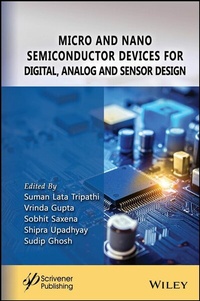
Micro and Nano Semiconductor Devices for Digital, Analog and Sensor Design
Description

Stay ahead of the curve in the rapidly evolving world of portable electronics with this expert guide, which offers a deep dive into the advanced semiconductor materials and low-power design techniques essential for fabricating the next generation of high-performance micro and nano devices.
In the era of smart portable and flexible electronic devices, technology needs to continuously evolve for improved performance. Advanced techniques, efficient computing algorithms, and models help develop efficient solutions at a low cost using low power for these devices. This book provides a detailed discussion of the design techniques, advanced semiconductor materials, fabrication techniques, and applications of efficient micro and nano devices. Expert insights will guide a deep-dive into modern design techniques using the latest tools, software, and simulators in a virtual environment. This guide's forward-looking approach makes it an essential resource for exploring the challenges and future of sensor design.
More details
Other editions
Additional editions
Persons
Suman Lata Tripathi, PhD is a Professor at Lovely Professional University with more than 22 years of experience in academics and research. She has published more than 125 research papers in refereed science journals, conference proceedings, and e-books, edited and authored more than 27 books, 14 Indian patents, and four copyrights. Her areas of expertise include microelectronics device modeling and characterization, low-power VLSI circuit design, advanced FET design for IoT, and embedded system design.
Vrinda Gupta, PhD is an Associate Professor in the Department of Electronics and Communication Engineering at the National Institute of Technology Kurukshetra. She has more than 75 publications in international journals, national and international conferences, and book chapters. Her research interests are in the fields of computer communications, network and information security, wireless communications and networking, embedded systems design, and Internet of Things.
Sobhit Saxena, PhD is a Professor in the School of Electronics and Electrical Engineering at Lovely Professional University with more than 14 years of teaching experience. He has published more than 35 research papers in international journals and conferences, two book chapters, and two books, as well as filed three patents. His areas of expertise include nanomaterial synthesis and characterization, and electrochemical analysis.
Shipra Upadhyay, PhD is an Assistant Professor at the Ramaiah Institute of Technology. She has published many papers in peer-reviewed international journals, conferences, and books. Her research interests include, custom analog IC design, field programmable gate array programming, nanoelectronics, and low-power circuit design.
Sudip Ghosh, PhD is an Assistant Professor in the School of VLSI Technology at the Indian Institute of Engineering Science and Technology. He has more than 60 publications in international journals and conferences. His areas of interest include digital image and video watermarking systems design, logic synthesis and verification of digital circuits, VLSI physical design, and VLSI testing.
Content
- Cover
- Series Page
- Title Page
- Copyright Page
- Contents
- Preface
- Chapter 1 Design of Advanced MOSFET Architectures
- 1.1 Introduction
- 1.2 History of Transistors
- 1.2.1 Evolution of Transistors
- 1.2.2 Non-Planar Device Architectures
- 1.3 SOI MOSFET: From Single Gate to Multigate
- 1.4 Current Non-Planar Device Architectures
- 1.4.1 FinFET
- 1.4.1.1 FinFET Advantages
- 1.4.1.2 FinFET Disadvantages
- 1.4.1.3 FinFET in Semiconductor Industries
- 1.4.1.4 Future of FinFET
- 1.4.2 GAAFET
- 1.4.2.1 GAAFET Advantages
- 1.4.2.2 Working of GAAFET
- 1.4.2.3 Advancement in GAA Device Design
- 1.4.2.4 Future of GAAFET
- 1.4.3 Reconfigurable FET (RFET)
- 1.4.3.1 Future of RFET
- 1.4.4 Tunnel FET
- 1.4.4.1 TFET Advantages
- 1.4.4.2 Future of TFET
- 1.5 Applications of Non-Planar Transistors in Analog and Digital Circuits
- 1.5.1 Applications in Digital Circuits
- 1.5.2 Applications in Analog Circuits
- 1.5.3 Design Considerations
- 1.5.4 Challenges and Future Trends
- 1.6 Conclusion
- References
- Chapter 2 Multi Gate MOSFET Architectures
- 2.1 Introduction
- 2.2 About Multi-Gate MOSFETs
- 2.3 Types of Multi-Gate MOSFETs
- 2.3.1 Double-Gate MOSFETs
- 2.3.1.1 Structure of DG MOSFET
- 2.3.1.2 Applications of DG MOSFETs
- 2.3.1.3 Design Challenges of DG MOSFETs
- 2.3.2 Tri-Gate MOSFETs
- 2.3.2.1 Structure of Tri-Gate MOSFET
- 2.3.2.2 Applications of Tri-Gate MOSFETs
- 2.3.2.3 Design Challenges of Tri-Gate MOSFETs
- 2.3.3 Gate-All-Around (GAA) MOSFETs
- 2.3.3.1 Structure of Gate-All-Around (GAA) MOSFET
- 2.3.3.2 Applications of Gate-All-Around (GAA) MOSFET
- 2.3.3.3 Design Challenges of Gate-All-Around (GAA) MOSFET
- 2.3.4 Omega-Gate MOSFET
- 2.3.4.1 Structure of Omega-Gate MOSFET
- 2.3.4.2 Applications of Omega-Gate MOSFET
- 2.3.4.3 Design Challenges of Omega-Gate MOSFET
- 2.4 Advantages of Multi-Gate MOSFETs
- 2.5 Conclusion
- References
- Chapter 3 Design and Comparative Analysis of Hybrid DG-MOSFET with Conventional CMOS Using Visual TCAD
- 3.1 Introduction
- 3.2 Design Methodology
- 3.3 Device Architecture and Materials Description
- 3.4 Results and Discussion
- 3.4.1 N-Channel DG-MOSFET
- 3.4.2 P-Channel DG-MOSFET
- 3.5 CMOS Compatibility of Proposed n- & p- Channel DG-MOSFET
- 3.6 Hybrid DG-MOSFET
- 3.6.1 Device Simulation on TCAD
- 3.6.2 Hybrid DG-MOSFET Response
- 3.6.3 Electric Field & Potential Plot
- 3.7 Applications & Future Scope
- 3.8 Conclusion
- Acknowledgement
- References
- Chapter 4 Nano Devices for Comparator Designs
- 4.1 Introduction
- 4.2 Experimental Methods and Materials
- 4.2.1 Carbon Nano Tubes
- 4.2.2 Potentials of Carbon Nanotubes (CNTs)
- 4.2.3 Design Considerations of CNTs
- 4.2.4 Experimental Demonstrations for CNTs
- 4.3 Graphene
- 4.3.1 Potentials of Graphene
- 4.3.2 Design Considerations of Graphene
- 4.3.3 Experimental Demonstrations for Graphene
- 4.4 Tunnel Field Effect Transistor
- 4.4.1 Potential of Tunnel Field Effect Transistor
- 4.4.2 Design Considerations of TFET
- 4.4.3 Experimental Demonstrations for TFET
- 4.5 Results and Discussion
- 4.5.1 Performance Parameters of Comparator Circuits
- 4.6 Conclusion
- References
- Chapter 5 Nano Device for SRAM Memory Arrays
- 5.1 Introduction
- 5.2 Study
- 5.3 Methodology
- 5.3.1 Device Simulation and Modeling
- 5.3.2 Fabrication Techniques
- 5.3.3 SRAM Cell Design and Integration
- 5.3.4 Performance Evaluation
- 5.3.5 Variability and Reliability Analysis
- 5.4 Result and Discussion
- 5.4.1 Performance Comparison
- 5.4.2 Variability and Reliability
- 5.4.3 Scalability and Future Prospects
- 5.4.4 Integration Challenges
- 5.4.5 Economic Considerations
- 5.5 Conclusion
- Bibliography
- Chapter 6 Technology Computer-Aided Design (TCAD) for Simulation of Advanced Transistor Design
- 6.1 Introduction
- 6.2 Essentials of Device Simulation
- 6.2.1 TCAD: Key Features and Capabilities
- 6.3 Design and Simulation of MOSFET: STEP-BY-STEP
- 6.3.1 Material Selection
- 6.3.2 Structure Definition
- 6.4 Advanced MOSFET Structure Design
- 6.4.1 Simulation of GaN HEMT with Example and Case Studies
- 6.5 Conclusion and Future Scope
- Acknowledgements
- References
- Chapter 7 FETs for Biomedical Applications: Recent Developments and Prospects for the Future
- 7.1 Introduction
- 7.1.1 Bio-FET and Solid-Liquid Interface
- 7.2 Applications of FET
- 7.2.1 Ion-Sensitive FETs (ISFETs)
- 7.2.2 Influenza
- 7.2.3 Cancer
- 7.2.4 Tear Sensors
- 7.2.5 Cardiovascular Disease (CVDs)/Acute Myocardial Infarction (AMI)
- 7.2.6 Diabetes
- 7.3 Prospects and Difficulties for Bio-FET
- 7.4 Conclusion
- References
- Chapter 8 Efferent Circuit Design and Energy Consumption of Gray-to- Binary (G2B) and Binary-to-Gray (B2G) Code Conversion Using QCA Nanoelectronic Technologies
- 8.1 Introduction
- 8.2 Literature Work
- 8.3 Synchronization Clocking Operation for Proposed Design
- 8.4 Proposed Design for Nanoelectronic Circuits
- 8.5 Result Analysis and Comparison
- 8.6 Conclusion
- References
- Chapter 9 Asymmetrical Double Gate Junction Less FET
- 9.1 Introduction
- 9.2 Simulated Device Dimensions and Material
- 9.3 Simulated Device Architecture Description
- 9.4 Result and Simulations
- 9.5 Subthreshold Performance
- 9.6 Comparison with Another Technology Node
- 9.7 Applications of Asymmetric Gate DG MOSFET
- 9.8 Conclusion
- References
- Chapter 10 Smart Materials for Semiconductor Devices: Research, Characteristics and Applications
- 10.1 Introduction
- 10.2 Shrewd Materials
- 10.3 Types of Smart or Keen Materials
- 10.3.1 Shape Memory Combination
- 10.3.1.1 Thermoelectricity
- 10.3.1.2 Pseudoelasticity
- 10.3.1.3 Damping Capacity
- 10.3.2 Piezoelectric Materials
- 10.3.3 Magnetostrictive Materials
- 10.3.4 Chromic Materials
- 10.3.4.1 Photochromic
- 10.3.4.2 Thermochromic
- 10.3.4.3 Piezochromic
- 10.3.5 pH Delicate Materials
- 10.3.6 Magnetorheological and Electrorheological Fluids
- 10.4 Application of Savvy Materials
- 10.4.1 Walking Piezo Lever
- 10.4.2 Aviation Innovation
- 10.4.3 Atomic Businesses Keen Substances
- 10.5 Shrewdly Material
- 10.6 Conclusions
- References
- Chapter 11 Nanotechnology for Energy Applications: Harnessing Nano and Artificial Intelligence for Sustainable Energy
- 11.1 Introduction
- 11.1.1 Overview of Nanotechnology
- 11.1.2 Applications of Nanotechnology
- 11.1.3 Role of Artificial Intelligence in Energy Applications
- 11.1.4 Importance of Sustainable Hybrid Energy Solutions
- 11.2 Need of the Work
- 11.2.1 Nanotechnology in Energy Generation
- 11.2.2 Nanotechnology in Energy Storage
- 11.2.3 AI Optimization in Hybrid Energy Systems
- 11.3 Hybrid Renewable System: Case Study of Rural Region
- 11.3.1 Objectives of the Chapter
- 11.4 Methodology
- 11.4.1 Location Details
- 11.4.2 System Designing and Modeling
- 11.4.3 Main Outcomes of Hybrid Solar-Wind-Battery System
- 11.5 Results and Discussion
- 11.5.1 Energy Efficiency and Sustainability
- 11.5.2 Challenges and Future Directions
- 11.5.3 Regulatory and Ethical Considerations
- 11.6 Conclusion
- References
- Chapter 12 Implementation and Analysis of Various Full Adder Configuration Using Cadence Virtuoso
- 12.1 Introduction
- 12.2 Adders
- 12.2.1 Half Adder
- 12.2.2 Full-Adder
- 12.2.3 Ripple Carry Adder
- 12.2.4 Carry Look-Ahead Adder
- 12.2.5 Carry-Save Adder
- 12.2.6 Parallel Prefix Adders
- 12.2.7 Serial Adder
- 12.3 CMOS Implementation of Adders
- 12.3.1 28T Full Adder
- 12.3.2 14T Full Adder
- 12.3.3 20T Full Adder
- 12.3.4 10T Full-Adder
- 12.3.5 8T Full-Adder
- 12.4 Implementation of Full-Adder 28T and 14T
- 12.4.1 Simulation Results
- 12.5 Conclusion
- Bibliography
- Chapter 13 Process Corner Analysis of 4-Bit Look Up Table (LUT) Using 90nm CMOS Technology
- 13.1 Introduction
- 13.2 Look-Up Table (LUT)
- 13.3 Basic Blocks Used in Design of LUT at 90nm CMOS
- 13.3.1 2X1 Multiplexer
- 13.3.2 D-Flip Flop (DFF)
- 13.3.3 Schematic of 4 Bit-LUT
- 13.3.3.1 Functions Implementation Using 4-Bit LUT
- 13.4 Corner Analysis
- 13.5 Applications
- 13.5.1 Implementation of Digital Logic Functions
- 13.5.2 DSP Processors
- 13.5.3 Signal and Image Processing
- 13.6 Conclusion
- References
- Chapter 14 Designing and Small Signal Analysis of Common Source Amplifier Using GaN Based HEMT
- 14.1 Introduction
- 14.2 Device Structure
- 14.3 Results and Discussions
- 14.4 Conclusion
- References
- Chapter 15 The 5th Generation: Major Implementation, Challenges and Massive MIMO Technology
- 15.1 Introduction
- 15.2 Major Challenges Faced in 5G Implementation
- 15.2.1 Infrastructure
- 15.2.2 Cost
- 15.2.3 Testing of 5G
- 15.2.4 5G Backhaul
- 15.2.5 Security Concerns
- 15.3 Classification of 5G Services
- 15.4 Massive MIMO for 5G
- 15.5 Conclusion
- References
- Chapter 16 Smart Nanomaterials: Revolutionizing Drug Delivery Strategies
- 16.1 Introduction
- 16.2 Disease Specific Drug Delivery
- 16.3 Synthesis of Nanomaterials for Drug Delivery
- 16.4 Location Specific Drug Delivery
- 16.5 Future Scope
- 16.6 Conclusion
- References
- About the Editors
- Index
- Also of Interest
- EULA
