

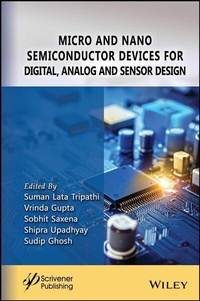
Micro and Nano Semiconductor Devices for Digital, Analog and Sensor Design
Description

Stay ahead of the curve in the rapidly evolving world of portable electronics with this expert guide, which offers a deep dive into the advanced semiconductor materials and low-power design techniques essential for fabricating the next generation of high-performance micro and nano devices.
In the era of smart portable and flexible electronic devices, technology needs to continuously evolve for improved performance. Advanced techniques, efficient computing algorithms, and models help develop efficient solutions at a low cost using low power for these devices. This book provides a detailed discussion of the design techniques, advanced semiconductor materials, fabrication techniques, and applications of efficient micro and nano devices. Expert insights will guide a deep-dive into modern design techniques using the latest tools, software, and simulators in a virtual environment. This guide's forward-looking approach makes it an essential resource for exploring the challenges and future of sensor design.
More details
Other editions
Additional editions
Persons
Suman Lata Tripathi, PhD is a Professor at Lovely Professional University with more than 22 years of experience in academics and research. She has published more than 125 research papers in refereed science journals, conference proceedings, and e-books, edited and authored more than 27 books, 14 Indian patents, and four copyrights. Her areas of expertise include microelectronics device modeling and characterization, low-power VLSI circuit design, advanced FET design for IoT, and embedded system design.
Vrinda Gupta, PhD is an Associate Professor in the Department of Electronics and Communication Engineering at the National Institute of Technology Kurukshetra. She has more than 75 publications in international journals, national and international conferences, and book chapters. Her research interests are in the fields of computer communications, network and information security, wireless communications and networking, embedded systems design, and Internet of Things.
Sobhit Saxena, PhD is a Professor in the School of Electronics and Electrical Engineering at Lovely Professional University with more than 14 years of teaching experience. He has published more than 35 research papers in international journals and conferences, two book chapters, and two books, as well as filed three patents. His areas of expertise include nanomaterial synthesis and characterization, and electrochemical analysis.
Shipra Upadhyay, PhD is an Assistant Professor at the Ramaiah Institute of Technology. She has published many papers in peer-reviewed international journals, conferences, and books. Her research interests include, custom analog IC design, field programmable gate array programming, nanoelectronics, and low-power circuit design.
Sudip Ghosh, PhD is an Assistant Professor in the School of VLSI Technology at the Indian Institute of Engineering Science and Technology. He has more than 60 publications in international journals and conferences. His areas of interest include digital image and video watermarking systems design, logic synthesis and verification of digital circuits, VLSI physical design, and VLSI testing.
Content
Preface xv
1 Design of Advanced MOSFET Architectures 1
Remya Jayachandran and Salila Hegde
1.1 Introduction 2
1.2 History of Transistors 3
1.3 SOI MOSFET: From Single Gate to Multigate 6
1.4 Current Non-Planar Device Architectures 9
1.5 Applications of Non-Planar Transistors in Analog and Digital Circuits 20
1.6 Conclusion 23
2 Multi Gate MOSFET Architectures 31
Vrinda Gupta, L.G. Naveen Kumar and K.N.S. Santosh
2.1 Introduction 32
2.2 About Multi-Gate MOSFETs 35
2.3 Types of Multi-Gate MOSFETs 36
2.4 Advantages of Multi-Gate MOSFETs 47
2.5 Conclusion 48
3 Design and Comparative Analysis of Hybrid DG-MOSFET with Conventional CMOS Using Visual TCAD 51
Kushagra, Suman Lata Tripathi and Balwinder Raj
3.1 Introduction 52
3.2 Design Methodology 53
3.3 Device Architecture and Materials Description 54
3.4 Results and Discussion 54
3.5 CMOS Compatibility of Proposed n- & p- Channel DG-MOSFET 61
3.6 Hybrid DG-MOSFET 63
3.7 Applications & Future Scope 67
3.8 Conclusion 68
4 Nano Devices for Comparator Designs 73
Niranjana C., Vineeth Kumar P. K., Jijesh J. J. and Lakshmi Manasa B.
4.1 Introduction 73
4.2 Experimental Methods and Materials 74
4.3 Graphene 77
4.5 Results and Discussion 81
4.6 Conclusion 88
5 Nano Device for SRAM Memory Arrays 91
Akey Sungheetha, Rajesh Sharma R. and Sheila Mahapatra
5.1 Introduction 91
5.2 Study 93
5.3 Methodology 95
5.4 Result and Discussion 99
5.5 Conclusion 106
6 Technology Computer-Aided Design (TCAD) for Simulation of Advanced Transistor Design 109
P. Sivakumar, Shashi Kant Dargar and P. Harikrishnan
6.1 Introduction 110
6.2 Essentials of Device Simulation 111
6.3 Design and Simulation of MOSFET: STEP-BY-STEP 112
6.4 Advanced MOSFET Structure Design 114
6.5 Conclusion and Future Scope 122
7 FETs for Biomedical Applications: Recent Developments and Prospects for the Future 125
Anbuselvi D., S. GraceInfantiya and D. Bharath
7.1 Introduction 126
7.2 Applications of FET 128
7.3 Prospects and Difficulties for Bio-FET 133
7.4 Conclusion 134
8 Efferent Circuit Design and Energy Consumption of Grayto-Binary (G2B) and Binary-to-Gray (B2G) Code Conversion Using QCA Nanoelectronic Technologies 143
Mukesh Patidar, Ankit Jain, Shreyaskumar Patel, Keshav Patidar and Hemanshi Chugh
8.1 Introduction 144
8.2 Literature Work 145
8.3 Synchronization Clocking Operation for Proposed Design 148
8.4 Proposed Design for Nanoelectronic Circuits 148
8.5 Result Analysis and Comparison 150
8.6 Conclusion 156
9 Asymmetrical Double Gate Junction Less FET 159
Lijin Wilson and Suman Lata Tripathi
9.1 Introduction 160
9.2 Simulated Device Dimensions and Material 161
9.3 Simulated Device Architecture Description 163
9.4 Result and Simulations 167
9.5 Subthreshold Performance 173
9.6 Comparison with Another Technology Node 174
9.7 Applications of Asymmetric Gate DG MOSFET 176
9.8 Conclusion 176
10 Smart Materials for Semiconductor Devices: Research, Characteristics and Applications 179
Krishan Arora
10.1 Introduction 179
10.2 Shrewd Materials 180
10.3 Types of Smart or Keen Materials 181
10.4 Application of Savvy Materials 187
10.5 Shrewdly Material 188
10.6 Conclusions 189
11 Nanotechnology for Energy Applications: Harnessing Nano and Artificial Intelligence for Sustainable Energy 195
Harpreet Kaur Channi, Ramandeep Sandhu, Deepika Ghai and Nimisha Singh
11.1 Introduction 196
11.2 Need of the Work 201
11.3 Hybrid Renewable System: Case Study of Rural Region 204
11.4 Methodology 204
11.5 Results and Discussion 218
11.6 Conclusion 221
12 Implementation and Analysis of Various Full Adder Configuration Using Cadence Virtuoso 229
Spoorthi S.P., Bharathi S.H., Shipra Upadhyay and Chaithanya D.J.
12.1 Introduction 230
12.2 Adders 230
12.3 CMOS Implementation of Adders 234
12.4 Implementation of Full-Adder 28T and 14T 238
12.5 Conclusion 241
13 Process Corner Analysis of 4-Bit Look Up Table (LUT) Using 90nm CMOS Technology 243
Talla. Narayana Swami, Shiridi Sravanthi, Suman Lata Tripathi and Yuli Sun Hariyani
13.1 Introduction 244
13.2 Look-Up Table (LUT) 244
13.3 Basic Blocks Used in Design of LUT at 90nm CMOS 246
13.4 Corner Analysis 252
13.5 Applications 255
13.6 Conclusion 256
14 Designing and Small Signal Analysis of Common Source Amplifier Using GaN Based HEMT 261
Yogesh Kumar Verma
14.1 Introduction 261
14.2 Device Structure 263
14.3 Results and Discussions 265
14.4 Conclusion 269
15 The 5th Generation: Major Implementation, Challenges and Massive MIMO Technology 273
Rashmi Roges, Sandeep Sharma and Praveen Kumar Malik
15.1 Introduction 273
15.2 Major Challenges Faced in 5G Implementation 276
15.3 Classification of 5G Services 280
15.4 Massive MIMO for 5G 281
15.5 Conclusion 286
16 Smart Nanomaterials: Revolutionizing Drug Delivery Strategies 289
Jujhaar Singh Aidhen, Arjun Vitthal Chambarge, Chavan Aniket Navnath, Atharv Mohan Patil, Vedant Dnyandev Arjun, Jupinder Kaur and Rajan Vohra
16.1 Introduction 290
16.2 Disease Specific Drug Delivery 292
16.3 Synthesis of Nanomaterials for Drug Delivery 305
16.4 Location Specific Drug Delivery 310
16.5 Future Scope 320
16.6 Conclusion 320
References 321
About the Editors 325
Index 327
1
Design of Advanced MOSFET Architectures
Remya Jayachandran* and Salila Hegde
Dept. of Electronics and Communication Engineering, The National Institute of Engineering, Mysore, Karnataka, India
Abstract
Multigate devices, widely called as FinFETs (Fin type field effect transistors), belong to a category of transistors used in modern microprocessors. They consist of a fin-shaped gate structure that surrounds the channel, due to which flow of electric current is controlled in better way. This design enables multigate devices to work at lower voltages with reduced power consumption and increased performance. The multiple gates also help to reduce leakage current, making them more reliable and efficient. Due to this, multigate devices have become a crucial component in the growth of ultraminiaturized, high-performance ICs (integrated circuits). Due to the advancement in technology especially by incorporating artificial intelligence in the gadgets, the requirement of high computation processors led to the replacement of FinFET with new device architecture beyond 3 nm technology node. The evolution of transistor from planar structure to multigate non-planar structures, tunnel FETs, reconfigurable FETs etc. are detailed in this chapter. These devices are used to build high performance and low-power circuits, such as, memory, digital and analog circuits. In digital circuits, multigate device has many advantages, which includes lower leakage current, improved sub threshold slope, and increased switching speed which are also discussed in this chapter.
Keywords: FinFET, GAAFET, TFET, RFET, analog circuits, digital IC
1.1 Introduction
For the past five decennium, the evolution and expansion of VLSI (very-large-scale integration) circuits have been driven by the persistent scaling down of device structures in alignment with Moore's Law [1-4]. Non-planar device structures are used in recent electronic gadgets which have processors working at high frequency, embedded systems etc. instead of conventional planar transistors [5]. Since the analog circuit part is built using planar transistors, fabrication of both analog and digital circuits demand two different process technologies which makes the cost of product high. Scaling down the device dimension can increase the frequency of operation of the device with a trade-off in increased parasitic capacitances and fabrication complexity. New device architectures such as carbon nanotubes, multi-gate devices, single electron devices, tunnel FETs and reconfigurable FETs can outdo conventional planar MOSFETs in terms of lesser area, higher speed and low power consuming devices [5-10]. Among the various multi-gate transistor structures, "Gate All Around FET" (GAAFET) device has better control of gate over the channel and channel length scaled down below 5nm. One more multi-gate device in use recently is reconfigurable field-effect transistor (RFET), which can be configured either as an p-type or n-type FET by applying suitable bias. RFET device structures with single gate to multiple gates have been detailed in the published works [11-18]. Experimental demonstration of logic circuits, current mirror circuits, memory circuits, amplifiers etc. using new device architectures and its performance analysis are available in literature [19-25]. Basic digital circuits have been demonstrated using scaled-down new transistor architectures. Analog circuit and signals are more susceptible to changes in device parameters and hence makes it hard to replace conventional transistor with new device structures. In scaled-down devices, non-linear parameters become more dominant that significantly impacts analog circuit design. As device dimensions continue to scale down, the design complexity increases more significantly for analog circuits compared to digital circuits. Despite the fact that digital circuits have already made their way to the nanoscale regime, there is still research on designing analog circuits using scaled-down device architectures [17, 22]. Electrical characterization of various nanowire FET devices and the circuit simulations using these transistors are illustrated in [26-38]. The physical size of devices has been significantly reduced due to the rapid development of smart electronic devices and gadgets. As device dimensions shrink, maintaining effective gate control over the channel becomes increasingly challenging for planar transistors. The cylindrical type GAAFET offers the lowest natural length, making it possible to scale down the device. Carrier conduction is not restricted by the Si/SiO2 interface in the GAA device, but rather by the center of the device due to its unique architecture. This alleviates interface-related issues like charge carrier mobility and interface impurities caused by the dangling bonds during development. The current technology node is 3 nm node that uses GAAFET device by name 3GAA that can replace the FinFET structure.
In this chapter, the evolution of MOSFET structures is explained in section 1.2 followed by silicon-on-insulator (SOI) MOSFET structures in section 1.3. Current multigate MOSFET structures and their challenges and future scopes are discussed in section 1.4 followed by applications of non-planar transistors in analog and digital circuits in section 1.5. The prime objective of this chapter is to introduce the new transistor architectures and challenges in existing analog and digital circuit designs using non-conventional transistors.
1.2 History of Transistors
During wartime (World wars), the need for advanced technology to create highly efficient computational devices spurred the blooming of transistors. This invention, as well as subsequent utilization of transistors in integrated circuits, marked a significant boost in the semiconductor industries. In this section, the evolution of transistors is detailed that led to the new device architectures both planar and non-planar multigate transistors.
1.2.1 Evolution of Transistors
The evolution of active electronic devices has undergone a remarkable transformation over time. The journey began with the vacuum tubes, which were superseded by the bipolar transistors (BJT) and subsequently by the advancements in the MOS (metal-oxide-semiconductor) transistor. Vacuum tubes were bulky, power-hungry, and had limited lifespan. The field of solid-state materials and devices underwent numerous explorations and breakthroughs after John Bardeen and Walter Brattain demonstrated the point-contact form of transistor in December 1947 [1]. The transistor offered a more compact, efficient, and reliable alternative to vacuum tubes, which led to the significant advancements in electronic technology. A possible alternate design was suggested by the fact that the point-contact transistor's two contacts were quite close to one another. A comparable result can be achieved with more consistent application by sandwiching an extremely thin layer of material with complimentary doping between two silicon pieces.
Building on this insight, William Shockley defined "junction" transistor. This new design, based on the p-n junction principle, offered a more robust and practical solution compared to the initial point-contact transistor. In 1956, Brattain, Bardeen and Shockley were awarded Nobel Prize for creating a device capable of generating solid-state amplification. While Shockley pioneered the bipolar transistor, Bardeen and Brattain created the point-contact transistor. William Shockley directed the efforts of Bardeen and Brattain at Bell Labs to develop a three-electrode device, which is the basis for the field-effect transistor. However, the team led by Brattain faced a significant challenge in overcoming the surface states that interfered with the gate voltage. Despite their attempts, they were unable to realize a successful insulated-gate FET. M.M.(John) Atalla and Dawon Kahng, also at Bell Labs, finally achieved the breakthrough and demonstrated the initial insulated-gate FET (IGFET) successfully in 1959. This landmark achievement paved the way for the development of the metal oxide semiconductor field effect transistor widely known as MOSFET, which has become the foundation of modern electronics and computing.
The evolution of the MOSFET has been a remarkable journey in the history of semiconductor technology. The MOSFET was first conceptualized by Julius Lilienfeld in 1925, but the first working MOSFET was demonstrated by Mohamed Atalla and Dawon Kahng at Bell Labs in 1959. Jack Kilby at Texas Instruments realized a simple (flip-flop) circuit with dual BJTs on a solo chip of germanium which led to the invention of integrated circuits in September 1958. In the 1960s, the planar MOSFET structure was developed, which allowed for the multiple transistor integration on a single chip, leading to the start of integrated circuits. Over the decades, MOSFETs have undergone continuous scaling, with the channel length being reduced from several micrometers to the nanometer scale, following Moore's law. To address the challenges of short channel effects in scaled-down planar MOSFETs, various multi-gate structures were introduced, such as the double-gate MOSFET, FinFET, and GAAFET. To address the drawbacks of conventional silicon dioxide (SiO2) gate dielectrics, metal gates and high-k dielectric materials were developed, improving the gate control and reducing leakage currents. The incorporation of strained silicon channels has been used to enhance carrier mobility...
