

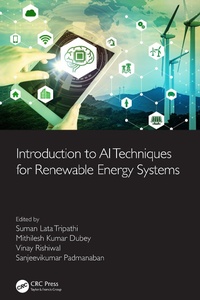
Introduction to AI Techniques for Renewable Energy System
1st Edition
Published on 25. November 2021
422 pages
978-1-000-39245-6 (ISBN)
Description

Introduction to AI techniques for Renewable Energy System
Artificial Intelligence (AI) techniques play an essential role in modeling, analysis, and prediction of the performance and control of renewable energy. The algorithms used to model, control, or predict performances of the energy systems are complicated, involving differential equations, enormous computing power, and time requirements. Instead of complex rules and mathematical routines, AI techniques can learn critical information patterns within a multidimensional information domain. Design, control, and operation of renewable energy systems require a long-term series of meteorological data such as solar radiation, temperature, or wind data. Such long-term measurements are often non-existent for most of the interest locations or, wherever they are available, they suffer from several shortcomings, like inferior quality of data, and in-sufficient long series. The book focuses on AI techniques to overcome these problems. It summarizes commonly used AI methodologies in renewal energy, with a particular emphasis on neural networks, fuzzy logic, and genetic algorithms. It outlines selected AI applications for renewable energy. In particular, it discusses methods using the AI approach for prediction and modeling of solar radiation, seizing, performances, and controls of the solar photovoltaic (PV) systems.
Features
Focuses on a significant area of concern to develop a foundation for the implementation of renewable energy system with intelligent techniques
Showcases how researchers working on renewable energy systems can correlate their work with intelligent and machine learning approaches
Highlights international standards for intelligent renewable energy systems design, reliability, and maintenance
Provides insights on solar cell, biofuels, wind, and other renewable energy systems design and characterization, including the equipment for smart energy systems
This book, which includes real-life examples, is aimed at undergraduate and graduate students and academicians studying AI techniques used in renewal energy systems.
Artificial Intelligence (AI) techniques play an essential role in modeling, analysis, and prediction of the performance and control of renewable energy. The algorithms used to model, control, or predict performances of the energy systems are complicated, involving differential equations, enormous computing power, and time requirements. Instead of complex rules and mathematical routines, AI techniques can learn critical information patterns within a multidimensional information domain. Design, control, and operation of renewable energy systems require a long-term series of meteorological data such as solar radiation, temperature, or wind data. Such long-term measurements are often non-existent for most of the interest locations or, wherever they are available, they suffer from several shortcomings, like inferior quality of data, and in-sufficient long series. The book focuses on AI techniques to overcome these problems. It summarizes commonly used AI methodologies in renewal energy, with a particular emphasis on neural networks, fuzzy logic, and genetic algorithms. It outlines selected AI applications for renewable energy. In particular, it discusses methods using the AI approach for prediction and modeling of solar radiation, seizing, performances, and controls of the solar photovoltaic (PV) systems.
Features
Focuses on a significant area of concern to develop a foundation for the implementation of renewable energy system with intelligent techniques
Showcases how researchers working on renewable energy systems can correlate their work with intelligent and machine learning approaches
Highlights international standards for intelligent renewable energy systems design, reliability, and maintenance
Provides insights on solar cell, biofuels, wind, and other renewable energy systems design and characterization, including the equipment for smart energy systems
This book, which includes real-life examples, is aimed at undergraduate and graduate students and academicians studying AI techniques used in renewal energy systems.
More details
Edition
1. Auflage
Language
English
Place of publication
London
United Kingdom
Publishing group
Taylor & Francis Ltd
Target group
College/higher education
Professional and scholarly
Illustrations
43 Tables, black and white; 175 Line drawings, black and white; 21 Halftones, black and white; 196 Illustrations, black and white
ISBN-13
978-1-000-39245-6 (9781000392456)
Copyright in bibliographic data and cover images is held by Nielsen Book Services Limited or by the publishers or by their respective licensors: all rights reserved.
Schweitzer Classification
Other editions
Additional editions
Suman Lata Tripathi | Mithilesh Kumar Dubey | Vinay Rishiwal
Introduction to AI Techniques for Renewable Energy System
Book
03/2025
1st Edition
CRC Press
€72.60
Shipment within 15-20 days
Suman Lata Tripathi | Mithilesh Kumar Dubey | Vinay Rishiwal
Introduction to AI Techniques for Renewable Energy System
Book
11/2021
1st Edition
CRC Press
€243.10
Shipment within 15-20 days
Persons
Suman Lata Tripathi is working as a Professor at School of Electronics and Electrical Engineering, Lovely Professional University, India.
Mithilesh Kumar Dubey is working as an Associate Professor at School of Computer Science and Engineering, Lovely Professional University, India.
Vinay Rishiwal is working as a Professor at Department of Computer Science and Information Technology, Faculty of Engineering and Technology, MJP Rohilkhand University, Bareilly, Uttar Pradesh, India.
Sanjeevikumar Padmanaban is working as a faculty member, at Department of Energy Technology, Aalborg University, Esbjerg, Denmark.
Mithilesh Kumar Dubey is working as an Associate Professor at School of Computer Science and Engineering, Lovely Professional University, India.
Vinay Rishiwal is working as a Professor at Department of Computer Science and Information Technology, Faculty of Engineering and Technology, MJP Rohilkhand University, Bareilly, Uttar Pradesh, India.
Sanjeevikumar Padmanaban is working as a faculty member, at Department of Energy Technology, Aalborg University, Esbjerg, Denmark.
Content
Chapter 1: Artificial Intelligence: A New Era in Renewable Energy Systems. Chapter 2: Role of AI in Renewable Energy Management. Chapter 3: AI-based Renewable Energy with Emerging Applications: Issues and Challenges. Chapter 4: Foundations of Machine Learning. Chapter 5: Introduction of AI techniques and Approaches. Chapter 6: A Comprehensive Overview of Hybrid Renewable Energy Systems. Chapter 7: Dynamic Modelling and Performance Analysis of Switched-Mode Controller for Hybrid Energy Systems. Chapter 8: Artificial Intelligence and Machine Learning Methods for Renewable Energy. Chapter 9: Artificial Neural Network Based Power Optimizer for Solar Photovoltaic System: An Integrated Approach with Genetic Algorithm. Chapter 10: Predictive Maintenance: AI Behind Equipment Failure Prediction. Chapter 11: AI Techniques for the Challenges in Smart Energy Systems. Chapter 12: Energy Efficiency. Chapter 13: Renewable Energy from Plant Biomass and Photosynthetic Organisms and its Operations. Chapter 14: Evolving Trends for Smart Grid Using Artificial Intelligent Techniques. Chapter 15: Introduction to AI techniques for Photovoltaic Energy Conversion System. Chapter 16: Deep Learning Based Fault Identification of Micro Grid Transformers. Chapter 17: Power Quality Improvement for Grid Integrated Renewable Energy Sources: A Comparative analysis of UPQC Topologies. Chapter 18: AI based Energy Efficient Fault Mitigation Technique for Reliability Enhancement of Wireless Sensor Network. Chapter 19: AI Techniques Applied to Wind Energy. Chapter 20: Comparative Performance Analysis of Multi-Objective Metaheuristic Approaches for Parameter Identification of Three-Diode Modelled Photovoltaic Cells. Chapter 21: Artificial Intelligence Techniques in Smart Grid. Chapter 22: Parameter Identification of a New Reverse Two Diode Model by Moth Flame Optimizer. Chapter 23: Time-Series Energy Prediction and Improved Decision Making.
