

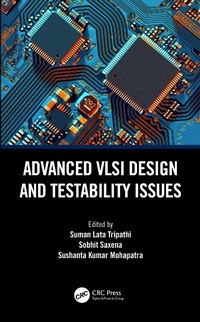
Advanced VLSI Design and Testability Issues
1st Edition
Published on 18. August 2020
378 pages
978-1-000-16817-4 (ISBN)
Description

This book facilitates the VLSI-interested individuals with not only in-depth knowledge, but also the broad aspects of it by explaining its applications in different fields, including image processing and biomedical. The deep understanding of basic concepts gives you the power to develop a new application aspect, which is very well taken care of in this book by using simple language in explaining the concepts. In the VLSI world, the importance of hardware description languages cannot be ignored, as the designing of such dense and complex circuits is not possible without them. Both Verilog and VHDL languages are used here for designing. The current needs of high-performance integrated circuits (ICs) including low power devices and new emerging materials, which can play a very important role in achieving new functionalities, are the most interesting part of the book. The testing of VLSI circuits becomes more crucial than the designing of the circuits in this nanometer technology era. The role of fault simulation algorithms is very well explained, and its implementation using Verilog is the key aspect of this book.
This book is well organized into 20 chapters. Chapter 1 emphasizes on uses of FPGA on various image processing and biomedical applications. Then, the descriptions enlighten the basic understanding of digital design from the perspective of HDL in Chapters 2-5. The performance enhancement with alternate material or geometry for silicon-based FET designs is focused in Chapters 6 and 7. Chapters 8 and 9 describe the study of bimolecular interactions with biosensing FETs. Chapters 10-13 deal with advanced FET structures available in various shapes, materials such as nanowire, HFET, and their comparison in terms of device performance metrics calculation. Chapters 14-18 describe different application-specific VLSI design techniques and challenges for analog and digital circuit designs. Chapter 19 explains the VLSI testability issues with the description of simulation and its categorization into logic and fault simulation for test pattern generation using Verilog HDL. Chapter 20 deals with a secured VLSI design with hardware obfuscation by hiding the IC's structure and function, which makes it much more difficult to reverse engineer.
This book is well organized into 20 chapters. Chapter 1 emphasizes on uses of FPGA on various image processing and biomedical applications. Then, the descriptions enlighten the basic understanding of digital design from the perspective of HDL in Chapters 2-5. The performance enhancement with alternate material or geometry for silicon-based FET designs is focused in Chapters 6 and 7. Chapters 8 and 9 describe the study of bimolecular interactions with biosensing FETs. Chapters 10-13 deal with advanced FET structures available in various shapes, materials such as nanowire, HFET, and their comparison in terms of device performance metrics calculation. Chapters 14-18 describe different application-specific VLSI design techniques and challenges for analog and digital circuit designs. Chapter 19 explains the VLSI testability issues with the description of simulation and its categorization into logic and fault simulation for test pattern generation using Verilog HDL. Chapter 20 deals with a secured VLSI design with hardware obfuscation by hiding the IC's structure and function, which makes it much more difficult to reverse engineer.
More details
Edition
1. Auflage
Language
English
Place of publication
London
United Kingdom
Publishing group
Taylor & Francis Ltd
Target group
Professional and scholarly
Product notice
Reflowable
Illustrations
29 Tables, black and white; 192 Illustrations, black and white
ISBN-13
978-1-000-16817-4 (9781000168174)
Copyright in bibliographic data and cover images is held by Nielsen Book Services Limited or by the publishers or by their respective licensors: all rights reserved.
Schweitzer Classification
Other editions
Additional editions
Suman Lata Tripathi | Sobhit Saxena | Sushanta Kumar Mohapatra
Advanced VLSI Design and Testability Issues
Book
04/2022
1st Edition
CRC Press
€68.30
Shipment within 15-20 days
Suman Lata Tripathi | Sobhit Saxena | Sushanta Kumar Mohapatra
Advanced VLSI Design and Testability Issues
Book
08/2020
1st Edition
CRC Press
€156.70
Shipment within 15-20 days
Persons
Suman Lata Tripathi is associated with Lovely Professional University, Phagwara, Punjab, as Professor with more than seventeen years of experience in academics. Her area of expertise includes microelectronics device modeling and characterization, low power VLSI circuit design, VLSI design of testing and advance FET design for IOT and biomedical applications etc.
Sobhit Saxena is an Associate Professor at Lovely Professional University University, Phagwara, Punjab. His area of expertise includes nanomaterial synthesis and characterization, electrochemical analysis and modeling and simulation of CNT based interconnects for VLSI circuits.
S. K. Mohapatra is working as Assistant Professor, in School of Electronics Engineering, Kalinga Institute of Industrial Technology, Bhubaneswar. His research interests include Modeling and Simulation of Nanoscale Devices and its application in IoT. Energy efficient Wireless Sensor Networking, Adhoc Networks, Cellular Communications, Metamaterial absorbers in THz application, UWB-MIMO Antenna, Reconfigurable Antenna, Performance enhancement for high frequency.
Sobhit Saxena is an Associate Professor at Lovely Professional University University, Phagwara, Punjab. His area of expertise includes nanomaterial synthesis and characterization, electrochemical analysis and modeling and simulation of CNT based interconnects for VLSI circuits.
S. K. Mohapatra is working as Assistant Professor, in School of Electronics Engineering, Kalinga Institute of Industrial Technology, Bhubaneswar. His research interests include Modeling and Simulation of Nanoscale Devices and its application in IoT. Energy efficient Wireless Sensor Networking, Adhoc Networks, Cellular Communications, Metamaterial absorbers in THz application, UWB-MIMO Antenna, Reconfigurable Antenna, Performance enhancement for high frequency.
Content
1. Digital Design with Programmable Logic Devices. 2. Review of Digital Electronics Design. 3 Verilog HDL for Digital and Analog Design. 4. Introduction to Hardware Description Languages. 5. Introduction to Hardware Description Languages (HDLs). 6. Emerging Trends in Nanoscale Semiconductor Devices. 7. Design Challenges and Solutions in CMOS-Based FET. 8. Analytical Design of FET-Based Biosensors. 9. Low-Power FET-Based Bio-sensors. 10. Nanowire Array-Based Gate-All-Around MOSFET for Next-Generation Memory Devices. 11. Design of 7T SRAM Cell Using FinFET Technology. 12. Performance Analysis of AlGaN/GaN Heterostructure Field Effect Transistor (HFET). 13. Synthesis of Polymer-Based Composites for Application in Field-Effect Transistors. 14. Power Efficiency Analysis of Low-Power Circuit Design Techniques in 90-nm CMOS technology. 15. Macromodeling and Synthesis of Analog Circuits. 16. Performance-Linked Phase-Locked Loop Architectures: Recent Developments. 17. A Review of Analog-to-Digital and Digital-to-Analog Converters for Smart Antenna Application. 18. Active Inductor-Based VCO for Wireless Communication. 19. Fault Simulation Algorithms: Verilog Implementation. 20. Hardware Protection through Logic Obfuscation.
