

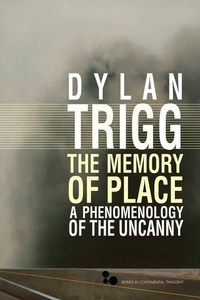
The Memory of Place
A Phenomenology of the Uncanny
1st Edition
Published on 9. January 2012
277 pages
978-0-8214-4404-7 (ISBN)
Description

From the frozen landscapes of the Antarctic to the haunted houses of childhood, the memory of places we experience is fundamental to a sense of self. Drawing on influences as diverse as Merleau-Ponty, Freud, and J. G. Ballard, The Memory of Place charts the memorial landscape that is written into the body and its experience of the world.
Dylan Trigg's The Memory of Place offers a lively and original intervention into contemporary debates within "place studies," an interdisciplinary field at the intersection of philosophy, geography, architecture, urban design, and environmental studies. Through a series of provocative investigations, Trigg analyzes monuments in the representation of public memory; "transitional" contexts, such as airports and highway rest stops; and the "ruins" of both memory and place in sites such as Auschwitz. While developing these original analyses, Trigg engages in thoughtful and innovative ways with the philosophical and literary tradition, from Gaston Bachelard to Pierre Nora, H. P. Lovecraft to Martin Heidegger. Breathing a strange new life into phenomenology, The Memory of Place argues that the eerie disquiet of the uncanny is at the core of the remembering body, and thus of ourselves. The result is a compelling and novel rethinking of memory and place that should spark new conversations across the field of place studies.
Edward S. Casey, Distinguished Professor of Philosophy at Stony Brook University and widely recognized as the leading scholar on phenomenology of place, calls The Memory of Place "genuinely unique and a signal addition to phenomenological literature. It fills a significant gap, and it does so with eloquence and force." He predicts that Trigg's book will be "immediately recognized as a major original work in phenomenology."
Dylan Trigg's The Memory of Place offers a lively and original intervention into contemporary debates within "place studies," an interdisciplinary field at the intersection of philosophy, geography, architecture, urban design, and environmental studies. Through a series of provocative investigations, Trigg analyzes monuments in the representation of public memory; "transitional" contexts, such as airports and highway rest stops; and the "ruins" of both memory and place in sites such as Auschwitz. While developing these original analyses, Trigg engages in thoughtful and innovative ways with the philosophical and literary tradition, from Gaston Bachelard to Pierre Nora, H. P. Lovecraft to Martin Heidegger. Breathing a strange new life into phenomenology, The Memory of Place argues that the eerie disquiet of the uncanny is at the core of the remembering body, and thus of ourselves. The result is a compelling and novel rethinking of memory and place that should spark new conversations across the field of place studies.
Edward S. Casey, Distinguished Professor of Philosophy at Stony Brook University and widely recognized as the leading scholar on phenomenology of place, calls The Memory of Place "genuinely unique and a signal addition to phenomenological literature. It fills a significant gap, and it does so with eloquence and force." He predicts that Trigg's book will be "immediately recognized as a major original work in phenomenology."
Reviews / Votes
"Genuinely unique and a signal addition to phenomenological literature.... It fills a significant gap, and it does so with eloquence and force." "Important for readers of continental philosophy in general, as well as place studies and psychology, Trigg's work is an indispensable piece not to be overlooked." (International Journal of Philosophical Studies) "The rewards of (The Memory of Place)...are manifold, and its contribution to the growing literature on the uncanny is undeniable.... My experience of (Trigg's) book can be characterized in the terms that Trigg himself uses: it is one of ambivalent fascination, at once enthralled and overwhelmed." (Rain Taxi) "This work marks a highly original contribution to the growing interdisciplinary, phenomenological informed, literature examining the nature of place. However, while drawing on phenomenology, this is by no means standard phenomenologically-informed fare. The terrain covered and position arrived at is far weirder and unsettled." (Emotion, Space and Society) "Trigg displays an impressive knowledge of the recent literature on place, memory and the uncanny, and the book is worth the effort for those with an interest in where the concept is currently headed... . Trigg's emphasis on Merleau-Ponty rather than Heidegger for his phenomenology is a master-stroke: Trigg skillfully deploys Merleau-Ponty's philosophy to transcend the rigid dichotomy between subject and object and thus manages to reveal uncanniness as both a subjective experience." (Los Angeles Review of Books) "(The Memory of Place) will be of interest to researchers in philosophy, cultural studies, architectural theory, geography, and environmental studies. Summing Up: Recommended." (Choice) "Trigg takes readers on a subtle and nuanced tour that will intrigue philosophers and psychologists as well as students and researchers involved with any of the disciplines that intersect as 'place studies'-including architecture, geography, urban planning, and environmental studies." (Book News)More details
Series
Edition
1. Auflage
Language
English
Place of publication
Athens
United States
Target group
Professional and scholarly
File size
4,20 MB
ISBN-13
978-0-8214-4404-7 (9780821444047)
Copyright in bibliographic data and cover images is held by Nielsen Book Services Limited or by the publishers or by their respective licensors: all rights reserved.
Schweitzer Classification
Other editions
Additional editions
Book
03/2013
Ohio University Press
€35.00
Shipment within 10-20 days
Book
01/2012
Ohio University Press
€67.00
Shipment within 10-20 days
Person
Dylan Trigg is a postdoctoral research fellow at University College Dublin, School of Philosophy. He is also a visiting researcher at Les Archives Husserl, Ecole Normale Superieure, Paris. He is the author of The Aesthetics of Decay and has published widely on phenomenology, continental philosophy, and aesthetics. He lives in Dublin and Paris.
Content
- Intro
- Title
- Copyright
- Contents
- List of Illustrations
- Preface: Touching the Past
- Acknowledgments
- Introduction: Phenomenology and Place
- A Phenomenology of Place
- Body Memory
- Embodiment and Phenomenology
- Placing Phenomenology
- 1. Second Seeing
- 2. The Life-World
- 3. The Uncanny
- 4. Descriptiveness
- The Phenomenological Method
- Part one: From Place to Memory
- 1 Between memory and Imagination
- Scene and Surrounding
- The Memory of Place
- Journeying Toward Slovenia
- Dreaming of Place
- Memory as a Rediscovery
- 2 Monuments of Memory
- From Memory to History
- Placing Narratives
- A Phenomenology of the Chattri
- Memory, Meaning, Materiality
- A Texture of Death
- Part Two: From Flesh to Materiality
- 3 Memories of the Flesh
- The Lived-Body
- Inside and Outside
- The Absolute Here
- The Memory of Airports
- Against Non-Places
- Wild Being
- Journeying Toward the Service Station
- Light, Shadow, Texture
- Anxious Embodiment
- Alien Flesh
- 4 The Dark Entity
- Place-Making
- A Phenomenology of Nostalgia
- Homesickness
- Spatial Morphology
- An Uncanny Return
- The Dark Entity
- Part Three: From Black Holes to specters
- 5 Traumatic Embodiment
- The Event Horizon
- (Re)claiming Experience
- The Skin of Memory
- The Phantom Zone
- 6 Ruins of Trauma
- Abnormal Embodiment
- Memories of Nightmares
- Taumatized Materiality
- A Disturbance of Memory
- Conclusion: This Place Is Haunted
- Ghost H(a)unting
- The Doppelgünger
- Phantom Memory
- An Uncanny Mood
- The Haunting
- References
- Index
