

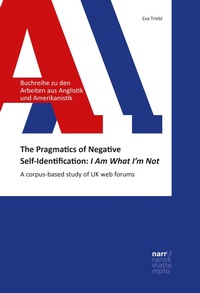
The Pragmatics of Negative Self-Identification: I Am What I'm Not
A corpus-based study of UK web forums
1st Edition
Published on 8. December 2025
378 pages
978-3-381-12823-5 (ISBN)
Description

This book explores how variants of "I'm not a/n..." function as a linguistic strategy in web forums, revealing how users present themselves while negotiating shared interests. It starts from the premise that identity is not fixed but performed in interaction, shaped by situational and sociocultural factors. In disembodied online communication, negative self-identification positions speakers in relation to their claims and highlights relevant identity categories. Through a corpus-based study, this book uncovers patterns of meaning-making and guides readers through conducting research in discourse pragmatics. It will be of interest to students of English linguistics, scholars in applied linguistics, and anyone curious about the links between language, identity, and the social world.
More details
Other editions
Additional editions
Eva Triebl
The Pragmatics of Negative Self-Identification: I Am What I'm Not
A corpus-based study of UK web forums
Book
12/2025
1st Edition
Narr Francke Attempto
€84.00
Shipment within 7-9 days
Person
Eva Triebl ist angewandte Sprachwissenschaftlerin im Bereich Anglistik und arbeitet als Lektorin an den Universitäten Wien und Klagenfurt.
Ihr Forschungsinteresse liegt in der korpusbasierten, pragmatisch orientierten Kritischen Diskursanalyse. Dabei konzentriert sie sich insbesondere auf pragmatische Strategien zur Legitimation von Meinungsäußerungen und zur Konstituierung von Expertise in digitalen Medien.
Ihr Forschungsinteresse liegt in der korpusbasierten, pragmatisch orientierten Kritischen Diskursanalyse. Dabei konzentriert sie sich insbesondere auf pragmatische Strategien zur Legitimation von Meinungsäußerungen und zur Konstituierung von Expertise in digitalen Medien.
Content
1. INTRODUCTION
2. IDENTITY, (NEGATIVE) SELF-IDENTIFICATION AND THE SOCIAL WORLD
2.1. Conceptualizing identity
2.2. Contemporary struggles around identity
2.3. The discourse context: Self-identification on web forums
2.4. Summary
3. THEORETICALLY CONTEXTUALIZING NEGATIVE SELF-IDENTIFIERS
3.1. Studying forms, meanings, and functions
3.2. Theorizing negatives
3.3. Theorizing the identifying noun phrase
3.4. The structure "I + copula + NOT + identifying NP" in British English
3.5. Summary
4. FUNCTIONALLY CONCEPTUALIZING NEGATIVE SELF-IDENTIFICATION
4.1. Negative self-identifiers as speech acts
4.2. Negative self-identifiers as context-dependent meaning potentials
4.3. Negative self-identifiers and (corpus-based) Critical Discourse Analysis
4.4. Summary
5. THE EMPIRICAL STUDY: DATA AND METHOD
5.1. Theoretical and methodological principles
5.2. Data selection and collection
5.3. Summary
6. THE EMPIRICAL STUDY: ANALYTICAL APPROACH AND ANNOTATION
6.1. A formal-functional framework of negative self-identifiers in use
6.2. Corpus annotation
6.3. Data analysis
6.4. Summary
7. CONCEPTUALLY PROFILING NEGATIVE SELF-IDENTIFIERS
7.1. Theoretical considerations and methodological principles
7.2. Results
7.3. Summary
8. NEGATIVE SELF-IDENTIFIERS AND THEIR IMMEDIATE CO-TEXTS
8.1. General co-textual profile
8.2. Negative self-identifiers and their formally related co-texts
8.3. Summary
9. THE DISCOURSE FUNCTIONS OF NEGATIVE SELF-IDENTIFIERS
9.1. Functional analysis of formally related co-texts
9.2. Functional analysis of co-texts preceding negative self-identifiers
9.3. Qualitatively studying negative self-identifiers in context
9.4. Summary
10. DISCUSSION AND CONCLUSION
11. REFERENCES
APPENDIX
2. IDENTITY, (NEGATIVE) SELF-IDENTIFICATION AND THE SOCIAL WORLD
2.1. Conceptualizing identity
2.2. Contemporary struggles around identity
2.3. The discourse context: Self-identification on web forums
2.4. Summary
3. THEORETICALLY CONTEXTUALIZING NEGATIVE SELF-IDENTIFIERS
3.1. Studying forms, meanings, and functions
3.2. Theorizing negatives
3.3. Theorizing the identifying noun phrase
3.4. The structure "I + copula + NOT + identifying NP" in British English
3.5. Summary
4. FUNCTIONALLY CONCEPTUALIZING NEGATIVE SELF-IDENTIFICATION
4.1. Negative self-identifiers as speech acts
4.2. Negative self-identifiers as context-dependent meaning potentials
4.3. Negative self-identifiers and (corpus-based) Critical Discourse Analysis
4.4. Summary
5. THE EMPIRICAL STUDY: DATA AND METHOD
5.1. Theoretical and methodological principles
5.2. Data selection and collection
5.3. Summary
6. THE EMPIRICAL STUDY: ANALYTICAL APPROACH AND ANNOTATION
6.1. A formal-functional framework of negative self-identifiers in use
6.2. Corpus annotation
6.3. Data analysis
6.4. Summary
7. CONCEPTUALLY PROFILING NEGATIVE SELF-IDENTIFIERS
7.1. Theoretical considerations and methodological principles
7.2. Results
7.3. Summary
8. NEGATIVE SELF-IDENTIFIERS AND THEIR IMMEDIATE CO-TEXTS
8.1. General co-textual profile
8.2. Negative self-identifiers and their formally related co-texts
8.3. Summary
9. THE DISCOURSE FUNCTIONS OF NEGATIVE SELF-IDENTIFIERS
9.1. Functional analysis of formally related co-texts
9.2. Functional analysis of co-texts preceding negative self-identifiers
9.3. Qualitatively studying negative self-identifiers in context
9.4. Summary
10. DISCUSSION AND CONCLUSION
11. REFERENCES
APPENDIX
