

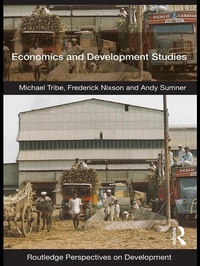
Economics and Development Studies
1st Edition
Published on 13. September 2010
312 pages
978-1-136-93874-0 (ISBN)
Description

Development studies textbooks and courses have sometimes tended to avoid significant economic content. However, without an understanding of the economic aspects of international development many of the more complex issues cannot be fully comprehended. Economics and Development Studies makes the economic dimension of discourse around controversial issues in international development accessible to second and third year undergraduate students working towards degrees in development studies.
Following an introductory chapter outlining the connections between development economics and development studies, this book consists of eight substantive chapters dealing with the nature of development economics, economic growth and structural change, economic growth and developing countries, economic growth and economic development since 1960, the global economy and the Third World, developing countries and international trade, economics and development policy, and poverty, equality and development economists, with a tenth concluding chapter.
This book synthesizes existing development economics literature in order to identify the salient issues and controversies and make them accessible and understandable. The concern is to distinguish differences within the economics profession, and between economists and non-economists, so that the reader can make informed judgments about the sources of these differences, and about their impact on policy analysis and policy advice. The book features explanatory text boxes, tables and diagrams, suggestions for further reading, and a listing of the economic concepts used in the chapters.
Following an introductory chapter outlining the connections between development economics and development studies, this book consists of eight substantive chapters dealing with the nature of development economics, economic growth and structural change, economic growth and developing countries, economic growth and economic development since 1960, the global economy and the Third World, developing countries and international trade, economics and development policy, and poverty, equality and development economists, with a tenth concluding chapter.
This book synthesizes existing development economics literature in order to identify the salient issues and controversies and make them accessible and understandable. The concern is to distinguish differences within the economics profession, and between economists and non-economists, so that the reader can make informed judgments about the sources of these differences, and about their impact on policy analysis and policy advice. The book features explanatory text boxes, tables and diagrams, suggestions for further reading, and a listing of the economic concepts used in the chapters.
Reviews / Votes
"For far too long students of development studies have found economics, particularly its mainstream variant, to be arcane and inaccessible due to barriers of language and method. Instead of absorbing and at times confronting the discipline, many students have side-stepped important economic issues. Economics, in turn, has been able to dismiss insights from development studies as outside their field. Tribe, Nixson and Sumner have written a highly accessible new volume that goes beyond the dogma of mainstream economics to incorporate the richness and diversity of the field of development economics. Their book will undoubtedly create a new level of economic literacy in the next generation of development studies students and contribute to an improved dialogue of the disciplines." Howard Stein, Professor, University of Michigan."Most development studies texts shy away from discussing economics in any real depth, but this one does not. It provides the reader with a rigorous, but accessible - and critical - account of the importance of economics to the study of development, and is highly recommended." Professor Ray Kiely, School of Politics and International Relations, Queen Mary University of London.
"A wonderful resource for anyone wanting to think rigorously about national and international policy for human development, this book brings key elements of development economics in accessible language. The book synthesizes much of the best thinking and lessons of best practice in the last half century of international development." Sakiko Fukuda-Parr, Professor, Graduate Program in International Affairs, The New School, New York.
More details
Series
Edition
1. Auflage
Language
English
Place of publication
London
United Kingdom
Publishing group
Taylor & Francis Ltd
Target group
College/higher education
Illustrations
15 s/w Abbildungen, 17 s/w Tabellen, 3 s/w Photographien bzw. Rasterbilder, 12 s/w Zeichnungen
17 Tables, black and white; 12 Line drawings, black and white; 3 Halftones, black and white; 15 Illustrations, black and white
File size
5,18 MB
ISBN-13
978-1-136-93874-0 (9781136938740)
Copyright in bibliographic data and cover images is held by Nielsen Book Services Limited or by the publishers or by their respective licensors: all rights reserved.
Schweitzer Classification
Other editions
Additional editions
Michael Tribe | Frederick Nixson | Andy Sumner
Economics and Development Studies
Book
08/2010
1st Edition
Routledge
€76.92
Shipment within 15-20 days
Michael Tribe | Frederick Nixson | Andy Sumner
Economics and Development Studies
Book
08/2010
1st Edition
Routledge
€232.20
Shipment within 15-20 days
Persons
Michael Tribe is a development economist whose principal overseas research, consultancy and teaching experience has been in sub-Saharan Africa, in Uganda and Ghana in particular, over four decades. He has been the Honorary Secretary of the UK and Ireland Development Studies Association since 2000.
Frederick Nixson is Emeritus Professor of Development Economics at the University of Manchester. His research interests span macroeconomic policy, aid, industrialisation strategies and experiences, privatisation, the Asian transitional economies and poverty.
Andy Sumner is a fellow of the Vulnerability and Poverty Research Team at the Institute of Development Studies. He is a cross-disciplinary economist with primary foci of interest in child poverty and wellbeing; poverty indicators, concepts, methods, approaches; and the politics of policy processes.
Frederick Nixson is Emeritus Professor of Development Economics at the University of Manchester. His research interests span macroeconomic policy, aid, industrialisation strategies and experiences, privatisation, the Asian transitional economies and poverty.
Andy Sumner is a fellow of the Vulnerability and Poverty Research Team at the Institute of Development Studies. He is a cross-disciplinary economist with primary foci of interest in child poverty and wellbeing; poverty indicators, concepts, methods, approaches; and the politics of policy processes.
Content
1. Development Economics and Development Studies 2. The Nature of Development Economics 3. Economic Growth and Structural Change 4. Economic Growth and Developing Countries 5. Economic Growth and Economic Development Since 1960 6. The Global Economy and the Third World 7. Developing Countries and International Trade 8. Economics and Development Policy 9. Poverty, Inequality and Development Economists 10. Conclusion
