

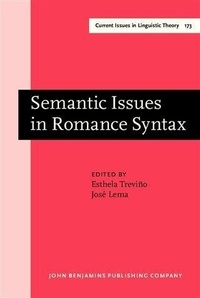
Semantic Issues in Romance Syntax
1st Edition
Published on 15. May 1999
VIII, 309 pages
978-90-272-8459-4 (ISBN)
Description

All of the articles in this volume focus on the interaction of form and meaning. Most of them are developed under the principal thesis of the Minimalist Program. These works show that the theoretical linguistic trend is to discover semantic aspects which are assumed to have visible syntactic repercussions through morphosyntactic and morphosemantic features.
More details
Other editions
Additional editions
Esthela Trevino | Jose Lema
Semantic Issues in Romance Syntax
Book
05/1999
John Benjamins Publishing Co
€127.20
Shipment within 10-15 days
Persons
Content
- SEMANTIC ISSUES IN ROMANCE SYNTAX
- Editorial page
- Title page
- Copyright page
- PREFACE
- Table of contents
- INFINITIVES VS. PARTICIPLES
- 1. Basic proposal
- 2. Infinitives vs. participles - Genericity vs. single event reading
- 3. The analysis
- 4. Conclusions
- REFERENCES
- WITHOUT EXPLETIVE REPLACEMENT?
- 1. Introduction
- 2. The expletive replacement proposal
- 3. A first problem: Principle A
- 4. A second problem: Principle C
- 5. Binding in CLLD
- 6. Dissociating Binding and Control?
- 7. Without Expletive Replacement
- 8. Conclusion
- REFERENCES
- VERBAL STRUCTURES AND VARIATION
- 1. Introduction
- 2. Verb internal variation
- 3. Phrasal structur
- 4. Concluding remarks
- REFERENCES
- FRENCH DEGREE QUANTIFIERS AND THE SYNTAX OF MASS AND COUNT
- 1. The problem
- 2. French degree quantifiers
- 3. The mass/count distinction in the verbal system
- 4. The proposal
- 5. Conclusions
- REFERENCES
- NEUTER RELATIVES AND THE DEGREE OPERATOR
- 1. Kayne's analysis of relative clauses
- 2. Degree relatives and the neuter determiner
- 3. The contribution of the semantics of lo
- 4. A syntactic analysis and its interpretation
- 5. The degree operator
- 6. Why does the adjective raise?
- REFERENCES
- ON THE INTERPRETATION OF SPANISH N-WORDS
- 1. Initial n-words as NQs
- 2. Standard non-initial n-words are NPIs
- 3. Non-initial n-words that function as NQs
- 4. Open questions
- REFERENCES
- WHAT DOES ZERO SYNTAX ADD TO AN ANALYSIS OF FRENCH PSYCH VERBS?
- 0. Introduction
- 1. Issues relating to Pesetsky's treatment
- 2. Revaluation of Pesetsky 's treatment
- 3. A minimalist proposal
- 4. Conclusion
- REFERENCES
- THE PRONOUN ~ DETERMINER DEBATE: EVIDENCE FROM SARDINIAN AND REPERCUSSIONS FOR FRENCH
- 1. The pronoun-determiner debate
- 2. Evidence from Sardinian
- 3. Repercussions for French
- 4. Conclusion
- REFERENCES
- A MINIMALIST APPROACH TO COMPOSITIONALITY OF ASPECT
- 1.0 Introduction
- 2.1 LexicalCompositionality (LC)
- 3.0 Conclusions
- REFERENCES
- CONFIGURATIONAL ATTITUDES
- 1. Introduction
- 2. Twotypes of belief
- 3. Extending the analysis: belief 'de se' and possession of beliefs
- 4. Conclusion
- REFERENCES
- INFORMATION FOCUS: BETWEEN CORE AND PERIPHERY
- Introduction
- 1. Wide Focus Interpretation
- 2. Encoding Focus in Grammar
- 3. Focus and Subject In version
- 4. The Role of the EPP
- 5. Narrow focus
- 6. Markedness
- 7. Conclusions
- REFERENCES
- RELATIVIZED IMPERSONALITY: DEONTIC SENTENCES IN CATALAN
- 1. Introduction
- 2. Lexical relational structure of caldre
- 3. The Dative subject
- 4. The Object of caldre
- 5. Caldre + infinitive clause
- 5. Other Deontic Verbs
- 6. Concluding Remarks
- REFERENCES
- QUAINT AGREEMENT AND THE THEORY OF SPELL-OUT
- 1. Introduction
- 2. Assumptions
- 3. Characterization
- 4. Analysis
- 4. Conclusion
- REFERENCES
- AKTIONSART AND TRANSITIVE PHRASES
- 1. Interpretable Features and Functional Categories
- 2. What at is telicity ?
- 3. Determining the strength of the features
- 4. Unaccusatives
- 5. Summary and Conclusions
- REFERENCES
- DETERMINER TRANSPARENCY: EVIDENCE FROM BRAZILIAN PORTUGUESE
- Introduction
- 1. Basics of VP Aspect Calculus
- 2. The syntax o/DT
- REFERENCES
- THE POST-VERBAL SUBJECT POSITION OF ITALIANUNACCUSATIVE VERBS OF INHERENTLYDIRECTED MOTION
- 1. Introduction
- 2. The 'implicit locative' of arrive-type verbs
- 3. The syntax of contrastivefocus in Italian
- 4. Explanation for relation between presence / absence of GOAL and interpretation of post-verbal subject
- 5. Conclusions
- REFERENCES
- INDEX OF AUTHORS
- INDEXOF TERMS & CONCEPTS
- INDEX OF LANGUAGES & LANGUAGE FAMILIES
