

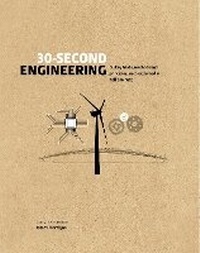
30-Second Engineering
50 key fields, methods, and principles, each explained in half a minute
Published on 1. October 2019
160 pages
978-1-78240-840-6 (ISBN)
Description

30-Second Engineering surveys the tasks and challenges that engineers face in every field, from civil to electrical, and explores their methods, inventions and achievements.
Part of the 30-Second series, this introduction to engineering is split into 7 chapters that cover:
Engineering Methods - from problem solving to applying mathematics
Civil & Environmental Engineering - building bridges, taming rivers and industry ethics
Mechanical, Materials & Mechatronic Engineering - from thrust bearings to robotics
Chemical Engineering & Energy Production - energy supplies and industry hazards
Electrical & Electronic Engineering - from computers to internet storage and biomedical body parts
Aerospace & Transport Engineering - driverless cars, floating factories and lessons from space
Engineering the future - how engineers endeavour to save the planet
Plus profiles of notable engineers, such as Ernst Dickmanns, William Rankine, Liang Jianying and Fazlur Khan.
Each topic is summarised in 300 words with one image, helping you understand the subject at great speed. Written by industry experts from around the world, this book gives incredible insight to an underrated but integral occupation. Without it, skyscrapers, driverless cars, energy supply systems, AI, factories, the internet and aircraft would not exist. Engineering enabled our evolution and this book will arm you with the conversational prowess to discuss it.
If you like this then you might be interested in 30-Second Energy . . .
Part of the 30-Second series, this introduction to engineering is split into 7 chapters that cover:
Engineering Methods - from problem solving to applying mathematics
Civil & Environmental Engineering - building bridges, taming rivers and industry ethics
Mechanical, Materials & Mechatronic Engineering - from thrust bearings to robotics
Chemical Engineering & Energy Production - energy supplies and industry hazards
Electrical & Electronic Engineering - from computers to internet storage and biomedical body parts
Aerospace & Transport Engineering - driverless cars, floating factories and lessons from space
Engineering the future - how engineers endeavour to save the planet
Plus profiles of notable engineers, such as Ernst Dickmanns, William Rankine, Liang Jianying and Fazlur Khan.
Each topic is summarised in 300 words with one image, helping you understand the subject at great speed. Written by industry experts from around the world, this book gives incredible insight to an underrated but integral occupation. Without it, skyscrapers, driverless cars, energy supply systems, AI, factories, the internet and aircraft would not exist. Engineering enabled our evolution and this book will arm you with the conversational prowess to discuss it.
If you like this then you might be interested in 30-Second Energy . . .
More details
Series
Language
English
Place of publication
London
United Kingdom
Publishing group
Quarto Publishing PLC
Product notice
Reflowable
File size
29,44 MB
ISBN-13
978-1-78240-840-6 (9781782408406)
Copyright in bibliographic data and cover images is held by Nielsen Book Services Limited or by the publishers or by their respective licensors: all rights reserved.
Schweitzer Classification
Other editions
Additional editions
James Trevelyan
30-Second Engineering
50 key fields, methods, and principles, each explained in half a minute
Book
10/2019
Ivy Press
€38.59
Article exhausted; check different version
Person
James Trevelyan is emeritus professor at The University of Western Australia, where he taught engineering for 41 years. He is best-known for pioneering sheep-shearing robots, remote access laboratories and landmine clearance methods. He won the pre-eminent award for robotics-the Engelberger Science and Technology Award-in 1993. An expert in the theory of engineering practice, Trevelyan has won several national awards for teaching excellence and awards for papers on engineering education. He is author of The Making of an Expert Engineer, which summarises his pioneering research on how engineering work is actually performed.
Content
- Cover
- Half Title
- Title
- Copyright
- CONTENTS
- Introduction
- Engineering Methods
- GLOSSARY
- Divide & Conquer
- Applying Mathematics
- Beyond Science
- Problem-solving Design
- Standards & Specifications
- Making it Happen
- Engineering Thinking
- Profile: Charles Yelverton O'Connor
- Civil & Environmental Engineering
- GLOSSARY
- Civil Engineering
- Profile: Fazlur Rahman Khan
- Force Equilibrium Principle
- Geotechnical Engineering
- Engineers & Architects
- Engineering & Civilization
- Taming Great Rivers
- Engineering Ethics
- Environmental Engineering
- Mechanical, Materials & Mechatronic Engineering
- GLOSSARY
- Mechanical Engineering
- Profile: William John Macquorn Rankine
- Materials Engineering
- Mechatronics
- Defence Readiness
- Thrust Bearings to Terabytes
- Wind Energy
- Robotics & Automation
- Chemical Engineering & Energy Production
- GLOSSARY
- Chemical Engineering
- Power Generation & Energy Storage
- Nuclear Power
- Organizational Safety
- Process Plant Safety
- Plastics & Fertilizers
- Profile: Fritz Haber & Carl Bosch
- Electrical & Electronic Engineering
- GLOSSARY
- Electrical Engineering
- Electronic Engineering
- Computer Engineering
- Software Engineering
- Profile: Grace Brewster Hopper
- Nanotechnology
- Information & Telecoms
- Signal Processing
- Biomedical Engineering
- Aerospace & Transport Engineering
- GLOSSARY
- Railway Engineering
- Profile: Liang Jianying
- Floating Factories
- Fundamentals of Aerodynamics
- Aerospace Materials
- Lessons from Space
- Driverless Cars
- Engineering the Future
- GLOSSARY
- Thinking Differently
- Innovation
- Profile: Ernst Dieter Dickmanns
- Energy & Finance
- Resource Scarcity
- Feeding Our World
- Water Security
- Controlling Pollution
- Future Transport: Drone Ships
- Appendices
- Resources
- Notes on Contributors
- Index
- A
- B
- C
- D
- E
- F
- G
- H
- I
- K
- L
- M
- N
- O
- P
- Q
- R
- S
- T
- U
- V
- W
- Acknowledgements
