

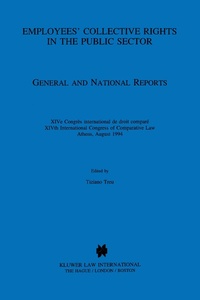
Employees' Collective Rights in the Public Sector
General and National Reports
Published on 1. March 1997
254 pages
978-90-411-7493-2 (ISBN)
Description

"Labour relations in the public service are undergoing a transformation, possibly more profound than the public sector. The concurrent effect of economic, technological and social pressures are challenging the very concept of public service and consequently the position of employees" --from the author's general report.
This important work brings together in one volume the author's general report and ten of the national reports presented by the panel on employees' collective rights in the public sector which convened at the XIVth International Congress of Comparative Law in Athens.
It focuses on recent developments and trends in employees
collective rights and on collective labour relations in the public sector over the last decade, the most significant of which is a general move towards some kind of privatization and deregulation.
The general report compares and contrasts common themes relating to employees' collective rights. National reports from Argentina, Australia, Belgium, Canada, France, Greece, Japan, the Netherlands, Portugal, and the United Kingdom follow. Each appears in the language of the originating country.
The contributors to this work are specialist lawyers and expert scholars in the field. The book will interest and inform practitioners and academics concerned with employment law and public law.
This important work brings together in one volume the author's general report and ten of the national reports presented by the panel on employees' collective rights in the public sector which convened at the XIVth International Congress of Comparative Law in Athens.
It focuses on recent developments and trends in employees
collective rights and on collective labour relations in the public sector over the last decade, the most significant of which is a general move towards some kind of privatization and deregulation.
The general report compares and contrasts common themes relating to employees' collective rights. National reports from Argentina, Australia, Belgium, Canada, France, Greece, Japan, the Netherlands, Portugal, and the United Kingdom follow. Each appears in the language of the originating country.
The contributors to this work are specialist lawyers and expert scholars in the field. The book will interest and inform practitioners and academics concerned with employment law and public law.
More details
Other editions
Additional editions
Tiziano Treu
Employees' Collective Rights in the Public Sector:XIVe Congres International De Droit Compare - XIVth International Congress of Comparative Law
General and National Reports
Book
03/1997
1st Edition
Kluwer Law International
€125.19
Shipment within 10-20 days
Content
- Cover
- Half Title Page
- Title Page
- Copyright Page
- Table of Contents
- PREMIERE PARTIE: LE RAPPORT GENERAL
- EMPLOYEES' COLLECTIVE RIGHTS IN THE PUBLIC SECTOR
- 1. INTRODUCTION: THE PUBLIC SECTOR AND THE TRENDS TOWARD PRIVATIZATION
- 2. THE PUBLIC SECTOR: RELATIVITY AND DIFFERENCES
- 3. THE RECOGNITION OF EMPLOYEES COLLECTIVE RIGHTS: THE RIGHT TO ORGANIZE
- 4. THE RIGHT TO COLLECTIVE BARGAINING
- 5. CONCERTATION, CONSULTATION, PARTICIPATION
- 6. THE RIGHT TO STRIKE (AND LOCK OUT)
- 7. CONCLUSION
- BIBLIOGRAPHY
- DEUXIEME PARTIE: LES RAPPORT NATIONAUX
- INFORME ARGENTINO REFERIDO AL RÉGIMEN DE LOS EMPLEADOS DEL ESTADO - ARGENTINA REPORT
- 1). Trabajadores públicos nacionales (dependientes del gobierno federal), provinciales y municipales de acuerdo con el esquema de organización nacional.
- 2). Derechos fundamentales que gozan.
- 3). Naturaleza del vinculo que los une al Estado.
- 4). Empleados de la Administración Central, descentralizada y de "Empresas de Estado".
- 5). Afiliación sindical de los empleados públicos.
- 6). Ejercicio del derecho de huelga.
- 7). Idem. de la negociación colectiva.
- 8). Convenios colectivos en el sector docente oficial.
- 9). Idem. en la Administración Pública Nacional.
- 10). Experiencia hasta la fecha en materia de negociación colectiva en dichos sectores.
- 11). Situación planteada con motivo de las privatizaciones.
- EMPLOYEES' COLLECTIVE RIGHTS IN THE PUBLIC SECTOR - AUSTRALIA REPORT
- INTRODUCTION
- 1. THE "TRADITIONAL'' AUSTRALIAN PUBLIC SECTOR
- 2. PUBLIC SERVICE REFORM
- 3. PUBLIC SECTOR UNIONISM
- 4. INDUSTRIAL BARGAINING
- 5. STRIKES AND OTHER INDUSTRIAL ACTION
- LE DROITS COLLECTIFS DES TRAVAILLEURS DU SECTEUR PUBLIC - BELGIUM REPORT
- 1. INTRODUCTION
- 1.1. Au préalable
- 1.2. Délimitation du sujet
- 2. CONVERGENCES ET DIVERGENCES DES SYSTÈMES DE RELATIONS DU TRAVAIL DES SECTEURS PRIVÉ ET PUBLIC
- 2.1. L'état de subordination du travailleur et la nécessité de protection sociale qui en découle
- 2.1.1. L'état de dépendance économique et juridique du travailleur
- 2.1.2. Nécessité de protection sociale et ses manifestations dans le droit
- 2.2. Les droits collectifs comme éléments essentiels de la protection sociale
- 2.2.1. Les droits collectifs: aperçu
- 2.2.2. Les droits collectifs comme éléments essentiels de la protection sociale
- 2.3. Relativité de la spécificité des relations du travail dans le secteur public
- 2.3.1. Spécificité
- 2.3.2. Relativité de la spécificité
- 2.4. Le problème insoluble de la délimitation du secteur public et du secteur privé
- 3. DROITS COLLECTIFS DES TRAVAILLEURS DU SECTEUR PUBLIC
- 3.1. Aperçu des droits collectifs et de leurs sources en droit belge
- 3.2. La liberté syndicale comme droit fondamental
- 3.2.1. Contenu de la liberté syndicale
- 3.2.2. Titulaires du droit
- 3.3. Droit à l'activité syndicale
- 3.3.1. Les sources et le contenu du droit
- 3.3.2. Titulaires du droit
- 3.4. Le droit à la negociation collective
- 3.4.1. Droit de négocier ou obligation pour l'autorité publique de négocier
- 3.4.2. Nature et contenu de l'obligation de négocier
- 3.4.3. Structures de la négociation collective
- 3.4.4. Issues de la négociation
- 3.5. Le droit à la concertation collective
- 3.5.1. Droit d'être consulté ou obligation de concertation pour l'autorité publique
- 3.5.2. Nature et contenu (portée) de l'obligation de concertation
- 3.5.3. Structures de la concertation collective
- 3.5.4. Issues de la concertation
- 3.6. Le droit de grève des travailleurs du secteur public
- 4. MUTATIONS DU SECTEUR PUBLIC ET INFLUENCE SUR L'ORGANISATION DES DROITS COLLECTIFS
- EMPLOYEES' COLLECTIVE RIGHTS IN THE PUBBLIC SECTOR - CANADA (COMMON LAW) REPORT
- INTRODUCTION
- 1. DEFINING THE PUBLIC SECTOR
- 2. CHARACTERISTICS OF THE GENERAL LEGISLATION
- 3. EXTENSION OF COLLECTIVE BARGAINING TO THE CIVIL SERVICE AND BEYOND
- 3.1. The Civil Service: A Multiplicity of Models
- 3.2. The Broader Public Sector
- 3.2.1. The Ontario Scene
- 3.2.2. Police in Other Jurisdictions
- 3.2.3. Education in Other Jurisdictions
- 3.2.4. Special Provisions re Firefighters
- 3.2.5. Separate Health Care Provisions
- 4. SOME DISTINCTIVE FEATURES OF LEGISLATION AFFECTING THE PUBLIC SECTOR
- 4.1. Exclusions
- 4.2. Definition of the Bargaining Unit
- 4.3. Requirement of Certification
- 4.4. The Scope of Bargaining
- 4.5. Impasse Resolution
- 4.6. Enforcement of Collective Agreements: Rights Disputes
- 5. ISSUES OF THE 1990S
- 5.1. Control over public expenditure and the restructuring of the system: Governments versus their employees?
- 5.1.1. Ontario's Social Contract
- 5.1.2. The Health Care Accord in British Columbia
- 5.1.3. Restructuring Bargaining in B.C.'s Public Sector
- 5.1.4. Privatization and Contracting Out
- 5.1.5. Other Bargaining Issues
- 6. CONCLUSIONS
- DROITS COLLECTIFS DES TRAVAILLEURS DANS LE SECTEUR PUBLIC - FRANCE REPORT
- INTRODUCTION
- 1. DROITS COLLECTIFS ET PARTICIPATION
- 1.1. Association des travailleurs à la gestion de leurs entreprises
- 1.1.1. Démocratisation du secteur public
- 1.1.2. Intéressement, participation et actionnariat
- 1.1.3. Négociation collective
- 1.2. Associations des fonctionnaires à la gestion de la fonction publique
- 2. DROITS COLLECTIFS ET REVENDICATIONS
- 2.1. Le droit syndical
- 2.2. Le droit de grève
- 2.2.1. L'exercice du droit de grève
- 2.2.2. Les effets de la grève
- EMPLOYEES' COLLECTIVE RIGHTS IN THE PUBLIC SECTOR - GREEK REPORT
- 1. APERÇU GENERAL
- 1.1. Notions sur le secteur public et son personnel
- 1.2. La reconnaissance des libertés syndicales aux fonctionnaires
- 2. LA REGLEMENTATION DES DROITS SYNDICAUX. FONDAMENTAUX DES FONCTIONNAIRES
- 2.1. La liberté de se syndiquer
- 2.2. La grève
- 2.3. Procedure de consultation et de negociations collectives
- 2.3.1. Procédures de consultation
- 2.3.2. La question des négociations en vue de conclure des conventions collectives
- EMPLOYEE'S COLLECTIVE RIGHTS IN THE PUBLIC SECTOR - JAPAN REPORT
- 1. DEFINITION OF THE PUBLIC SECTOR
- 1.1. Government Employees
- 1.2. Nature of Governmental Employment
- 1.3. Impact of Privatization
- 1.4. "Public Element" in the Private Sector
- 2. MAJOR CHARACTERISTICS OF PUBLIC SECTOR LABOR RELATIONS
- 2.1. Unions
- 2.2. Impact of the Formation of RENGO
- 2.3. Conflicts in the Labor Relations Arena
- 3. COLLECTIVE RIGHTS OF EMPLOYEES
- 3.1. Right to Organize
- 3.2. Right to Bargain
- 3.3. Procedures for Dispute Settlement
- 3.4. Right to Strike
- 4. CONCLUDING REMARKS
- EMPLOYEES' COLLECTIVE RIGHTS IN THE PUBLIC SECTOR - THE NETHERLANDS REPORT
- 1. INTRODUCTION
- 2. COLLECTIVE BARGAINING
- 3.1. Employee participation
- 3.2. Recent developments
- 4. INDUSTRIAL ACTION
- 5. COLLECTIVE RIGHTS IN THE SECTOR FUNDED BY INSURANCE CONTRIBUTIONS AND SUBSIDIES
- CONSULTED LITERATURE
- CASES
- LES DROITS COLLECTIFS DES TRAVAILLEURS DU SECTEUR PUBLIC - PORTUGAL REPORT
- 1. LA RAISON DE L'ORDRE
- 2. DÉLIMITATION DU CADRE DE L'ANALYSE: LE "SECTEUR PUBLIC
- 3. LES COORDONNÉES CONSTITUTIONNELLES
- 4. REPRÉSENTATION COLLECTIVE DES TRAVAILLEURS
- 5. LA NÉGOCIATION COLLECTIVE
- 6. LA GRÈVE DANS LE SECTEUR PUBLIC
- 7. DROITS DE PARTICIPATION
- 8. EXCEPTIONS
- 9. UN APERÇU DE SYNTHÈSE
- EMPLOYEES' COLLECTIVE RIGHTS IN THE PUBLIC SECTOR - UNITED KINDOM REPORT
- INTRODUCTION
- 1. THE HISTORY OF THE LEGAL TREATMENT OF PUBLIC SECTOR EMPLOYMENT
- 2. THE GROWTH OF PUBLIC LAW REMEDIES
- 3. THE INCIDENCE OF LEGISLATION AFFECTING PUBLIC SECTOR EMPLOYEES
- 4. PUBLIC AND PRIVATE SECTOR INDUSTRIAL RELATIONS
- 5. RECENT TRENDS
- 6. THE IMPORTANCE OF EC LAW IN THE PUBLIC SECTOR
- 7. THE RIGHT TO ORGANISE
- 8. INDUSTRIAL ACTION
- Back Cover
