

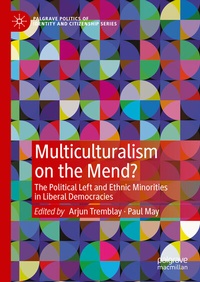
Multiculturalism on the Mend?
Description

This book sets out to provide a clearer picture of the movement and directionality of polyethnic rights - or immigrant-centered multiculturalism, as it is more commonly known - following recent shifts to the left in government (i.e., victories of left-parties, inclusion of left-parties in coalition governments, increase in left parties' presence in parliament, defeat of far-right parties and right-wing populists). In so doing, it aims to understand the near and longer-term prospects of multicultural policy, multicultural discourse, demographic multiculturalism, and laws and regulations related to the immigration process in the 21st century and in an increasingly complex ideological environment. The book comprises case studies of multicultural developments in eight countries - Sweden, Canada, Aotearoa New Zealand, Switzerland, Germany, the United States, Australia, and the United Kingdom - all of which have recently (2014-2024) experienced a shift to the left in national level politics, albeit in different ways and to varying degrees. In addition to understanding what has happened to multicultural policy and discourse in recent years, the book also sets out to identify the conditions under which multiculturalism is more or less likely to mend after a shift to the left in government. The book's overall aim is to see whether there is a future for multiculturalism in an increasingly ideologically complex environment or whether the victories of the political right, the rise of populism, the resurgence of anti-immigrant racism, the COVID-19 pandemic, and the changing nature of minority mobilization have irreversibly altered the course of multicultural affairs.
More details
Other editions
Additional editions
Persons
Arjun Tremblay
is Associate Professor in the Department of Politics and International Studies, University of Regina.
Paul May
is Associate Professor in the Département de Science Politique, Université du Québec à Montréal (UQAM).
Content
Chapter1: Shifts to the Left in Government and Multiculturalism: Expectations, Outcomes, and Puzzles.- Chapter2: Swedish Multiculturalism in the Wake of the Post-2015 Restrictive Turn in Immigration Politics.- Chapter3: Mending or Patching Over Inequality? The Substance of Multiculturalism under Canada's Liberal Government Since 2015.- Chapter4: Governing Diversity Through Crisis: Multicultural Politics Under Aotearoa New Zealand's Sixth Labour Government.- Chapter5: Multiculturalism and the Left in Switzerland: Tensions and Perspectives.- Chapter6: Multiculturalism Discourse and Policy: The Convergence of Two Path-Dependent Trajectories in Germany.- Chapter7: Multiculturalism, American-Style: The Politics of Race, Culture, and Diversity.- Chapter8: Multiculturalism and the Political Left in Australia: An Exceptional Case?.- Chapter9: Multicultural Continuity in the Absence of Deep Diversity in the United Kingdom.- Chapter10: Concluding Remarks.
