

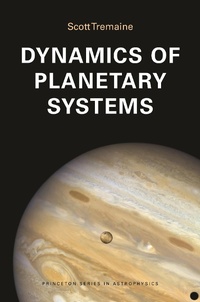
Dynamics of Planetary Systems
Published on 7. February 2023
640 pages
978-0-691-24422-8 (ISBN)
Description

An introduction to celestial mechanics for advanced undergraduates, graduate students, and researchers new to the field Celestial mechanics--the study of the movement of planets, satellites, and smaller bodies such as comets--is one of the oldest subjects in the physical sciences. Since the mid-twentieth century, the field has experienced a renaissance due to advances in space flight, digital computing, numerical mathematics, nonlinear dynamics, and chaos theory, and the discovery of exoplanets. This modern, authoritative introduction to planetary system dynamics reflects these recent developments and discoveries and is suitable for advanced undergraduate and graduate students as well as researchers. The book treats both traditional subjects, such as the two-body and three-body problems, lunar theory, and Hamiltonian perturbation theory, as well as a diverse range of other topics, including chaos in the solar system, comet dynamics, extrasolar planets, planetesimal dynamics, resonances, tidal friction and disruption, and more. The book provides readers with all the core concepts, tools, and methods needed to conduct research in the subject. Provides an authoritative introduction that reflects recent advances in the field Topics treated include Andoyer variables, co-orbital satellites and quasi-satellites, Hill's problem, the Milankovich equations, Colombo's top and Cassini states, the Yarkovsky and YORP effects, orbit determination for extrasolar planets, and more More than 100 end-of-book problems elaborate on concepts not fully covered in the main text Appendixes summarize the necessary background material Suitable for advanced undergraduates and graduate students; some knowledge of Hamiltonian mechanics and methods of mathematical physics (vectors, matrices, special functions, etc.) required Solutions manual available on request for instructors who adopt the book for a course
More details
Other editions
Additional editions
Scott Tremaine
Dynamics of Planetary Systems
Book
02/2023
Princeton University Press
€77.00
Shipment within 10-20 days
Scott Tremaine
Dynamics of Planetary Systems
Book
02/2023
Princeton University Press
€151.50
Article not available at the moment
Person
Scott Tremaine is Professor Emeritus at the Institute for Advanced Study in Princeton and a member of the Royal Society of London, the Royal Society of Canada, and the US National Academy of Sciences. He is the author (with James Binney) of Galactic Dynamics (Princeton).
Content
- Cover
- Contents
- Preface
- 1. The two-body problem
- 1.1 Introduction
- 1.2 The shape of the Kepler orbit
- 1.3 Motion in the Kepler orbit
- 1.3.1 Orbit averages
- 1.3.2 Motion in three dimensions
- 1.3.3 Gauss's f and g functions
- 1.4 Canonical orbital elements
- 1.5 Units and reference frames
- 1.5.1 Time
- 1.5.2 Units for the solar system
- 1.5.3 The solar system reference frame
- 1.6 Orbital elements for exoplanets
- 1.6.1 Radial-velocity planets
- 1.6.2 Transiting planets
- 1.6.3 Astrometric planets
- 1.6.4 Imaged planets
- 1.7 Multipole expansion of a potential
- 1.7.1 The gravitational potential of rotating fluid bodies
- 1.8 Nearly circular orbits
- 1.8.1 Expansions for small eccentricity
- 1.8.2 The epicycle approximation
- 1.8.3 Orbits and the multipole expansion
- 1.9 Response of an orbit to an external force
- 1.9.1 Lagrange's equations
- 1.9.2 Gauss's equations
- 2. Numerical orbit integration
- 2.1 Introduction
- 2.1.1 Order of an integrator
- 2.1.2 The Euler method
- 2.1.3 The modified Euler method
- 2.1.4 Leapfrog
- 2.2 Geometric integration methods
- 2.2.1 Reversible integrators
- 2.2.2 Symplectic integrators
- 2.2.3 Variable timestep
- 2.3 Runge-Kutta and collocation integrators
- 2.3.1 Runge-Kutta methods
- 2.3.2 Collocation methods
- 2.4 Multistep integrators
- 2.4.1 Multistep methods for first-order differential equations
- 2.4.2 Multistep methods for Newtonian differential equations
- 2.4.3 Geometric multistep methods
- 2.5 Operator splitting
- 2.5.1 Operator splitting for Hamiltonian systems
- 2.5.2 Composition methods
- 2.5.3 Wisdom-Holman integrators
- 2.6 Regularization
- 2.6.1 Time regularization
- 2.6.2 Kustaanheimo-Stiefel regularization
- 2.7 Roundo error
- 2.7.1 Floating-point numbers
- 2.7.2 Floating-point arithmetic
- 2.7.3 Good and bad roundo behavior
- 3. The three-body problem
- 3.1 The circular restricted three-body problem
- 3.1.1 The Lagrange points
- 3.1.2 Stability of the Lagrange points
- 3.1.3 Surface of section
- 3.2 Co-orbital dynamics
- 3.2.1 Quasi-satellites
- 3.3 The hierarchical three-body problem
- 3.3.1 Lunar theory
- 3.4 Hill's problem
- 3.4.1 Periodic orbits in Hill's problem
- 3.4.2 Unbound orbits in Hill's problem
- 3.5 Stability of two-planet systems
- 3.6 Disk-driven migration
- 4. The N-body problem
- 4.1 Reference frames and coordinate systems
- 4.1.1 Barycentric coordinates
- 4.1.2 Astrocentric coordinates
- 4.1.3 Jacobi coordinates
- 4.2 Hamiltonian perturbation theory
- 4.2.1 First-order perturbation theory
- 4.2.2 The Poincaré-von Zeipel method
- 4.2.3 Lie operator perturbation theory
- 4.3 The disturbing function
- 4.4 Laplace coefficients
- 4.4.1 Recursion relations
- 4.4.2 Limiting cases
- 4.4.3 Derivatives
- 4.5 The stability of the solar system
- 4.5.1 Analytic results
- 4.5.2 Numerical results
- 4.6 The stability of planetary systems
- 5. Secular dynamics
- 5.1 Introduction
- 5.2 Lagrange-Laplace theory
- 5.3 The Milankovich equations
- 5.3.1 The Laplace surface
- 5.3.2 Stellar flybys
- 5.4 ZLK oscillations
- 5.4.1 Beyond the quadrupole approximation
- 5.4.2 High-eccentricity migration
- 6. Resonances
- 6.1 The pendulum
- 6.1.1 The torqued pendulum
- 6.1.2 Resonances in Hamiltonian systems
- 6.2 Resonance for circular orbits
- 6.2.1 The resonance-overlap criterion for nearly circular orbits
- 6.3 Resonance capture
- 6.3.1 Resonance capture in the pendulum Hamiltonian
- 6.3.2 Resonance capture for nearly circular orbits
- 6.4 The Neptune-Pluto resonance
- 6.5 Transit timing variations
- 6.6 Secular resonance
- 6.6.1 Resonance sweeping
- 7. Planetary spins
- 7.1 Precession of planetary spins
- 7.1.1 Precession and satellites
- 7.1.2 The chaotic obliquity of Mars
- 7.2 Spin-orbit resonance
- 7.2.1 The chaotic rotation of Hyperion
- 7.3 Andoyer variables
- 7.4 Colombo's top and Cassini states
- 7.5 Radiative forces on small bodies
- 7.5.1 Yarkovsky effect
- 7.5.2 YORP effect
- 8. Tides
- 8.1 The minimum-energy state
- 8.2 The equilibrium tide
- 8.2.1 Love numbers
- 8.3 Tidal friction
- 8.4 Spin and orbit evolution
- 8.4.1 Semimajor axis migration
- 8.4.2 Spinup and spindown
- 8.4.3 Eccentricity damping
- 8.5 Non-equilibrium tides
- 8.5.1 Planets on high-eccentricity orbits
- 8.5.2 Resonance locking
- 8.6 Tidal disruption
- 8.6.1 The Roche limit
- 8.6.2 Tidal disruption of regolith
- 8.6.3 Tidal disruption of rigid bodies
- 9. Planet-crossing orbits
- 9.1 Local structure of a planetesimal disk
- 9.2 Disk-planet interactions
- 9.2.1 Collisions
- 9.2.2 Gravitational stirring
- 9.3 Evolution of high-eccentricity orbits
- 9.4 The Galactic tidal field
- 9.5 The Oort cloud
- 9.6 The trans-Neptunian belt
- 9.7 Earth-crossing asteroids
- Appendix A. Physical, astronomical and solar-system constants
- Appendix B. Mathematical background
- B.1 Vectors
- B.2 Coordinate systems
- B.3 Vector calculus
- B.4 Fourier series
- B.5 Spherical trigonometry
- B.6 Euler angles
- B.7 Calculus of variations
- Appendix C. Special functions
- C.1 Kronecker delta and permutation symbol
- C.2 Delta function
- C.3 Gamma function
- C.4 Elliptic integrals
- C.5 Bessel functions
- C.6 Legendre functions
- C.7 Spherical harmonics
- C.8 Vector spherical harmonics
- Appendix D. Lagrangian and Hamiltonian dynamics
- D.1 Hamilton's equations
- D.2 Rotating reference frame
- D.3 Poisson brackets
- D.4 The propagator
- D.5 Symplectic maps
- D.6 Canonical transformations and coordinates
- D.7 Angle-action variables
- D.8 Integrable and non-integrable systems
- D.9 The averaging principle
- D.10 Adiabatic invariants
- D.11 Rigid bodies
- Appendix E. Hill and Delaunay variables
- E.1 Hill variables
- E.2 Delaunay variables
- Appendix F. The standard map
- F.1 Resonance overlap
- Appendix G. Hill stability
- Appendix H. The Yarkovsky effect
- Appendix I. Tidal response of rigid bodies
- I.1 Tidal disruption of a rigid body
- Appendix J. Relativistic effects
- J.1 The Einstein-Infeld-Hoffmann equations
- Problems
- References
- Index
