

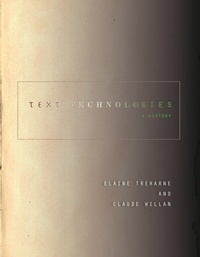
Text Technologies
A History
Published on 26. November 2019
222 pages
978-1-5036-0451-3 (ISBN)
Available for download
Description

The field of text technologies is a capacious analytical framework that focuses on all textual records throughout human history, from the earliest periods of traceable communication-perhaps as early as 60,000 BCE-to the present day. At its core, it examines the material history of communication: what constitutes a text, the purposes for which it is intended, how it functions, and the social ends that it serves.
This coursebook can be used to support any pedagogical or research activities in text technologies, the history of the book, the history of information, and textually based work in the digital humanities. Through careful explanations of the field, examinations of terminology and themes, and illustrated case studies of diverse texts-from the Cyrus cylinder to the Eagles' "Hotel California"-Elaine Treharne and Claude Willan offer a clear yet nuanced overview of how humans convey meaning. Text Technologies will enable students and teachers to generate multiple lines of inquiry into how communication-its production, form and materiality, and reception-is crucial to any interpretation of culture, history, and society.
This coursebook can be used to support any pedagogical or research activities in text technologies, the history of the book, the history of information, and textually based work in the digital humanities. Through careful explanations of the field, examinations of terminology and themes, and illustrated case studies of diverse texts-from the Cyrus cylinder to the Eagles' "Hotel California"-Elaine Treharne and Claude Willan offer a clear yet nuanced overview of how humans convey meaning. Text Technologies will enable students and teachers to generate multiple lines of inquiry into how communication-its production, form and materiality, and reception-is crucial to any interpretation of culture, history, and society.
Reviews / Votes
"Elaine Treharne and Claude Willan provide the big picture of the history of text-all the ways humans have recorded information from cave paintings to paper money and radar. Their work offers a rich conceptual framework and broad historical coverage to orient students and teachers amidst this fascinating landscape. Whether you are interested in theories that guide textual study, case studies about the Cyrus Cylinder or the Zoetrope, or questions of how technologies of inscription evolve, this clear and lucid book has ample material for a wide variety of curious readers."-Andrew Piper, McGill University "If there is one book to assign Humanities and Digital Humanities students that provides a wide range of knowledge about text technologies, it is this one. It introduces principal concepts along with ample historical examples, five diverse case studies, and an explanation about the way in which particular text technologies have shifted over time."-Dene Grigar, Washington State University Vancouver "A lucid and stimulating introduction to the history of text technologies, ranging from cave paintings, clay tablets, and Japanese tsunami memorials to films, mp3s, and iPads. Packed with thought-provoking examples and discussion, this book will engage a wide range of students, encouraging them to explore how the complex interplay between creativity, communication, and technology shapes global cultures."-Andrew Prescott, University of GlasgowMore details
Series
Edition
New edition
Language
English
Place of publication
Palo Alto
United States
Target group
Professional and scholarly
Edition type
New edition
Illustrations
75 s/w Abbildungen
3 tables, 75 halftones, 3 tables
ISBN-13
978-1-5036-0451-3 (9781503604513)
Copyright in bibliographic data and cover images is held by Nielsen Book Services Limited or by the publishers or by their respective licensors: all rights reserved.
Schweitzer Classification
Other editions
Additional editions
Book
11/2019
Stanford University Press
€106.50
Shipment within 15-20 days
Persons
Elaine Treharne is Roberta Bowman Denning Professor of Humanities and Professor of English (and, by courtesy, of German Studies) at Stanford University, as well as Director of Stanford's Center for Spatial and Textual Analysis.Claude Willan is Director of the Digital Research Commons at the University of Houston Libraries.
Content
- Cover
- Contents
- Illustrations
- Preface
- Acknowledgments
- PART I: CONCEPTUAL FRAMEWORK
- Introduction to TEXT
- Finding and Defining TEXT
- Describing TEXT
- What Is the Study of Text Technologies?
- How to Use This Book
- Overview of This Book
- Principal Concepts
- Intentionality
- Materiality
- Functionality
- Cultural Value/Aura
- Secondary Concepts
- Sedimentation
- Authority
- Production, Transmission, Consumption
- Censorship
- Copyright
- Consortia
- Cryptography
- PART II: HISTORICAL FRAMEWORK
- Timelines
- Historical Technologies
- Writing on Stone
- Chauvet Cave Paintings
- Babylonian Clay Tablets
- The Cyrus Cylinder
- The Florida Ostraka
- Behistun Monument
- The Rosetta Stone
- Roman Inscription
- Japanese Tsunami Stones
- Breamore Church
- Signs
- Graffiti
- Writing on Cellulose
- Papyrus
- Paper
- Wax Tablets
- Seals
- Writing on Animal Skin
- Parchment and Vellum
- The Hereford Mappa Mundi
- The Scroll
- The Codex
- Tattoos
- Form and Function
- Manuscript Culture
- A Bible
- A Book of Hours
- An Antiphonal
- Voynich Manuscript
- Jacobite Manuscript Poetry
- Bookbinding
- Woodcuts and Block Printing
- The Gutenberg Bible
- William Caxton and Early Modern Printing
- Protestant Bibles
- Shakespeare's Works
- Lithography
- Minard's Carte Figurative
- Chromolithography
- Reading for Everyone
- Newspapers
- Magazines
- The Spectator
- Samuel Johnson's A Dictionary of the English Language
- Denis Diderot and Jean le Rond d'Alembert's Encyclopédie
- Charles Dickens's Writing
- Readers and Reading
- The Marsh Library
- Duke Humfrey's Library
- The British Library
- Sound and Image
- The Zoetrope
- Film
- Television
- Radio
- Digital Technologies
- BBSs and the Well
- HTML, CSS, and RSS
- Web 2.0
- Touchscreen Tablets
- Proprietary Content Streams
- Research Questions
- New Text Technologies
- Writing Systems
- Form
- Substrates
- Sample Tools and Materials
- Trends, Themes, and Issues
- PART III: CASE STUDIES
- The One-Dollar Bill
- The Rosetta Disk
- The Cyrus Cylinder
- "Hotel California"
- Kelmscott Chaucer
- PART IV: TRANSFORMATIONS
- Manuscript to Print
- Compact Disc to MP3
- Scroll to Codex
- Notes
- Bibliography
- Index
- A
- B
- C
- D
- E
- F
- G
- H
- I
- J
- K
- L
- M
- N
- O
- P
- Q
- R
- S
- T
- U
- V
- W
- Y
- Z

