

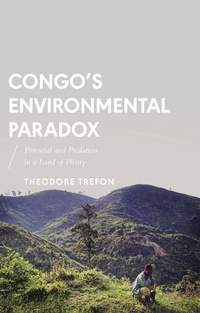
Congo's Environmental Paradox
Potential and Predation in a Land of Plenty
1st Edition
Published on 15. May 2016
209 pages
978-1-78360-245-2 (ISBN)
Description

The Democratic Republic of Congo has the natural resources the world needs - it is crucial to satisfying our craving for the latest high-tech gadgets; the Inga Dam could light up all of Africa; while Congo's farmers could feed a billion people. These realities are redefining the country's strategic contribution to a globalized world. A resource paradise for some, the DRC is an environmental nightmare for others.
Congo's Environmental Paradox analyses the new dynamics in the country's forest, mineral, land, water and oil sectors, revealing the interactions between these sectors. Connecting the dots, it shows how we need to fundamentally rethink power, politics and resource management in Congo today.
Congo's Environmental Paradox analyses the new dynamics in the country's forest, mineral, land, water and oil sectors, revealing the interactions between these sectors. Connecting the dots, it shows how we need to fundamentally rethink power, politics and resource management in Congo today.
Reviews / Votes
An unusual, fascinating and important book ... While there is often a tendency to sensationalize the country, the author takes a more balanced approach, demonstrating deep insight, engagement and knowledge.' * International Affairs * A sharp and well informed argument that shows that Congo's environmental paradox is also at the heart of the world's environmental paradox. * Africa at LSE * An excellent overview of the major ecological resources in the Democratic Republic of Congo ... reading this book is essential for understanding the many environmental paradoxes. * African Studies Quarterly * An invaluable contribution - a truly remarkable synthesis of the pathways to Congolese economic improvement and the many roadblocks along the way - the succinct and sparkling summation of the key elements of the political economy is most useful. The author's capacity to convey a rich treasure chest of information and acute analytical skills make this a landmark work. * Crawford Young, University of Wisconsin * A fascinating read, giving a no-nonsense view of the multitude of problems besetting Congo's natural resource sectors, how they affect ordinary people's daily lives, and how well-meaning donor initiatives are often intrinsically flawed. The book puts today's problems into historical perspective and will serve as a reality-check to politicians and activists. * Daniel Balint-Kurti, Global Witness * Most studies of natural resources and development delve into the details sector by sector. Linkages to violence, politics and state-building are treated separately for different resources. This eloquent and richly documented book focuses attention on the connections, and on the global forces adding complexity to these interactions and altering the political economy of possible change. * David Booth, Overseas Development Institute * This remarkable, fact-filled study will undoubtedly rank as required reading for anyone with an interest in the DRC - whether for specialists or for the general reader. Following his Congo Masquerade, this should confirm Trefon's standing as one of the most perceptive observers and analysts of that central African giant. * Edouard Bustin, Boston University * The first successful attempt to take stock of emerging trends in Congo's natural resource sectors. Well-written, clearly structured and thoroughly documented, Trefon offers fresh analysis on the gap between resource potential and socio-economic development. * Jeroen Cuvelier, University of Ghent * A remarkable guide to the tangled relationships between minerals, water and other sectors of the political economy in the Congo. It goes beyond slogans such as "rich land, poor people" to explain how the rich get richer while the poor struggle to survive. Indispensable reading for humanitarians and human rights advocates, both Congolese and international * Tom Turner, author of The Congo Wars: Conflict, Myth and Reality *More details
Series
Edition
1. Auflage
Language
English
Place of publication
London
United Kingdom
Publishing group
Bloomsbury Publishing PLC
Target group
College/higher education
Illustrations
Tables, black and white 7 ; Maps 1 ; Figures 2
ISBN-13
978-1-78360-245-2 (9781783602452)
Copyright in bibliographic data and cover images is held by Nielsen Book Services Limited or by the publishers or by their respective licensors: all rights reserved.
Schweitzer Classification
Other editions
Additional editions
Book
05/2016
Zed Books Ltd
€116.00
Shipment within 3-4 weeks
Person
Theodore Trefon (PhD, Boston University) studies the politics of state-society relations and natural resource governance in the Democratic Republic of the Congo at the Belgian Royal Museum for Central Africa. He has devoted his career to the Congo as a researcher, author, project manager and consultant. Having lectured on development at the Catholic University of Leuven (KUL) and Boston University Brussels, he continues to teach and learn about environmental governance at Kinshasa's ERAIFT (Ecole Regionale Post-universitaire d'Amenagement et de Gestion Integres des Forets et Territoires Tropicaux). Trefon coordinated European Union-funded forest conservation projects while working at the Free University of Brussels (ULB) from 1994 to 2006. He has advised international development agencies, governments, think tanks, NGOs and private consultancy firms. Contributing editor to the Review of African Political Economy and founding director of the Belgian Reference Centre for Expertise on Central Africa, his expertise derives from desk study, analysis, participatory observation and extensive fieldwork. His previous book, Congo Masquerade: The Political Culture of Aid Inefficiency and Reform Failure (2011), also appeared in the African Arguments series.
Content
1. Introduction: Potential in a Land of Plenty
2. Forests of Wealth and Mystery
3. Food and Agriculture
4. Water: An Uncertain Ebb and Flow
5. Oil: Plenty for Some, Nothing for Most
6. Mining: Rise, Decline and Renaissance
7. Conclusion: Uncertainty and Predation in a Land of Plenty
2. Forests of Wealth and Mystery
3. Food and Agriculture
4. Water: An Uncertain Ebb and Flow
5. Oil: Plenty for Some, Nothing for Most
6. Mining: Rise, Decline and Renaissance
7. Conclusion: Uncertainty and Predation in a Land of Plenty
