

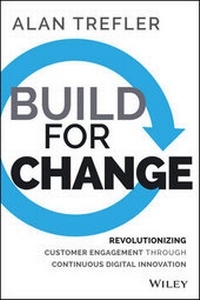
Build for Change
Description

Is your company prepared for the Gen D future, or is it headingtoward life support? A lot of companies across the globe are goingto die over the next few years, not because of macroeconomicstress, but because there is an emerging generation that isradically changing the rules of customer engagement. In BuildFor Change, Pegasystems CEO Alan Trefler shows exactly whatcompanies can do to turn the coming "customerpocalypse" into one ofthe biggest business opportunities of the decade. The newestgeneration of consumers is turning customer relationship managementon its head. Build For Change highlights the revolutionarychanges to business, marketing, and technology practices that areneeded to survive and thrive in these unforgiving times. Readerswill learn how businesses are increasingly relying on new forms ofcustomer engagement, and how one customer'sexperience--whether good or bad--can alter a company'sreputation with the click of a mouse. With practical insight from aleader in customer engagement, this book serves as a timely wakeupcall to companies that have not yet embraced the digitalfuture.
Traditional marketing is becoming increasingly irrelevant, andbusinesses must become more customer-centric while taking acompletely different approach to adopting and using technology.Build For Change outlines exactly what can--andmust--be done to ensure sustainable success in the new digitalera:
* Relate to the new generation of consumers, and understand theirpreferences and demands
* Stop obsessing about mountains of data, and instead applybusiness-driven continuous improvement to customer processes
* Learn how to overcome the fatal flaws of current technologyfads
* Rethink organizational roles to drive adaptive andtransformative innovation
Consumers have more options than ever before, and ensuringcustomer loyalty in the modern market means knowing exactly whatthe customer wants and how to deliver it brilliantly. Build ForChange provides actionable guidance for engaging this newconnected consumer.
All prices
More details
Other editions
Additional editions
Person
Content
Acknowledgments xiii
Chapter 1 Customerpocalypse 1
Great Expectations 4
It Is So Easy to Lose Customers 5
An Ominous Future 8
Are You Provoking Your Customers? 10
Welcome to the Nightmare 11
"Don't Sell to Me!" 14
Anthropomorphism 19
"I Want to Be the Discoverer!" 22
Chapter 2 Death by Data 27
Big Data, Bigger Problem 30
Autopsy of the "Customer Service Movement" 31
Data Is Only Memory 33
Data Suicide 35
Creepy Data Gathering 38
Getting beyond Data 41
Chapter 3 Adding Judgment and Desire 43
Data in Context 44
From Black-and-White to Color 46
Adding Judgment to the Mix 47
Bringing Smart to Big 51
The Power of Hypothesis 52
Next-Best-Action 54
Adaptive Learning 57
Organizing Your Insights 59
Feedback Loops 62
Intent Goes Both Ways 62
Chapter 4 Getting It Done with Customer Processes 71
The Best Execution for Every
Customer Interaction 75
First Impressions 76
Seamless Customer Processes 79
Getting beyond Business Process Modeling 81
Crossing Lines 83
Building for Change 88
A High-Definition Panorama 90
Chapter 5 Change How You Think about Technology 93
The Business-IT Collision 96
How Computer Programming Became a Mess 97
Traditional Development 100
Zombie Systems 104
Manual Systems 105
Rogue Systems 107
Shadow IT 108
Mind the Gap? 109
The Desperation Bandwagon 110
Agile Programming to the Rescue? 112
Ready to Change? 113
Chapter 6 Liberating Your Organization 117
Hybrid Vigor for Business and IT 118
Break the Grips of Channels and Silos 121
Realign Executive Leadership 122
Redesign the Role of Customer Service 124
Rewire the CFO Function 127
Chapter 7 You Are Your Software--The Digital Imperative131
Core Principles for Survival 134
Democratize How You Do Technology 134
Think in Layers 136
Use Analytics to Optimize Continually 141
From Dream to Reality 143
Growing Pressure 146
Your Next Steps 151
Beyond the Twilight of the Brands 154
Notes 161
Index 167
Chapter 2
Death by Data
Data can kill your business. Cost data is particularly deadly. It’s the easiest to gather and the most dangerous to apply. It becomes very easy to see what a customer is doing that costs your business money, and to calibrate how different practices might be less expensive. Responding to this without proper context can impose ultimately self-destructive changes on how you engage with customers, because that response is based on an incomplete understanding of the consequences. Consider an early cautionary tale that is periodically recycled through analogous missteps by tone-deaf companies.
In the mid-1990s, First National Bank of Chicago looked at some of the information it had been gathering about its customers and decided to try influencing their behavior in a way that would cut costs. The bank wanted to drive customers to its automated “Bank-by-Phone” system, which was a money saver for First Chicago, so it imposed a $2 charge on customers who wanted to get account information from a live Customer Service Representative.1
It’s not surprising that First Chicago is long gone. Imagine telling a Gen C customer she has to pay to speak to someone in your enterprise. Then imagine trying to do business that way with a Gen D customer! But First Chicago embraced and assertively advocated this idea of influencing customer behavior, arguing that the bank’s new policy was, in fact, good customer service because it would encourage the very behavior it believed most beneficial to the bank.
Instead, what First Chicago did was disenfranchise its customers.
Eventually, the charges disappeared. But the idea of charging customers fees to influence their behavior did not go away. Some business sectors became especially aggressive, trying to charge customers a fee for everything they could think of. Think airlines: Fees for checked baggage, when first introduced, were both aimed at increasing revenue and considered a way to discourage passengers from bringing stuff on trips that make the airplanes heavier and thus increase fuel costs at a time when those costs were skyrocketing.
Again, the aim was to change customer behavior. The culmination may well be Ireland-based no-frills Ryanair’s announcement in 2010 that it would charge to use the bathroom on its flights. “Stephen McNamara, spokesperson for the airline, told TravelMail: ‘By charging for the toilets we are hoping to change passenger behaviour so that they use the bathroom before or after the flight.’”2
Fortunately, the Ryanair plan was aborted, just like the First Chicago fee to talk to a real live person. But what hasn’t disappeared are the mechanized and unresponsive Voice Response Units each of us have to contend with every day when we try to do business. These are more of the same, imposing a behavior change when you just want to talk to someone living and breathing. No wonder nearly everyone has a visceral hatred for these systems.
There are so many other stories of bad, bad decisions being made because of cost data. Since the advent of Frederick Winslow Taylor’s “scientific management” (also known as Taylorism) back in the nineteenth century, businesses have sought to improve their economic efficiency by breaking down everything about the business into the smallest parts that could be analyzed and gathering information about how much those parts cost. Companies gather cost data about goods, processes, waste, customers . . . you name it. The prevalence of cost data is buttressed by accounting systems that make it easily available to decision makers. But as the tales above show, it’s a most unfortunate place to start when dealing with customers.
The data you choose to focus on can drive you to make some really bad decisions about your customers and about influencing their behavior. Gen D customers don’t just reject being told how to behave; they will tell the world you are trying to manipulate them.
In both the Netflix and Xbox One missteps described in Chapter 1, data played a destructive role. In Microsoft’s case, “the data suggested it made business sense to require Xbox One to have Internet to protect Microsoft from piracy. In the case of Netflix, the data also showed that streaming video is the future, so separating the streaming service into a separate company made sense as well.”3
Even with lessons like these, the core of how most companies structure their relationships with their customers continues to be based on customer data. Lots of data. Tons of data. Megadata. Metadata. Businesspeople love data. They are addicted to it. It’s tangible. It’s reassuring.
As you accumulate more and more data, though, you need to ask yourself whether the way around the bad decisions that too often result from a data focus is to use even more data. If decisions based on increasing access to data are turning out badly, what is going to happen when you add more data to the mix?
Big Data, Bigger Problem
Big Data is a loosely used term in information technology used to describe sets of data that are so dauntingly large, so harrowingly complex, that mere mortals can only work with them through highly sophisticated systems. While storing big data is no longer the challenge it once was, the challenge of searching through it, analyzing it, sharing it, and—quite frankly—making heads or tails of it has only been exacerbated as the amount of data has grown exponentially. But in a typical case of the tail wagging the dog, the capacity and capability of information technology on the purely technological side keeps making the problem of big data bigger and bigger. We are on our way from the terabyte to the yottabyte, which equals 1 septillion bytes (a septillion, by the way, has 24 zeros).
Just in case you doubt the inexorable march to bigger and bigger data storage, consider the news in late January 2013 from a group of researchers at the European Bioinformatics Institute. They reported that they had succeeded in storing digital information in synthetic DNA molecules and then were able to recreate the original data files without error. Sure, it was only 739 kilobytes, but “the researchers said their new technique, which includes error-correction software, was a step toward a digital archival storage medium of immense scale. Their goal is a system that will safely store the equivalent of one million CDs in a gram of DNA for 10,000 years.”4
For businesses, big data is not a cost issue. The plummeting cost of data storage ensures that, but—as technology facilitates the aggregation of more and more data—is anyone really thinking about what data represents? Are you thinking about more and more data and what good it might do you in a world of Gen D customers?
Autopsy of the “Customer Service Movement”
Businesspeople have been gathering data about customers for a long time. You can see why they can fall so easily into the trap that “more of the same” will halt the impending customerpocalypse. After all, data has been at the center of just about every aspect of how companies have tried to figure out how best to deal with their customers over the decades. They’ve gone from ad-hoc approaches to more disciplined approaches to full-blown programs centered on customer “engagement” and customer “relationships.” Eventually, an entire industry emerged around what is called Customer Relationship Management (CRM). Note that nasty word “management” that Gen D abhors, which was supposed to create alignment with customers wherever they were heading and thus prevent the very demonization and destruction described in Chapter 1.
CRM is the source for a very important false promise about data. It concerns the infamous 360-degree view of the customer. The concept of 360 comes from the number of degrees in a circle and implies that if you can put your customer in the middle of a circle, you can gather up all the data about that customer to see him or her from every possible angle, creating the basis for deep understanding of customer needs. Here is a rather typical definition of 360-degree view of the customer that comes from an online dictionary.
A 360-degree customer view offers a total view of the customer relationship dynamic for a business.5
Now, facilitating customer engagement with that customer’s data can be helpful, but no customer is a standalone amoeba swimming in a round petri dish. Putting a customer in the 360 view typically shows you nothing about how that customer is part of a larger “organism,” a network of networks that are familial, business, and social. You can peer at the customer in the middle of the petri dish all day and all night, but you are not necessarily going to see any of that network. In other words, the 360 view alone may be interesting, but it is indubitably incomplete.
Still, the concept of the 360-degree customer view permeates the business world. It’s everywhere. A recent Google search on “360 customer” got 428 million hits. But it has a rather checkered history, having developed out of a customer service movement that spawned all manner of approaches to handling customers—as in the First Chicago example, not all of them very customer-oriented.
Another trend that emerged in the customer service movement and CRM, which is linked to cost data and treating customer service...
