

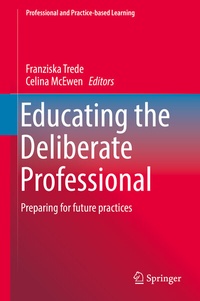
Educating the Deliberate Professional
Description

Educating the deliberate professional is a comprehensive volume that carves out and explores a framework for a pedagogy of deliberateness that goes beyond educating reflective and deliberative practitioners. As a whole, this book argues for the importance of educating deliberate professionals, because, in the current higher education climate, there is a need to reconcile critique (thinking), participation (doing) and moral responsibility (relating to others) in professional practice and professional education.
Reviews / Votes
"This book provides a very valuable contribution to the literature and assists in our understanding of the complex aspects of learning for the modern world through work-integrated learning for students. I, therefore, recommend this book without hesitation to researchers and curricular developers in work-integrated learning, and also to those engaged in wider curricular renewal and review in higher education." (Dr. Karsten E. Zegwaard, Asia-Pacific Journal of Cooperative Education, Vol. 17 (3), 2016)More details
Other editions
Additional editions
Content
Section 1 - Setting the scene.- Scoping the deliberate professional, Franziska Trede and Celina McEwen.- Carving out the territory for educating the deliberate professional, Franziska Trede and Celina McEwen.- Educating for professional responsibility: From critical thinking to deliberative communication, or why critical thinking is not enough, Tone Drydal Solbrekke, Tomas Englund, Berit Karseth, Eevi E. Beck.- Section 2 -Reconceptualising the professional.- Critique and the deliberate professional: Framing the new and enhanced role of intermediaries in digital culture, Jonathan Roberge.- Deliberate and emergent approaches to practice development: Lessons learnt from the Australian environment movement, Rick Flowers.- The soul of the university: A hero's journey towards deliberate leadership, Andrew Vann.- Parrhesia, artisans and the possibilities for deliberate practice, David A. Nicholls.- University and community engagement: Towards a partnership based on deliberate reciprocity,Lesley Cooper and Janice Orrell.- Section 3 - Rethinking practice education.- Learning to master profession-specific knowledge practices: A prerequisite for the deliberate professional? Monika Nerland.- A capabilities approach to educating the deliberate professional: Theory and practice, Monica McLean and Melanie Walker.- Taking professional practice seriously: Implications for deliberate course design, David Boud.- Deliberate subversion of time: Slow scholarship and learning
through research, Tony Harland.- Deliberately owning my practice model: Realising my professional practice, Joy Higgs.- Section 4 - Panoptic musings.- The deliberate professional in the digital age: A manifesto in the tradition of critical theory and pedagogy, Rainer Winter.- Educating deliberate professionals: Beyond reflective and deliberative practitioners, Celina McEwen and Franziska Trede.
