

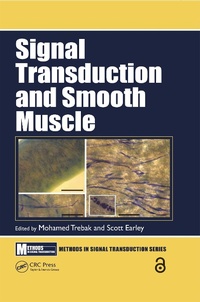
Signal Transduction and Smooth Muscle
1st Edition
Published on 6. August 2018
432 pages
978-1-4987-7423-9 (ISBN)
Description

All hollow organs, such as blood vessels, the gastrointestinal tract, airways, male and female reproductive systems, and the urinary bladder are primarily composed of smooth muscle. Such organs regulate flow, propulsion and mixing of luminal contents and storage by the contraction and relaxation of smooth muscle cells. Smooth muscle cells respond to numerous inputs, including pressure, shear stress, intrinsic and extrinsic innervation, hormones and other circulating molecules, as well as autocrine and paracrine factors. This book is a review of smooth muscle cell regulation in the cardiovascular, reproductive, GI, and other organ systems with emphasis on calcium and receptor signaling.
Key selling features:
Focuses on smooth muscles of different types
Describes ion channel signaling mechanisms
Reviews calcium and receptor signaling
Includes novel, cutting-edge methodologies
Summarizes studies of mice with genetically encoding sensors in smooth muscle
Chapter 9 of this book is freely available as a downloadable Open Access PDF at http://www.taylorfrancis.com under a Creative Commons Attribution (CC-BY) 4.0 license.
Key selling features:
Focuses on smooth muscles of different types
Describes ion channel signaling mechanisms
Reviews calcium and receptor signaling
Includes novel, cutting-edge methodologies
Summarizes studies of mice with genetically encoding sensors in smooth muscle
Chapter 9 of this book is freely available as a downloadable Open Access PDF at http://www.taylorfrancis.com under a Creative Commons Attribution (CC-BY) 4.0 license.
More details
Series
Edition
1. Auflage
Language
English
Place of publication
London
United Kingdom
Publishing group
Taylor & Francis Ltd
Target group
College/higher education
Illustrations
67 s/w Abbildungen, 8 farbige Abbildungen
6 Tables, black and white; 32 Illustrations, color; 39 Illustrations, black and white
File size
12,58 MB
ISBN-13
978-1-4987-7423-9 (9781498774239)
Copyright in bibliographic data and cover images is held by Nielsen Book Services Limited or by the publishers or by their respective licensors: all rights reserved.
Schweitzer Classification
Other editions
Additional editions
Mohamed Trebak | Scott Earley
Signal Transduction and Smooth Muscle
Book
03/2021
1st Edition
CRC Press
€63.13
Shipment within 15-20 days
Mohamed Trebak | Scott Earley
Signal Transduction and Smooth Muscle
Book
09/2018
1st Edition
CRC Press
€349.12
Shipment within 15-20 days
Persons
Mohamed Trebak is Professor of Cellular and Molecular Physiology at the Penn State Hershey College of Medicine.
Scott Earley is Associate Professor of Pharmacology at the University of Nevada Reno.
Scott Earley is Associate Professor of Pharmacology at the University of Nevada Reno.
Content
Series Preface
Preface
Editors
Contributors
Chapter 1 Elucidation of Vasopressin Signal Transduction Pathways in Vascular Smooth Muscle
Kenneth L. Byron and Lyubov I. Brueggemann
Chapter 2 Investigating Chloride Channels in Smooth Muscle
Henry R. Askew Page and Iain A. Greenwood
Chapter 3 Methods for the Isolation of and Study of Ca2+ Signaling in Arteriolar Smooth Muscle Cells
William F. Jackson
Chapter 4 Ion Channel Trafficking in Arterial Smooth Muscle Cells and Functional Significance
M. Dennis Leo and Jonathan H. Jaggar
Chapter 5 Total Internal Reflection Fluorescence Microscopy in Vascular Smooth Muscle
Madeline Nieves-Cintron, Sendoa Tajada, L. Fernando Santana, and Manuel F. Navedo
Chapter 6 T-Type Ca2+ Channels in Vascular Smooth Muscle: Properties, Regulation, and Function
Osama F. Harraz, Ahmed M. Hashad, and Donald G. Welsh
Chapter 7 Calcium Sensitization in Smooth Muscle Involving Regulation of Myosin Light Chain Phosphatase Activity
Justin A. MacDonald, Michael P. Walsh, and William C. Cole
Chapter 8 Approaches for Investigating the Functional Significance of Transient Receptor Potential Cation Channels in Smooth Muscle Cells
Harry A. T. Pritchard, Paulo W. Pires, and Scott Earley
Chapter 9 Mitochondria Structure and Position in the Local Control of Calcium Signals in Smooth Muscle Cells
John G. McCarron, Christopher Saunter, Calum Wilson, John M. Girkin, and Susan Chalmers
Chapter 10 ORAI Channels in Vascular Smooth Muscle
Maxime Gueguinou, Xuexin Zhang, Trayambak Pathak, Scott Emrich, Ryan Yoast, and Mohamed Trebak
Chapter 11 G Protein-Coupled Receptors in Airway Smooth Muscle Function and Obstructive Lung Disease
Tonio Pera and Raymond B. Penn
Chapter 12 Brain-Derived Neurotrophic Factor in Airway Smooth Muscle: Contributions to Asthma
Michael Thompson, Rodney Britt Jr, Anne Roesler, Katelyn Cummings, Christina M. Pabelick, and Y. S. Prakash
Chapter 13 Antibody-Based Approaches for Protein Analysis of Smooth Muscles
Brian A. Perrino and Yeming Xie
Chapter 14 Role of Ion Channels in Urinary Bladder Smooth Muscle Function
Georgi V. Petkov
Chapter 15 Methods for Investigating the Regulation of Smooth Muscle Excitability by Interstitial Cells
Bernard T. Drumm and Kenton M. Sanders
Chapter 16 Electrical Pacemaking in Lymphatic Vessels
Scott D. Zawieja, Jorge A. Castorena-Gonzalez, Kim H. T. To, Peichun Gui, Timothy Domeier, and Michael J. Davis
Chapter 17 NADPH Oxidase, Redox Signaling, and Vascular Smooth Muscle Function
Daniel S. de Jesus, Eugenia Cifuentes-Pagano, Sanghamitra Sahoo, and Patrick J. Pagano
Index
Preface
Editors
Contributors
Chapter 1 Elucidation of Vasopressin Signal Transduction Pathways in Vascular Smooth Muscle
Kenneth L. Byron and Lyubov I. Brueggemann
Chapter 2 Investigating Chloride Channels in Smooth Muscle
Henry R. Askew Page and Iain A. Greenwood
Chapter 3 Methods for the Isolation of and Study of Ca2+ Signaling in Arteriolar Smooth Muscle Cells
William F. Jackson
Chapter 4 Ion Channel Trafficking in Arterial Smooth Muscle Cells and Functional Significance
M. Dennis Leo and Jonathan H. Jaggar
Chapter 5 Total Internal Reflection Fluorescence Microscopy in Vascular Smooth Muscle
Madeline Nieves-Cintron, Sendoa Tajada, L. Fernando Santana, and Manuel F. Navedo
Chapter 6 T-Type Ca2+ Channels in Vascular Smooth Muscle: Properties, Regulation, and Function
Osama F. Harraz, Ahmed M. Hashad, and Donald G. Welsh
Chapter 7 Calcium Sensitization in Smooth Muscle Involving Regulation of Myosin Light Chain Phosphatase Activity
Justin A. MacDonald, Michael P. Walsh, and William C. Cole
Chapter 8 Approaches for Investigating the Functional Significance of Transient Receptor Potential Cation Channels in Smooth Muscle Cells
Harry A. T. Pritchard, Paulo W. Pires, and Scott Earley
Chapter 9 Mitochondria Structure and Position in the Local Control of Calcium Signals in Smooth Muscle Cells
John G. McCarron, Christopher Saunter, Calum Wilson, John M. Girkin, and Susan Chalmers
Chapter 10 ORAI Channels in Vascular Smooth Muscle
Maxime Gueguinou, Xuexin Zhang, Trayambak Pathak, Scott Emrich, Ryan Yoast, and Mohamed Trebak
Chapter 11 G Protein-Coupled Receptors in Airway Smooth Muscle Function and Obstructive Lung Disease
Tonio Pera and Raymond B. Penn
Chapter 12 Brain-Derived Neurotrophic Factor in Airway Smooth Muscle: Contributions to Asthma
Michael Thompson, Rodney Britt Jr, Anne Roesler, Katelyn Cummings, Christina M. Pabelick, and Y. S. Prakash
Chapter 13 Antibody-Based Approaches for Protein Analysis of Smooth Muscles
Brian A. Perrino and Yeming Xie
Chapter 14 Role of Ion Channels in Urinary Bladder Smooth Muscle Function
Georgi V. Petkov
Chapter 15 Methods for Investigating the Regulation of Smooth Muscle Excitability by Interstitial Cells
Bernard T. Drumm and Kenton M. Sanders
Chapter 16 Electrical Pacemaking in Lymphatic Vessels
Scott D. Zawieja, Jorge A. Castorena-Gonzalez, Kim H. T. To, Peichun Gui, Timothy Domeier, and Michael J. Davis
Chapter 17 NADPH Oxidase, Redox Signaling, and Vascular Smooth Muscle Function
Daniel S. de Jesus, Eugenia Cifuentes-Pagano, Sanghamitra Sahoo, and Patrick J. Pagano
Index
